

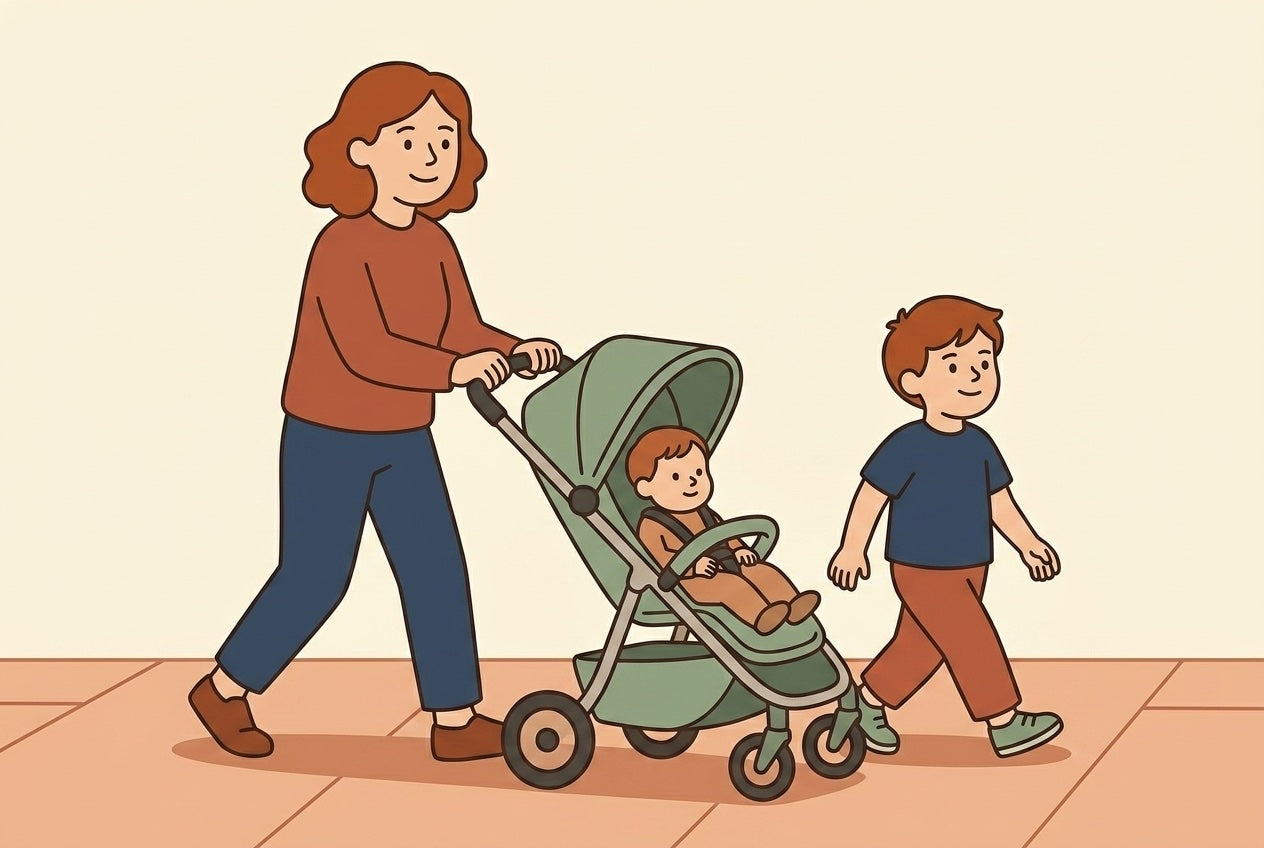
Most parents stop using a stroller for their older child somewhere between ages 4 and 5. But honestly? The right time depends less on a birthday and more on three practical things: how far you're walking, what kind of day it is, and whether your child is developmentally ready to cover that distance on their own two feet.
There's no official rule that says the stroller must disappear at a certain age. What matters is reading your child — and your situation — clearly.
Key Takeaways
Most children are ready to walk independently for everyday distances between ages 4 and 5.
Walking stamina and emotional readiness matter more than age alone.
Long days, travel, illness, and growth spurts are all valid reasons to keep a ride option available.
There's no shame in having a backup plan for tired little legs — even at 5.
A compact add-on seat like Hoppie can bridge the gap without bringing back a full stroller.
The developmental and physical signals to watch for
Every child develops differently, but there are real patterns in walking stamina and emotional readiness that can guide you. If you're wondering whether your 3-year-old, 4-year-old, or 5-year-old still needs the stroller, these are the things worth paying attention to.
Walking stamina milestones
Toddlers and young children build walking endurance gradually. A 2-year-old can reasonably manage short bursts — think a trip around the block or a quick errand. A typical 3-year-old can handle maybe 20 to 30 minutes of walking before they hit a wall. By 4, many children can walk a couple of kilometres on a flat surface without too much complaint — on a good day, with the right shoes, at the right pace.
The AAP and NHS both note that children this age are still building their cardiovascular and muscular endurance. "Can walk further than last year" doesn't mean "can walk as far as you need them to." Stamina also drops fast when children are hungry, warm, or emotionally overstimulated — which describes most family outings.
A useful mental check: if your child regularly makes it through the full outing on foot, in most weather conditions, without melting down or needing to be carried — the stroller is probably optional. If they make it three-quarters of the way and then collapse, it's still earning its place.
Emotional readiness to walk independently
Physical stamina is one half. The other half is whether your child is emotionally ready to walk alongside you without constant cajoling, negotiation, or safety incidents.
Around age 4 to 5, most children develop better impulse control and spatial awareness. They understand "stay on the pavement", "hold my hand at the crossing", and "we're nearly there" in a way a 2-year-old simply doesn't. That shift makes unsupported walking genuinely safer and less exhausting for the parent.
But emotional readiness isn't linear. A child who walked confidently last week might refuse to walk this week because they're coming down with something, had a hard day at nursery, or just woke up on the wrong side of the bed. That's normal child behaviour — not regression, and not a sign the stroller has to come back permanently.
The practical takeaway: if your child walks well most of the time but occasionally needs a ride, you don't need a full stroller. You need a backup plan.

Situations where the stroller still helps — even for older children
Keeping a ride option available for a 4- or 5-year-old doesn't mean you're holding them back. It means you're being realistic about the situations that push everyone's limits — yours and theirs.
Long days out
A child who walks beautifully on the school run may completely fall apart after three hours at a theme park, a museum, or a long market. Adults do too — we just don't sit down in the middle of the pavement and cry about it.
On long days, having a seat available for the older child isn't about dependency. It's about managing the day well. A 20-minute rest in the stroller can reset a tired 4-year-old enough to walk the last stretch home without a meltdown. That's not a parenting setup issue — that's good logistics.
Travel
Airports are the clearest example. Terminals are enormous. Distances between gates can be further than a young child's entire comfortable walking range for the day. Add luggage, a baby, and flight anxiety, and the idea of an older child walking the whole way on their own legs becomes a gamble most parents don't want to take.
The same logic applies to holiday days out — beach walks, city sightseeing, long transfers. Travel days are genuinely hard for young children. A compact ride option, even one your child uses only occasionally, makes the whole trip more manageable for everyone.
Illness or growth spurts
Children's energy levels drop dramatically when they're fighting off a cold, recovering from a virus, or going through a growth spurt. During these windows, a child who normally walks confidently may genuinely need more rest than usual. That's a physiological reality, not a behaviour problem.
Keeping a ride option flexible — rather than declaring the stroller gone forever — means you can adapt to these phases without stress. You're not going backwards. You're just being practical.

Should you push your child to walk more?
Yes — gently and gradually. Walking is genuinely important for children's physical development, coordination, and independence. The goal isn't to keep the stroller forever; it's to use it less and less as your child's stamina grows.
The most effective approach isn't refusing the stroller cold turkey. It's extending the walking window slowly. Walk a bit further before offering a ride. Celebrate when they make it to a landmark on foot. Make walking feel like an achievement rather than a chore.
Most children naturally phase out of needing a stroller between 4 and 5 years old, especially as they start school and realise walking is what the other kids do. Social motivation is a surprisingly powerful driver at this age.
What doesn't help is turning the stroller into a battleground. If your child is tired and you have a long walk ahead, using a ride option isn't permissive parenting — it's getting home without carrying a screaming child on your hip.
When an add-on seat makes more sense than a full stroller
If your older child still needs a ride occasionally but you're past the stage of needing a proper second stroller, a compact add-on hammock seat is a practical middle ground. It attaches to the back of the stroller you're already pushing for your younger child, gives your older child a place to rest when they hit the wall, and keeps your setup compact and manageable.
Hoppie is designed for children from around 18 months to 5 years old, up to 20 kg / 44 lbs. It's not a permanent replacement for walking — it's a backup for the moments when tired little legs need a rest. Those moments don't disappear at age 4, and they don't mean you've done anything wrong.
Always follow Hoppie's installation instructions and check your stroller manufacturer's maximum load capacity before use. Always supervise your child while using Hoppie.

FAQ
At what age should you stop using a stroller?
Most children are ready to walk independently for everyday outings between ages 4 and 5. That said, there's no single right age — it depends on walking distance, the child's stamina, and the specific situation. Many parents keep a compact ride option available until age 5 or even 6 for long days, travel, or times of illness.
Is it OK for a 5-year-old to ride in a stroller?
Yes. There's nothing developmentally wrong with a 5-year-old having a rest in a stroller on a long day or during travel. The key is balance — encouraging walking as the default while keeping a ride available for the genuinely tiring stretches. Using a stroller occasionally at 5 doesn't prevent a child from developing good walking habits.
When do most parents stop using a stroller for their older child?
Most parents find they use the stroller for their older child less and less from around age 4, and stop needing it regularly by the time the child starts school at 4 to 5 years old. The transition is usually gradual rather than a single decision — more walking, fewer rides, until the stroller stays at home most days.
Should I push my older child to walk more instead of using the stroller?
Gradually, yes. The goal is to extend the walking window a little more each time, celebrate the distance they cover on foot, and use a ride only when genuinely needed. Forcing a very tired child to walk usually creates more conflict than it resolves. A slow, positive transition works better than drawing a hard line.
Is there a weight limit for using a stroller add-on seat?
Yes. Hoppie supports children up to 20 kg / 44 lbs and is designed for children from around 18 months to 5 years old. Always check both the add-on seat's weight limit and your stroller manufacturer's total load capacity before use.
What's a good alternative to a full stroller for an older child who still gets tired?
A compact hammock seat that attaches to the back of your existing stroller is a practical option. It gives your older child a place to rest without adding a second bulky stroller to your setup. It's designed for occasional use — for the moments when tired little legs need a break — rather than as a permanent seated position.
Does using a stroller for longer make it harder for a child to learn to walk independently?
Not if the stroller is used as a rest option rather than the default. Children build walking stamina when they're encouraged to walk and are given the chance to do so regularly. Having a backup for long, tiring situations doesn't undo that progress.
Hoppie gives you a few extra years before the stroller exits your life entirely
The stroller doesn't have to disappear the moment your older child hits a certain age. The real goal is having the right option available for the right moment — and not having to carry a tired 4-year-old through an airport because you left the ride at home.
Hoppie is designed for children from around 18 months to 5 years old, up to 20 kg / 44 lbs. It attaches to the back of your existing stroller, keeps your setup compact, and gives your older child a practical rest option on the days they need it most.
Keep the stroller you love. Add a second seat when you need it.
Disclaimer: Hoppie is an independent product and is not affiliated with, endorsed by, sponsored by, or approved by any stroller brand. Always follow Hoppie's installation instructions and check your stroller manufacturer's maximum load capacity before use. Hoppie should only be used with strollers that have a stable rear frame and enough rear clearance. Always supervise your child while using Hoppie.