

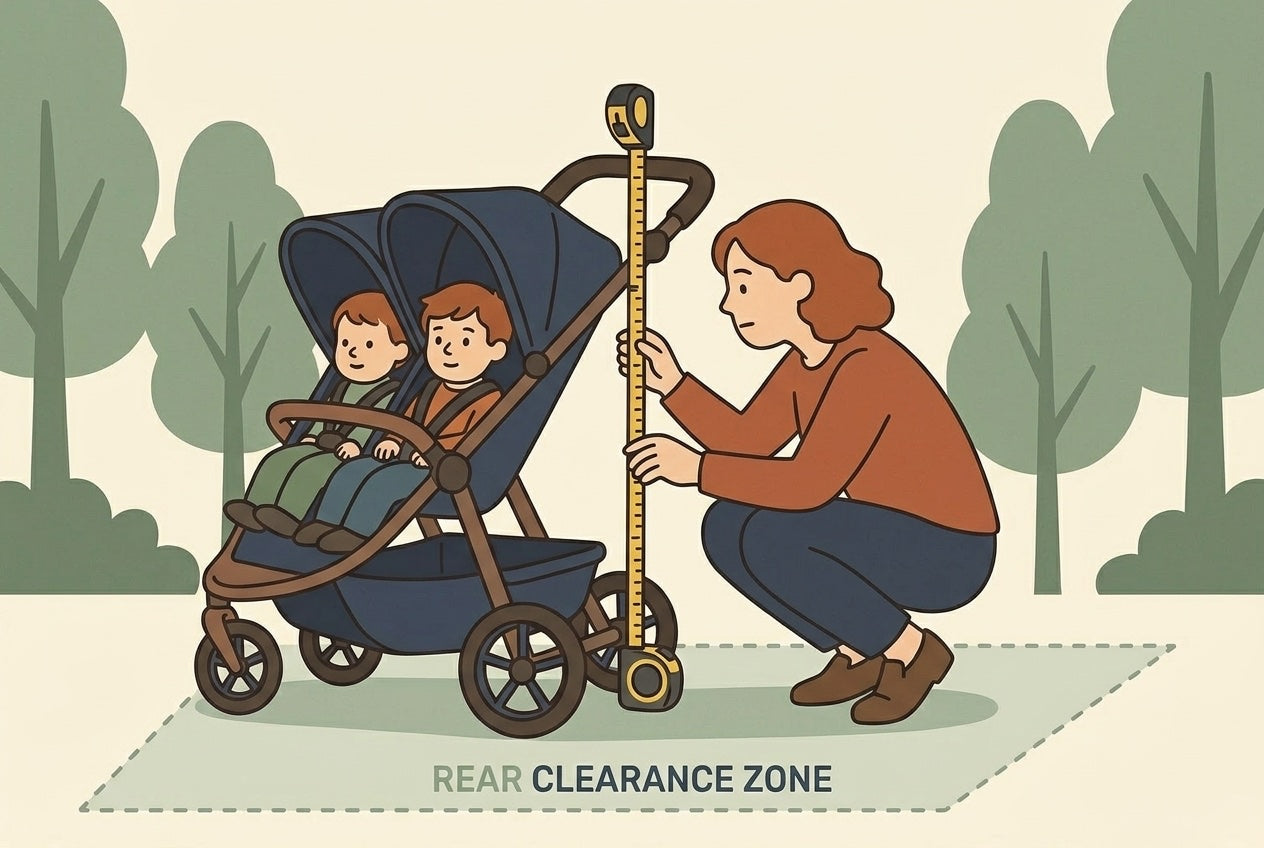
A stroller hammock seat needs a little clear space behind your stroller's main seat so it can hang freely. If you have that, you're almost certainly good to go. If you're not sure, this guide shows you exactly what to look for — no tools, and it takes under a minute.
Key Takeaways
- The hammock seat hangs vertically behind the main seat: it needs a clear zone there, free of the basket, a crossbar or the canopy.
- Stand behind the stroller and look from the rear axle upward to find your stroller's usable rear zone.
- Most baskets can be repositioned or removed in seconds — don't assume the basket is a reason to check with us first.
- City strollers, travel-system strollers, premium full-size strollers and most cabin-size travel strollers with a rigid frame have the space they need.
- If you're unsure, tell us the exact brand and model of your stroller and we'll confirm whether Hoppie fits.
Why rear clearance matters
A stroller hammock seat hangs vertically behind your stroller's main seat. When a child sits in it, the seat needs enough room to hold their body comfortably without pressing against the basket, the canopy, or the rear frame bars. If the space is too tight, the seat can't hang freely — and that affects both comfort and stability.
The rear zone has to cover the depth of the hammock itself plus a small buffer, so the seat can settle naturally under your child's weight without resting on anything it shouldn't. Most full-size and mid-range strollers clear this comfortably. Some ultra-light umbrella strollers don't — the basket or the folding mechanism fills the space behind the seat — which is one more reason they're not a good match for a hammock seat add-on. Compact travel strollers are a different story: many, like the Babyzen YOYO or Bugaboo Butterfly, have a rigid frame and a clear rear zone in their seat configuration.
The good news: you can check yours in under a minute, right now, with no guesswork.
How to check your stroller's rear clearance
Open your stroller fully and lock it in its normal in-use position. Apply the brake. Set it on flat ground. Then do this:
- Find the rear axle. This is the horizontal bar that runs between the two rear wheels. Stand behind your stroller and locate the centre point of that axle.
- Look straight upward from there. You're looking at the zone between the rear axle and the back of the main seat, where the hammock will hang.
- Note the first obstruction. This could be the bottom of the shopping basket, a crossbar, or any frame element that sits in the rear zone.
- Picture the seat hanging there. The hammock needs a clear gap in which a child-sized seat can hang freely, without resting on the basket, a bar or the canopy. If that gap is open, your rear clearance is a good starting point for a hammock seat.
That's the whole test. It doesn't require you to remove anything yet — just look at what you have right now, with your stroller set up the way you normally use it.
What the basket does (and doesn't) block
The shopping basket is the most common thing parents worry about. And it's a fair concern — on some strollers, the basket hangs low and sits right in the rear zone. But in most cases, it's less of a problem than it looks.
Here's why. Most stroller baskets either clip onto the frame or slide along a rail. They're not permanently fixed. This means that even if the basket is currently sitting in your rear zone, you may be able to push it forward a few centimetres — which is often enough to open up the clearance you need.
When you look, note whether it's the basket blocking the zone or a fixed bar or frame element. If it's the basket, check whether it can slide. If it's a hard frame component, that's a real constraint and the result stands as-is.
A few basket situations that parents often flag:
- Basket clips to two points on the frame. Usually can be unclipped and repositioned forward in seconds.
- Basket slides along a single rail. Push it as far forward as it will go and look at the rear zone again.
- Basket is fixed and integrated into the rear frame. This is less common but does occur on some compact strollers. If it fully occupies the rear zone, a hammock seat is not going to work on this stroller.
- Basket is removable entirely. If you don't need it for a particular outing, removing it completely gives you maximum rear clearance.
The takeaway: check with your basket in its normal position, then see if it can be moved. Don't write off your stroller until you've tried both positions.
Common stroller types and their typical rear clearance
Not every stroller is built the same, and rear clearance varies quite a bit depending on the design. Here's a practical overview of how different stroller categories tend to perform.
City strollers
City strollers are designed for everyday urban use — streets, shops, public transport. They tend to have a well-proportioned rear zone, with baskets that sit low to keep the stroller steady but that are usually repositionable. Many city strollers have a clear rear zone without any modification.
The key thing to check on city strollers is the basket position. On models where the basket hangs right below the seat, push it as far forward as it will go before you judge the space. You'll often gain several centimetres this way.
Travel-system strollers
Travel-system strollers — those designed to work with a car seat or carrycot on top — tend to have generous rear clearance. The seat sits higher on the frame, the rear zone is kept clear for the chassis legs, and the basket usually clips well clear of the rear axle area.
These strollers are often among the most straightforward to check. The frame is also typically robust and wide, which helps when adding a hammock seat. One thing to keep in mind: with the carrycot on, some of these strollers lose the rear space, so check in the configuration you'll actually use.
Premium strollers
Premium full-size strollers are generally well-suited for a hammock seat add-on. They're built with strong, rigid rear frames and generous proportions — both of which tend to translate into good rear clearance. Their baskets are usually accessible and repositionable, and the rear bar geometry is typically flat and easy to strap onto.
If you own a premium stroller and are wondering whether it will work with a hammock seat, it's worth running the check — but the odds are good. The main thing to verify is total weight capacity, especially if your baby is already on the heavier side or you carry a lot in the basket.
Compact travel strollers
Cabin-size travel strollers such as the Babyzen YOYO, Bugaboo Butterfly, UPPAbaby Minu, Cybex Melio or Nuna TRVL are compact, but they're built on a rigid frame and leave a clear rear zone when used with their regular seat. They're among the models most often used with Hoppie. The exception is the carrycot or newborn pack: on the YOYO, for example, Hoppie works with the child seat but not with the bassinet, which takes up the rear space.
When rear clearance is not the only check
Rear clearance is necessary — but it's not the whole picture. A stroller with a clear rear zone still needs two other things to be a good match for a hammock seat.
A stable rear frame
The hammock seat attaches to the stroller's rear frame, and that frame needs to be solid. Press down on the rear handlebar with both hands and half your body weight. If the frame doesn't flex visibly and doesn't creak, that's a strong sign. If it bends or wobbles, the frame may be too light for the load a second child adds.
Ultra-light umbrella strollers often fail this check regardless of how much rear space they have. A clear rear zone doesn't help if the frame isn't strong enough to hold the seat steady.
Enough total weight capacity
Every stroller has a maximum total load — usually printed in the manual or on a sticker near the rear wheels. Before installing a hammock seat, add up:
- The weight of your younger child in the main seat
- Anything stored in the basket
- Your older child on the hammock seat
The total must stay within your stroller's rated capacity. Hoppie is designed for children from around 18 months to 5 years old, up to 20 kg / 44 lbs. Always check both Hoppie's instructions and your stroller manufacturer's maximum load capacity before use.
If you're unsure whether your stroller works — whether it's the clearance, the frame, or the weight capacity — tell us the exact brand and model of your stroller and we'll confirm whether Hoppie fits.
What a good rear zone looks like in practice
When everything lines up — a clear rear zone, a solid frame, and adequate weight capacity — the installation is straightforward. The hammock seat hangs vertically in the rear zone, clear of the basket and frame, with the two top straps clipped to the handlebar and the two bottom straps clipped to the lower frame on each side. Your older child sits in it naturally, facing forward, feet hanging free, the stroller's width completely unchanged.
That last point is one of the reasons parents like this setup. A hammock seat doesn't make your stroller wider. Café doors, shop aisles, lift doors, and bus access that already worked for your single stroller still work exactly the same way.
Always follow Hoppie's installation instructions and check your stroller manufacturer's maximum load capacity before use. Always supervise your child while using Hoppie.
FAQ
How do I check stroller rear clearance?
Open your stroller fully and lock it in its normal in-use position. Stand behind it and look from the centre of the rear axle straight upward to the first obstruction — usually the bottom of the shopping basket or a frame bar. The hammock needs a clear gap there so it can hang freely and safely behind the main seat.
Does the basket block hammock-seat installation?
It depends on the basket. Most stroller baskets can be unclipped or slid forward a few centimetres, which is often enough to open up the rear zone. Check your clearance with the basket in its normal position, then try repositioning it forward and look again. Fixed, integrated baskets that can't move and fully occupy the rear zone are a genuine constraint — but this is relatively uncommon.
What's the minimum rear space for an add-on seat?
There's no single number to measure: what matters is that the hammock can hang freely under your child's weight without pressing against the basket or the frame. If the zone behind the main seat is open from the rear axle up to the back of the seat, you have what you need. If something sits in that zone and can't be moved, the seat may sit awkwardly or put pressure on parts of your stroller it shouldn't.
Can I remove the basket to fit a hammock seat?
Yes, if your basket is removable. Many parents remove the basket for outings where they don't need it — school runs, quick trips, travel days — which gives maximum rear clearance. For outings where you need storage, check whether repositioning the basket forward is enough. Avoid hanging bags from the handlebar while Hoppie is in use.
Does rear clearance vary by stroller type?
Yes. Travel-system and premium full-size strollers tend to have the most rear clearance. Standard city strollers usually have a clear rear zone once the basket is repositioned. Cabin-size travel strollers with a rigid frame, like the Babyzen YOYO or Bugaboo Butterfly, have the space they need in their seat configuration. Ultra-light umbrella strollers tend to have the least rear space and, more importantly, a frame that's too soft — they're generally not a good match for a hammock seat add-on.
Is rear clearance the only thing I need to check?
No. Rear clearance is necessary but not sufficient. You also need a stable rigid rear frame — one that doesn't flex under firm hand pressure — and enough total weight capacity on your stroller to safely carry your younger child plus your older child on the hammock seat. All three checks matter.
What if I'm not sure my stroller has enough rear space?
Tell us the exact brand and model of your stroller and we'll confirm whether Hoppie fits. It's the fastest way to get a clear answer without guessing.

Most strollers have the space — check yours before ordering
Rear clearance is simpler to check than most parents expect. Open your stroller, stand behind it, and look at the zone from the rear axle up to the back of the seat. Most full-size and city strollers have a clear rear zone without any adjustment. Many more have it once the basket is pushed forward.
Hoppie is designed for children from around 18 months to 5 years old, up to 20 kg / 44 lbs — a practical second seat for the days when tired little legs need a rest. If your stroller has the rear space, a rigid frame, and the weight capacity, Hoppie adds a smart second seat without replacing the stroller you already love.
Keep the stroller you love. Add a second seat when you need it.
Disclaimer: Hoppie is an independent product and is not affiliated with, endorsed by, sponsored by, or approved by any stroller brand. Brand names, when mentioned, are used only to indicate potential compatibility with certain stroller models. Always follow Hoppie's installation instructions and check your stroller manufacturer's maximum load capacity before use. Hoppie should only be used with strollers that have a stable rear frame and enough rear clearance. Always supervise your child while using Hoppie.


