

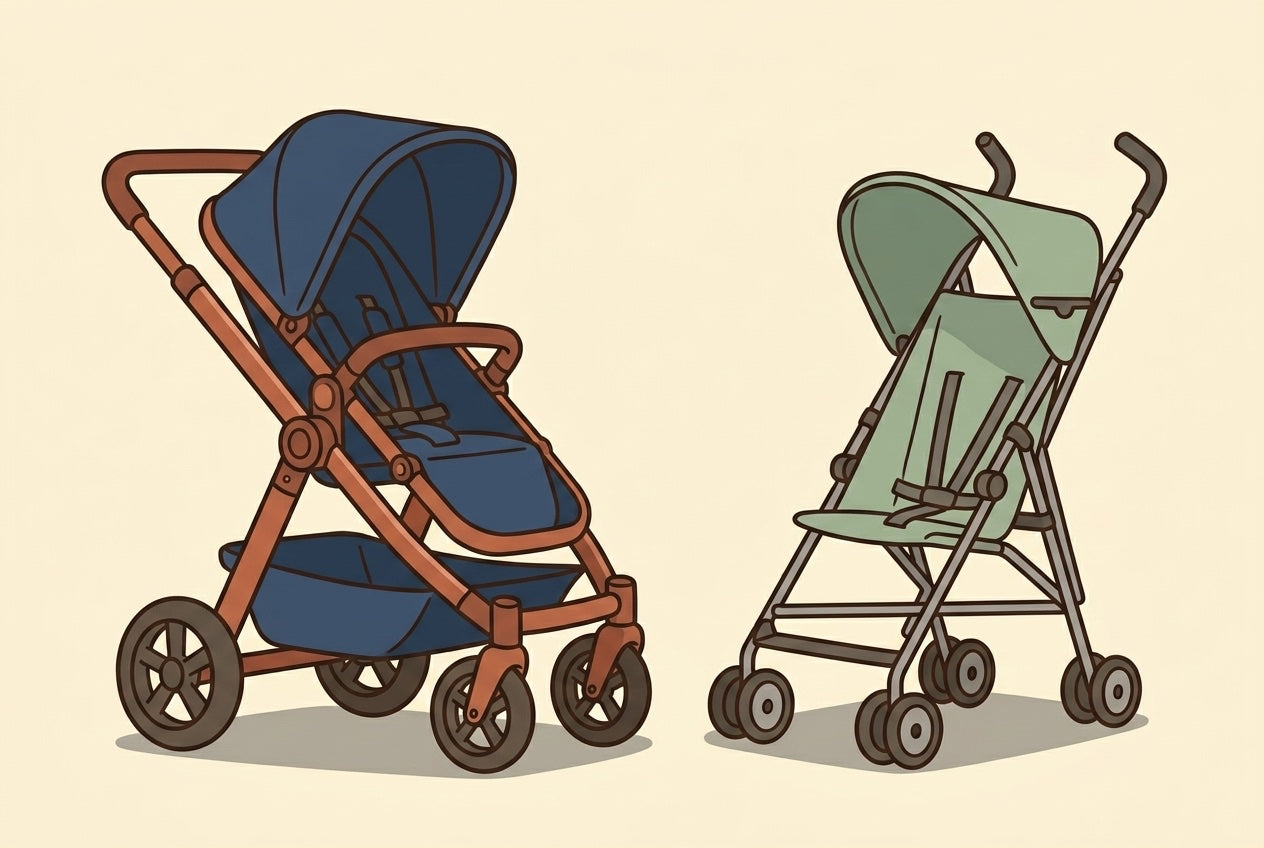
You love your lightweight stroller. It folds in one move, fits under the seat on the train, and doesn't wreck your back on the school run. The question is whether it can also handle a hammock seat for your older child — and the honest answer is: it depends on which kind of lightweight stroller you have.
Not all lightweight strollers are built the same way. Some have a reinforced metal frame that passes every stability test. Others — the ultra-thin umbrella type — are simply too flexible for a rear hammock seat to work safely. This guide helps you tell the difference in about 60 seconds.
Hoppie is an independent accessory and is not affiliated with, endorsed by, sponsored by, or approved by any stroller brand. Brand names, when mentioned, are used only to help parents understand potential compatibility.
Key Takeaways
Lightweight does not automatically mean too flimsy — many lightweight strollers have a rigid rear frame that works well with a hammock seat.
Ultra-light umbrella strollers without a stable rear frame are not suitable for a rear hammock seat.
The 60-second push-and-flex test tells you what you need to know before ordering anything.
Hoppie is designed for children from around 18 months to 5 years old, up to 20 kg / 44 lbs.
If you're unsure, tell us the exact brand and model of your stroller and we'll confirm whether Hoppie fits.
Lightweight ≠ umbrella: why the distinction matters
When parents say "lightweight stroller," they usually mean one of two very different things. The word covers everything from a compact city stroller built on a proper aluminum chassis to a paper-thin folding umbrella that weighs under four kilograms. The frame strength between those two extremes is enormous — and it's the frame that decides whether a hammock seat is safe to use.
A hammock seat puts your older child's weight — up to 20 kg / 44 lbs — on the rear of the stroller, spread across four straps with metal clips. A frame designed for that handles it without flexing. A frame that wasn't designed for it shows you immediately when you press down on the rear bar.
Reinforced lightweight strollers: the ones that usually work
Several of the most popular lightweight strollers on the market are genuinely well-built, with thick-walled aluminum tubing and a rear handlebar that's part of the main frame. Despite being marketed as compact or lightweight, their rear frame is rigid enough to carry an add-on seat.
Strollers in this category tend to have a total load rating of 22 kg or more, a solid rear horizontal bar, and a basket that either clips out or slides to create rear clearance. You'll find these traits across a number of popular brands — think of the kind of compact city stroller that a parent pushes every day for three or four years and expects to last. Models from brands like Cybex, Joolz, Nuna, and Bugaboo often fall into this category, though you should always run the flex test on your specific model before assuming it qualifies.
The key markers of a reinforced lightweight frame:
Visible aluminum or steel tubing along the rear legs — no fabric-only rear panel.
A handlebar that's welded or firmly bolted into the main frame, not a soft strap or clip-on rail.
A total-load rating in the manual that covers baby, basket contents, and a meaningful margin above that.
A rear bar that doesn't visibly move when you press down firmly with both hands.
If your lightweight stroller checks these boxes, there's a good chance it's a solid candidate for a hammock seat. The flex test below will confirm it.
True umbrella strollers: when to skip the hammock seat
A true umbrella stroller is a different beast. These are built for one job: being as light and compact as possible, often to fit in an overhead locker or a small car boot. The rear frame typically uses thin-gauge tubing, a fabric-back seat panel, and a handlebar that flexes when you push. That's fine — it's what they're designed for. The tradeoff is that they're not built for rear accessory loads.
Be careful not to confuse these with compact travel strollers that are built on a rigid aluminium frame. The Babyzen YOYO is the best-known example: it folds small enough for an overhead locker, yet its rear frame is solid, and it works with Hoppie when used with its child seat (not with the carrycot or newborn pack). The strollers to skip are true umbrella models with thin tubing and a fabric-back seat panel — their rear frames are not designed to carry an older child's weight at the back.
If you own one of these strollers and you need a solution for your tired toddler, the options are a soft-structured carrier rated to 20 kg / 44 lbs, or a compact second stroller for the older child on longer days.

The 60-second flex test for lightweight strollers
This test takes less than a minute and uses no tools. It's the same check you'd do on any stroller — but it's especially important for lightweight models, where the difference between "rigid enough" and "too thin" isn't always obvious by looking.
How to do it
Set your stroller up exactly as you use it every day. Fully open, fully locked, both rear wheels on flat ground. Don't test it half-folded — the frame is always softer in that position and will give you a misleading result.
Stand behind the stroller. Place both hands flat on the rear handlebar, palms down, shoulder-width apart.
Press down firmly. Use about half your body weight — roughly the same effort you'd use to push yourself up from a chair. Hold for two full seconds.
Watch the rear frame tubes. The tubes that run from the handlebar down to the rear axle should not visibly bend, bow, or twist. The handlebar itself should not drop more than a centimetre or so.
Listen for creaking. A clean frame is silent. Creaking or clicking sounds from the joints or tubing are a warning sign.
Release and look again. The frame should spring back exactly to where it was. No sag, no memory of the pressure, no visible deformation.
If the frame passes all five steps — no flex, no creak, no sag — your lightweight stroller is a strong candidate for a hammock seat. Move on to checking that you have a little clear space behind the seat and that the total weight stays within your stroller's rated load.
If the frame flexes noticeably, creaks, or doesn't return cleanly, don't attach a rear hammock seat to it. The stroller's design doesn't support that kind of load at the back, regardless of what's printed on the spec sheet.
What about lightweight strollers that feel borderline?
Some compact strollers sit in a grey zone — a small amount of flex under firm pressure, but nothing dramatic. For these, check the manufacturer's guidance on rear accessories and read parent reviews of similar add-ons used on the same model. If the brand lists compatible accessories with comparable weight ratings, there's reasonable confidence. If they don't mention accessories at all, or actively discourage them, take that seriously.
When in doubt, tell us the exact brand and model of your stroller. We'll confirm whether Hoppie fits. That's much faster than guessing.

Popular lightweight strollers: a practical breakdown
Every stroller model varies by year and configuration, so always run the flex test on your actual stroller. That said, here's a general sense of how common lightweight categories tend to perform:
Strollers that tend to pass the flex test
Mid-weight compact city strollers (typically 6–9 kg) with a full aluminum frame and a proper rear bar — these are the sweet spot. Light enough for everyday ease, strong enough for a rear hammock seat.
Travel-system-compatible lightweight strollers — if they're built to carry a car seat on top, the frame is usually more than rigid enough for a hammock seat at the rear.
Many models from Cybex, Joolz, Nuna, Bugaboo, and Uppababy in their compact or lightweight lines — though always verify your specific model and year, since product lines change.
Babyzen YOYO (YOYO², YOYO Connect, YOYO 6+) — compatible with Hoppie when used with the child seat. Not compatible with the carrycot or 0+ newborn pack.
Strollers that tend to fail the flex test
Ultra-compact umbrella strollers under 5 kg — the frame savings usually come directly from thinner tubing at the rear.
Strollers with a fabric-back seat panel and no rigid rear tubes — if you can't identify a metal tube running down the back of the stroller, assume it won't pass.
This isn't a complete list, and models evolve. The flex test is always the final word — not the brand name, not the weight category, not the price.
Always follow Hoppie's installation instructions and check your stroller manufacturer's maximum load capacity before use. Always supervise your child while using Hoppie.

Hoppie and lightweight strollers
Hoppie is designed for children from around 18 months to 5 years old, up to 20 kg / 44 lbs. It attaches to the rear frame of your stroller without tools and keeps your stroller compact — no extra width, no extra bulk.
It works well with reinforced lightweight strollers that pass the flex test. It is not recommended for ultra-light umbrella strollers without a stable rear frame.
If your lightweight stroller passes the 60-second test, Hoppie gives it a practical second seat for school runs, shopping trips, travel days, and all the moments when your toddler's legs suddenly stop working. You keep the stroller you already love. You just add a seat for when you need one.
If you're unsure whether your stroller is compatible, tell us the exact brand and model of your stroller and we'll confirm whether Hoppie fits.
FAQ
Are lightweight strollers safe to use with a hammock seat?
It depends on the specific stroller. Reinforced lightweight strollers with a rigid metal rear frame and a solid handlebar are often a good fit. Ultra-light umbrella strollers with thin tubing and no stable rear frame are not. The 60-second flex test is the most reliable way to know for your stroller.
What's the difference between a lightweight stroller and an umbrella stroller?
A lightweight stroller is any stroller that's lighter than a full-size model — but it can still have a proper rigid frame. An umbrella stroller is a specific type: very compact, folds at the handles like an umbrella, and is typically built with thinner, more flexible tubing to minimize weight. The umbrella style is the one most likely to fail the flex test.
How do I test whether my lightweight stroller can handle a hammock seat?
Use the flex test: open the stroller fully, stand behind it, press down firmly on the rear handlebar with both hands using about half your body weight, and watch the rear tubes. If the frame doesn't visibly flex, creak, or sag — and returns to position cleanly when you release — your stroller is likely a good candidate. If it flexes, creaks, or sags, it's not suitable for a rear hammock seat.
How much weight can a lightweight stroller carry at the rear?
That depends on your stroller's rated total load capacity, which you'll find in the manual or on a sticker near the rear wheels. The relevant calculation is: baby in the main seat + basket contents + your older child on the hammock seat. The total must stay within the stroller's rated limit. Hoppie itself supports children up to 20 kg / 44 lbs, but your stroller's total capacity is the limit that matters most.
Can I use Hoppie with a Babyzen Yoyo?
Yes. The Babyzen YOYO is compatible with Hoppie when it's used with its child seat (the 6+ configuration). It is not compatible with the carrycot or the 0+ newborn pack, because Hoppie must always be used with a child seated in the main seat. You can see the YOYO with Hoppie in action in the videos on our product page and Instagram.
My lightweight stroller is borderline on the flex test. What should I do?
If you're unsure, tell us the exact brand and model of your stroller. We'll confirm whether Hoppie fits. A borderline frame shouldn't be pushed to carry an older child's weight without a proper check first.
Does Hoppie add width to my lightweight stroller?
No. Hoppie hangs vertically behind the stroller, not to the side. Your stroller keeps its original width, which means it still fits through the same doorways, lifts, and café gaps it always did.
At what age and weight can my child use Hoppie?
Hoppie is designed for children from around 18 months to 5 years old, up to 20 kg / 44 lbs. The weight limit matters more than the age — once your child reaches 20 kg, it's time to stop using Hoppie, regardless of their age.
Disclaimer: Hoppie is an independent product and is not affiliated with, endorsed by, sponsored by, or approved by any stroller brand mentioned in this article. Brand names are used only to indicate potential compatibility with certain stroller models. Always follow Hoppie's installation instructions and check your stroller manufacturer's maximum load capacity before use.