

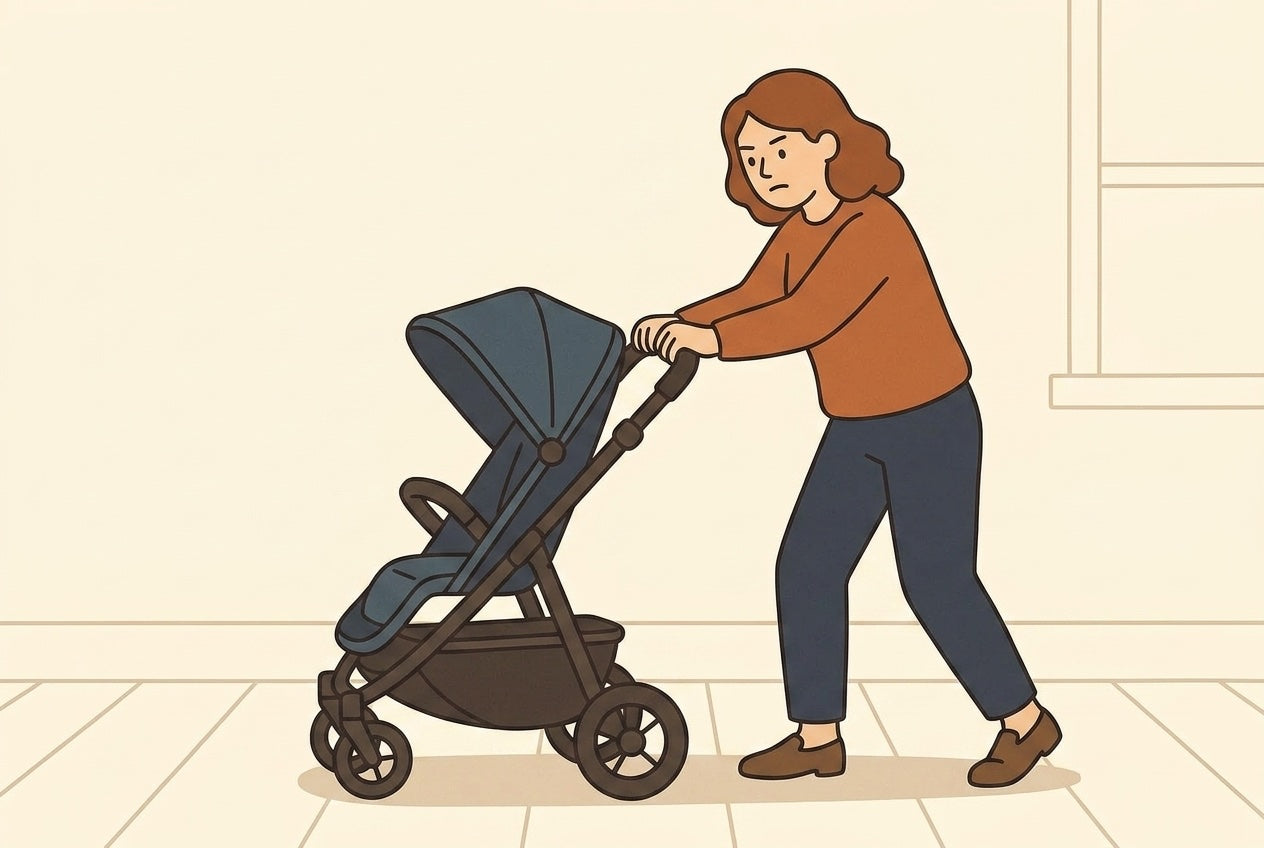
A stable rear frame is the single most important condition for safely adding a hammock seat to your stroller. Before you order Hoppie, you can run a 60-second push-and-flex test using only your hands — no tools, no manual, no expertise required. This guide walks you through the test, what to look for, and what your options are if your stroller doesn't pass.
Key Takeaways
A stable rear frame means the rear tubing doesn't visibly flex or creak under firm hand pressure.
The push-and-flex test takes 60 seconds and helps you see whether Hoppie can sit securely.
Tubular metal frames usually pass; fabric-backed and ultra-light umbrella frames often don't.
Hoppie is for children from around 18 months to 5 years old, up to 20 kg / 44 lbs.
If you're unsure, tell us the exact brand and model of your stroller and we'll confirm whether Hoppie fits.
Quick answer: what makes a stroller ready for Hoppie?
You're looking for three things on the back of your stroller:
Metal or rigid composite tubing — not fabric, not flimsy plastic.
A horizontal bar or crossbar at the back where the straps can grip.
No visible bending when you press firmly with both hands.
If your stroller has those three, the rear frame is almost certainly stable enough for a hammock seat. The 60-second test below confirms it in a couple of seconds.
What "rigid rear frame" actually means
A rigid rear frame is the part of your stroller that holds its shape when you press on it. It's what keeps the seat upright when your child wriggles, leans, or falls asleep — and it's what carries the extra load when a hammock seat is added.
Tubular frames vs fabric-backed strollers
Most modern strollers fall into two broad shapes at the back:
Tubular metal frames — sturdy aluminum or steel tubes running down the rear. These are designed to hold weight, and they usually do well with an accessory seat.
Fabric-backed strollers — the back of the seat is fabric stretched between thin frame rails. Common on ultra-light umbrella strollers. (Most cabin-size travel strollers, like the Babyzen YOYO or Bugaboo Butterfly, have a rigid tubular frame instead.) The fabric flexes, the rails flex, and a hammock seat doesn't have a solid anchor.
If you can see and feel a metal bar at the back of your stroller — not just fabric — you're starting from a good place.
How rigidity changes when the stroller is folded vs open
A stroller's rear frame is at its most rigid when fully unfolded and locked into position. Some strollers have a folding mechanism that keeps a little play in the frame even when open — that's normal, but it shouldn't be more than a few millimeters of movement.
Always run the push-and-flex test with the stroller fully open and locked in its walking position. Never test it half-folded.

The 60-second push-and-flex test
This is the test you actually run before ordering Hoppie. It tells you in one minute whether the rear frame is stable enough.
Step by step
Open your stroller fully and engage the parking brake.
Stand behind the stroller, facing the rear, with both hands on the rear handlebar.
Press down on the handlebar with both hands, using about half your body weight. Hold for two seconds.
While pressing, watch the rear tubes. Listen for creaking. Feel for flex.
Release the pressure. Watch the frame return to its shape.
What you should see and feel
Pass signs:
The frame feels solid under your hands.
The rear tubes don't visibly bend.
No creaking, no clicking, no plastic stress sounds.
When you let go, the frame returns cleanly to its position.
Fail signs:
The frame flexes visibly — more than a few millimeters of movement.
You hear creaking or plastic stress noises.
The stroller wobbles side to side under pressure.
The frame doesn't fully return to its original shape after you release.
Pass signs in all four checks? Your rear frame is likely stable enough for Hoppie. Even one fail sign? It's worth contacting us with the exact brand and model of your stroller before ordering — we'll tell you whether the flex you're seeing is a problem or just a normal feature of that model.

If your stroller fails the test
Not every stroller is built for a second seat. If your stroller fails the push-and-flex test, here's how to think about your next step.
When to ask us first
If the rear frame clearly fails the test — heavy flex, audible creaking, no return to shape — Hoppie is not recommended for this stroller. This is most common on:
Ultra-light umbrella strollers with thin tubing and fabric-back seats.
Older or worn-out budget strollers where the frame has developed play over years of use.
Don't confuse these with cabin-size travel strollers such as the Babyzen YOYO, Bugaboo Butterfly, UPPAbaby Minu, Cybex Melio or Nuna TRVL. Despite their size, they have a rigid frame and work well with Hoppie.
Alternative carry solutions
If a hammock seat isn't right for your stroller, you still have options:
A baby carrier for the older child on short outings. Soft-structured carriers from established brands work well for children up to around 18–20 kg.
A second compact stroller for the older child. Lower cost, but works best for two-adult families.
A more robust stroller if you're still early in your stroller's life. Replacing a frail stroller with a sturdier model often costs less in the long run.

Hoppie weight limit and age range
Hoppie is designed for children from around 18 months to 5 years old, up to 20 kg / 44 lbs.
The weight limit matters more than the age. Once your child reaches 20 kg / 44 lbs, Hoppie should no longer be used.
Before use, always check both Hoppie's instructions and your stroller manufacturer's maximum load capacity. Hoppie should only be used with strollers that have a stable rear frame and enough rear clearance. Always supervise your child while using Hoppie.
FAQs
What is a rigid rear frame on a stroller?
It's the metal or composite tubing at the back of the stroller that holds the seat in place and doesn't visibly bend when you press on it. A rigid rear frame is what allows an accessory like Hoppie to attach securely to the stroller.
Can I use Hoppie with a very light fabric-back stroller?
Usually not. Fabric-back strollers don't give the hammock straps a firm anchor, and the frame typically flexes too much under accessory load. Most ultra-light umbrella strollers fall into this category.
Does the rear frame need to be metal?
It needs to be rigid, which usually means metal — aluminum or steel tubing. Some premium strollers use rigid composite materials that also pass the push-and-flex test. The key is rigidity, not the material name.
How much weight should the rear bar hold?
Most modern strollers are built to handle significant accessory loads, but specifics vary by model. Your stroller's manual lists the maximum total load and any accessory restrictions. Always stay under that limit when adding Hoppie plus your older child.
My stroller moves a little — is that normal?
A few millimeters of flex is usually normal, especially on folding mechanisms. Significant flex — more than you can comfortably ignore, or with creaking — is a sign the frame may not be stable enough. When in doubt, tell us the exact brand and model of your stroller and we'll confirm whether Hoppie fits.
What if my stroller passes but I'm still not sure?
Tell us the exact brand and model of your stroller. We'll confirm whether the frame and the rear space are right for Hoppie. It's the fastest way to remove the doubt.


