

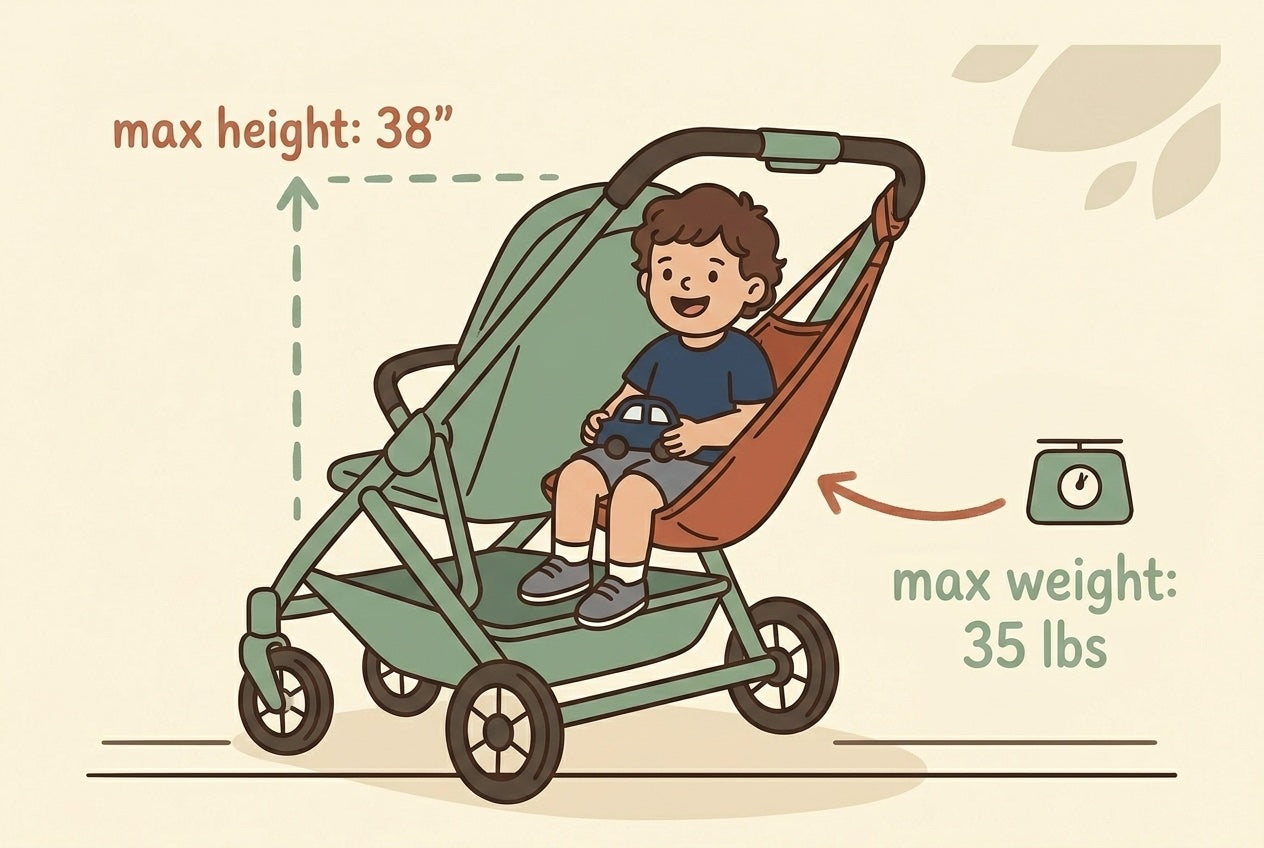
Your toddler climbs into the hammock seat, and for a second you wonder: are they too big for this? It's a fair question — and a quick one to answer. Hoppie is designed for children from around 18 months to 5 years old, up to 20 kg / 44 lbs. If your child is somewhere in that window, there's a good chance the seat still works well for them. If they're close to the edge, this guide will help you check.
Key Takeaways
Hoppie is designed for children from around 18 months to 5 years old, up to 20 kg / 44 lbs.
Age is a guide — weight and sitting balance matter more for a safe, comfortable fit.
Both limits matter: 5 years and 20 kg / 44 lbs. Stop at whichever comes first.
There are clear physical signs when a child has outgrown the seat — trust what you see.
Always supervise your child while using Hoppie, and check that your stroller's total load capacity covers the combined weight.
Age range vs actual fit
The "18 months to 5 years" range is a practical guide, not a hard cut-off that applies equally to every child. A tall, active four-year-old and a small, steady three-year-old can both be great users of the same hammock seat — or neither might be, depending on their build and temperament. The range tells you where to look. The real check comes from three things: weight, sitting balance, and a few obvious physical signs.
Why age isn't the only measure
Children grow at very different rates. According to WHO child growth standards, the typical weight range for a two-year-old runs from roughly 10 kg to 14 kg, while a healthy five-year-old might weigh anywhere from 15 kg to 21 kg. That spread means two children of the same age can sit on very different sides of the weight limit.
Age is also a rough proxy for sitting balance. A confident eighteen-month-old who walks steadily and sits well independently is a very different passenger from an eighteen-month-old who is only just finding their footing. A hammock seat requires your child to sit without slouching sideways or lurching forward — not because the seat is unsafe otherwise, but because the ride is more comfortable and stable when they can hold themselves upright.
So when parents ask "is my child too big?", the fuller question is really three questions:
Are they under 20 kg / 44 lbs?
Can they sit independently and comfortably in the seat?
Do their legs and body fit within the seat's natural shape?
If the answer to all three is yes, Hoppie is still the right tool. If one of them is no, it's time to reassess.
Height, weight, and sitting balance
The 20 kg / 44 lbs weight limit is the hard boundary. It's not a suggested maximum — it's the design limit, and it exists for both your child's safety and the integrity of the seat over time. Weigh your child before each new season if you're not sure. Most bathroom scales give a good enough reading when you hold your child and then subtract your own weight.
Height matters in a different way. There's no strict height cut-off for Hoppie, but a child who has grown very tall may find the seat less comfortable — legs dangling lower, more movement when walking. That's not a safety issue; it's a comfort signal. A child who keeps wriggling, shifting their weight, or asking to get out quickly is probably telling you the fit isn't right for them anymore.
Sitting balance is the softer check, and the most important one for younger children. A child who still topples sideways without support, or who grabs the side of the seat to stay upright, may not be quite ready. Most children have solid seated balance by around 18 to 24 months, but again — trust what you observe over what the calendar says.

When your child outgrows the hammock seat
Outgrowing Hoppie usually happens gradually. One day you notice something feels a little off — they seem more cramped, or you can see the seat sitting lower than usual. That's normal, and it's the right moment to make the call.
Signs they've outgrown it
Here are the clearest signals that your child has moved past the hammock seat stage:
Their weight is approaching or at 20 kg / 44 lbs. This is the non-negotiable one. Check the scale regularly as they approach five years old.
Their legs hang very low and swing into the wheels or frame. Some leg dangle is normal and expected — it's part of the relaxed hammock position. But if their legs are long enough to make contact with the stroller frame or rear wheels while moving, they've grown too tall for a comfortable fit.
They can't sit still in it. Older children who are physically restless and keep shifting their weight dramatically are harder to carry safely in a hammock seat. If every outing ends with them trying to climb out after two minutes, the seat has done its job and they've moved on.
The seat fabric is visibly stretched or strained. This is a practical sign that the load is consistently at or near the design limit. Don't ignore it.
Your child tells you it's not comfortable. Children this age can usually tell you. If they consistently resist getting in, or complain about it, believe them.
None of these signs mean you've done anything wrong. They just mean your child has grown — which is exactly what they're supposed to do.
What to use after the hammock seat
The good news is that a child who has outgrown Hoppie is usually also old enough to manage more independently on a walk. Five-year-olds have the stamina, balance, and attention span for quite a bit more than a two-year-old. Still, tired legs happen at any age, and you'll want a backup plan for long days.
A few things that work well at this stage:
A scooter or balance bike. For children four and up, a scooter alongside the stroller is often faster than walking and keeps them engaged. It also solves the "carry me" moment — when they're tired, they can hop on and glide rather than demanding your arms.
A stroller board. Some strollers accept a clip-on standing board at the rear. This works better for children who are comfortable standing and balancing, and it handles more weight than a hammock seat. Check your stroller brand's own accessories for this option.
Planning shorter walking legs. At five and six, children can usually walk farther — but they still have a wall. Breaking longer outings into smaller sections with a rest or a snack in the middle goes a long way.
Letting them walk at their own pace on quieter routes. Not every outing needs to be efficient. When there's no deadline, letting them set the pace removes most of the "tired toddler" friction entirely.

Is there a minimum age?
The lower end of the range matters too. Hoppie is designed for children from around 18 months old. Before that, most children don't yet have the independent sitting balance a hammock seat requires. They may slouch, slide, or lean in ways that make the ride less safe and less comfortable for them.
Around 18 months, most children have been walking for a few months and can sit independently for extended periods. Their core strength and body awareness are developed enough to handle the gentle sway of a hammock seat during a normal walk. If your child is close to 18 months but not quite there in terms of sitting balance, waiting a few more weeks is the right call.
If you're unsure whether your younger toddler is ready, the easiest test is to sit them on a firm surface without any side support and see how long they stay comfortably upright on their own. If they can manage a few minutes without toppling, they're likely ready for the hammock seat too.
Always follow Hoppie's installation instructions and check your stroller manufacturer's maximum load capacity before use. And always supervise your child while Hoppie is in use.

A practical size check you can do right now
If you're not sure whether your child still fits, run through this quick list:
Weigh them. Under 20 kg / 44 lbs? Good. Getting close? Keep checking monthly.
Sit them in the seat at home. Do they fit naturally, with no obvious cramping or squishing? Does the seat hold its shape?
Watch their legs. Gentle dangle is fine. Legs reaching the rear wheels or frame is a sign they've grown past the comfortable range.
Ask them. "Is it comfortable?" is a question most three, four, and five-year-olds can answer honestly.
Check your stroller's total load. Add your baby's weight, the older child's weight, and anything in the basket. The total should stay within your stroller manufacturer's rated maximum.
If you're unsure whether your stroller's setup will handle the combined load, tell us the exact brand and model of your stroller and we'll confirm whether Hoppie fits.
FAQ
What age can a child use a stroller hammock seat?
Hoppie is designed for children from around 18 months to 5 years old. The lower limit is about sitting balance — most children can sit independently and safely in a hammock seat from around 18 months. The upper limit is both age and weight: 5 years and 20 kg / 44 lbs, whichever comes first.
Can a 6-year-old use a hammock seat?
No. Hoppie is designed for children up to 5 years old and 20 kg / 44 lbs, and both limits apply. By six, most children have outgrown the age range, and many have passed the weight limit too. It's time to move on to a scooter, a balance bike, or shorter walking legs with a rest in the middle.
Is there a height limit for a hammock seat?
Hoppie doesn't have a strict height cut-off. In practice, children who have grown very tall may find the seat less comfortable — their legs may hang lower and feel cramped, or the overall fit may feel snug. If your child's legs consistently reach the rear wheels or frame while the stroller is moving, that's a sign the fit is no longer comfortable for their size, even if they're still under the weight limit.
What is the minimum age for a stroller hammock seat?
Hoppie is designed for children from around 18 months old. Before that age, most children haven't yet developed the independent sitting balance the seat requires. If your child is close to 18 months but still unsteady when sitting without support, wait a few more weeks and try again. The test is simple: can they sit independently on a firm surface for a few minutes without toppling?
What is the maximum weight for a stroller hammock seat?
Hoppie supports children up to 20 kg / 44 lbs. This is the design limit — not a suggested guideline. Once your child reaches or approaches this weight, stop using the seat. Always check your stroller's total load capacity as well, since your baby in the front seat and items in the basket all count toward that total.
How do I know when my toddler has outgrown the hammock seat?
The clearest signs are: their weight is at or near 20 kg, their legs reach the stroller's rear frame or wheels, they're visibly uncomfortable or restless in the seat, or the seat fabric looks strained. Any one of these is enough to make the call. Children grow fast — it's worth checking every few months if yours is getting close to the upper end of the range.
Can a young toddler (under 18 months) use a hammock seat?
Hoppie is not designed for children under 18 months. Young toddlers typically haven't developed the independent sitting balance and core strength needed to sit comfortably and safely in a rear hammock seat. If your child is younger than 18 months, a baby carrier or the stroller's main seat is the right option.
Does my toddler need to be able to walk before using a stroller hammock seat?
Walking ability isn't the deciding factor — sitting balance is. That said, most children who are walking confidently have also developed the core strength and body awareness they need for a hammock seat. If your child walks well and can sit independently, they're likely ready from around 18 months.
Hoppie is designed for tired little legs — at just the right size
When your toddler hits that wall mid-walk and says "carry me," you need a backup plan that actually works for their size. Hoppie is designed for children from around 18 months to 5 years old, up to 20 kg / 44 lbs — the exact window when tired little legs are most likely to give out.
Keep the stroller you love. Add a second seat when you need it.
Disclaimer: Hoppie is an independent product and is not affiliated with, endorsed by, sponsored by, or approved by any stroller brand. Always follow Hoppie's installation instructions and check your stroller manufacturer's maximum load capacity before use. Hoppie is designed for children from around 18 months to 5 years old, up to 20 kg / 44 lbs. Always supervise your child while Hoppie is in use.