

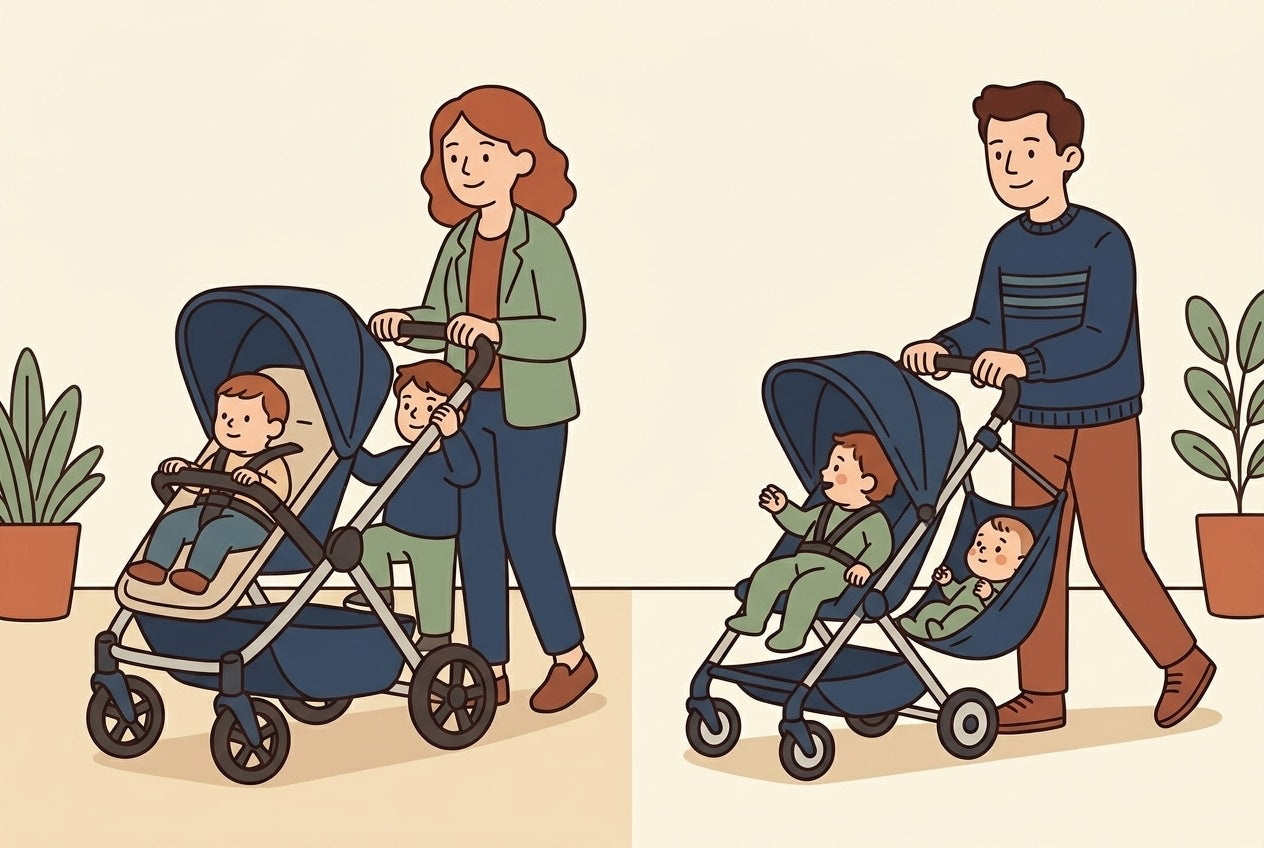
You have two kids and one stroller. The older one gets tired. So you start looking at options — and two keep coming up: a sit-and-stand stroller or a hammock seat add-on. They solve the same problem, but they're built very differently, cost very differently, and suit different families. This guide breaks down both so you can pick the one that actually fits your life.
Key Takeaways
A sit-and-stand stroller is a purpose-built two-child frame. A hammock seat is a compact add-on that attaches to your existing stroller.
Sit-and-stand models are heavier, bulkier, and cost significantly more than a hammock seat.
A hammock seat lets you keep the stroller you already love — no new frame to buy or manoeuvre.
Hoppie is designed for children from around 18 months to 5 years old, up to 20 kg / 44 lbs.
Your decision comes down to how often both children ride at the same time and how much you care about footprint and cost.
How each setup is built
Before comparing pros and cons, it helps to understand the structural difference. These are not two versions of the same thing — they're fundamentally different products that happen to serve the same parent problem.
The sit-and-stand stroller frame
A sit-and-stand stroller is a complete, purpose-built stroller frame designed from the ground up to carry two children. The younger child sits in a traditional forward seat at the front. The older child uses a rear platform to stand on, or sometimes a small pull-out seat to sit on.
The whole unit is one object. You buy it, you assemble it, and you push it as-is. Nothing attaches to an existing stroller — this is the stroller. That means the rear section is engineered and tested as part of the whole frame. It also means you're replacing your current stroller entirely, or adding a second one to your garage.
Because it's a full frame, a sit-and-stand is bigger than a standard single stroller in every dimension — longer, heavier, and noticeably harder to fold. Most of them do fold, but "compact" is rarely a word you'd use to describe the result. In a car boot, a lift, or a narrow café doorway, you'll feel the size difference immediately.
The trade-off is that the rear section is genuinely built for the job. A child standing on a sit-and-stand platform or sitting in the rear seat is on a surface that's part of the stroller's own tested structure.
The hammock seat attachment
A hammock seat — like Hoppie — is not a stroller. It's an accessory that attaches to the rear of your existing stroller, turning a single stroller into a smart two-child setup without replacing anything.
The seat hangs from straps looped around the stroller's rear frame, creating a snug hammock-style position for your older child. Because it attaches to the rear of the frame and hangs vertically, the stroller keeps its original width. You can still get through the same doorways, fit in the same lifts, and fold almost as compactly as before (Hoppie needs to be removed before folding).
The hammock seat works with most standard strollers that have a rigid rear frame and enough rear clearance — around 25 cm behind the main seat. Compatibility depends on your stroller's exact frame, shape, and weight capacity. It's not recommended for ultra-light umbrella strollers without a stable rear frame.
If you're unsure whether your stroller is compatible, send us a photo and we'll help you check.

Where each one wins
Neither option is perfect for every family. Here's an honest look at where each one earns its place.
Where sit-and-stand wins
A dedicated rear section
The biggest advantage of a sit-and-stand stroller is that the rear section — standing platform or seat — is an integrated, tested part of the frame. There's nothing to attach, no straps to route, no frame check to run. If you find a sit-and-stand that fits your family and your routine, it works out of the box.
Good for longer rides
When your older child genuinely needs to ride for long stretches — not just "I'm tired after five minutes of walking" but a full day at a theme park or an extended airport journey — a dedicated rear seat can be more comfortable for some children than a hammock position. The flat platform also lets children alternate between sitting and standing, which helps with restlessness on longer outings.
No compatibility check needed
You buy a sit-and-stand, and it's a complete product. There's no need to check your existing stroller's rear frame, measure rear clearance, or compare weight capacities. If that checking process feels like too much, a dedicated unit removes it entirely.
Where a hammock seat wins
Price
This is the most significant difference. A sit-and-stand stroller typically costs several times more than a hammock seat add-on. For a second-child solution you'll use for a year or two before your older child no longer needs a ride, that's a meaningful cost gap. Many parents find it hard to justify replacing a perfectly good stroller — one they love — for the sake of a temporary two-child phase.
Weight and footprint
A sit-and-stand is a bigger, heavier object than a standard single stroller. Getting it in and out of a car, through a lift, onto a bus, or into a café is a different experience from your current stroller. A hammock seat adds very little weight and keeps the stroller's original footprint — its width doesn't change at all.
You keep the stroller you already have
If you already own a stroller you like — one that folds the way you want, fits your car, handles your daily routes — a hammock seat lets you keep it. You're upgrading what you have, not replacing it. That matters a lot to parents who spent time and money choosing the right stroller for their family.
Flexibility
A hammock seat goes on and comes off in a few minutes once you're used to it. When your older child is walking happily, leave the seat at home. When you know it's going to be a long day, clip it on. A sit-and-stand is always a sit-and-stand — it's the same size whether both children are riding or not.

Decision framework: which one is right for you?
Most families fit into one of a few clear situations. Here's a simple way to think it through.
Quick decision tree
Do both children need to ride for long stretches every day?
If yes — your older child regularly needs to ride for more than 30–40 minutes at a time, most days — a sit-and-stand may be worth the cost and bulk. A dedicated rear seat is designed for that kind of sustained use.
Does your older child mostly walk, but sometimes needs a break?
If yes — this is the hammock seat's sweet spot. Your older child is walking most of the time, but there are moments (tired after school, a long shopping day, an airport connection) when they need to ride. A hammock seat handles those moments well without adding permanent bulk to your setup.
Do you already own a stroller you love?
If yes — a hammock seat almost always makes more sense. Replacing a stroller you're happy with to get a larger, heavier one is a big step, especially when the two-child phase is temporary.
Is budget a significant factor?
If yes — the cost difference is real and worth taking seriously. A hammock seat gives you the core second-seat function at a fraction of the price of a sit-and-stand stroller.
Do you navigate tight spaces regularly?
If yes — lifts, narrow aisles, café doors, public transport — a hammock seat's compact footprint is a practical daily advantage. Sit-and-stand strollers are wider and longer, and some spaces simply don't accommodate them comfortably.
Mostly walking older child, occasional rides needed → hammock seat
Long daily rides for both children, budget allows → sit-and-stand
Happy with your current stroller → hammock seat
Tight city spaces, travel, public transport → hammock seat
Hoppie is designed for children from around 18 months to 5 years old, up to 20 kg / 44 lbs. Always follow Hoppie's installation instructions and check your stroller manufacturer's maximum load capacity before use. Always supervise your child while using Hoppie.

FAQ
Is a sit-and-stand stroller worth it?
It depends on how often both children need to ride at the same time and for how long. If your older child still needs long daily rides, a sit-and-stand can justify its cost. If your older child mostly walks but needs occasional rest stops, a hammock seat is usually a more practical and cost-effective choice.
Can a hammock seat replace a sit-and-stand stroller?
For most families, yes — especially if the older child walks independently most of the time and just needs somewhere to sit when tired. A hammock seat is not designed for hours of continuous riding every day, but it handles the everyday moments well: school runs, shopping trips, airport dashes, and long walks when little legs give out.
How heavy is a sit-and-stand stroller compared to a hammock seat setup?
Sit-and-stand strollers are full-size two-child frames and are noticeably heavier and larger than a standard single stroller. A hammock seat add-on weighs very little on its own, so your overall setup stays close to your current stroller's weight. If you regularly lift your stroller into a car or carry it up stairs, the weight difference between the two options matters a lot in practice.
Which is cheaper — a hammock seat or a sit-and-stand stroller?
A hammock seat costs significantly less than a sit-and-stand stroller. The price gap is large enough that for many families, a hammock seat is the obvious starting point — especially when you already own a stroller you're happy with and don't want to replace it.
Does a hammock seat work with my stroller?
Hoppie is designed to fit most standard strollers with a rigid rear frame and around 25 cm of rear clearance. It's not recommended for ultra-light umbrella strollers without a stable rear frame. Compatibility depends on your stroller's exact frame, shape, and weight capacity. If you're unsure, send us a photo of your stroller and we'll help you check.
At what age can my child use a hammock seat?
Hoppie is designed for children from around 18 months to 5 years old, up to 20 kg / 44 lbs. This covers the phase when older siblings walk but still get tired fast — exactly the situation where a second-seat solution makes the most difference.
Does a hammock seat affect how the stroller handles?
Adding a child to the rear of a stroller shifts the weight distribution, as it would with any two-child setup. Hoppie is designed to keep the stroller balanced and stable when used on strollers with a rigid rear frame. Keep the main seat loaded as usual, and always check your stroller's total weight capacity before use.
Is a hammock seat safe for everyday use?
Hoppie is designed for stability and comfort and is designed for everyday family use. As with any stroller accessory, always supervise your child, follow Hoppie's installation instructions, and check your stroller manufacturer's maximum load capacity before use. Use only on strollers with a stable rear frame.
Hoppie gives you the second-seat function at a fraction of the cost
You already love your stroller. Hoppie just gives it a second seat — for the moments when your older child's legs give out, without the bulk, the cost, or the hassle of replacing everything you have.
Hoppie is for parents who love their stroller but need a smart second seat. Keep the stroller you love. Add a second seat when you need it.
Hoppie is an independent product and is not affiliated with, endorsed by, sponsored by, or approved by any stroller brand. Brand names, when mentioned, are used only to indicate potential compatibility with certain stroller models. Always follow Hoppie's installation instructions and check your stroller manufacturer's maximum load capacity before use.


