

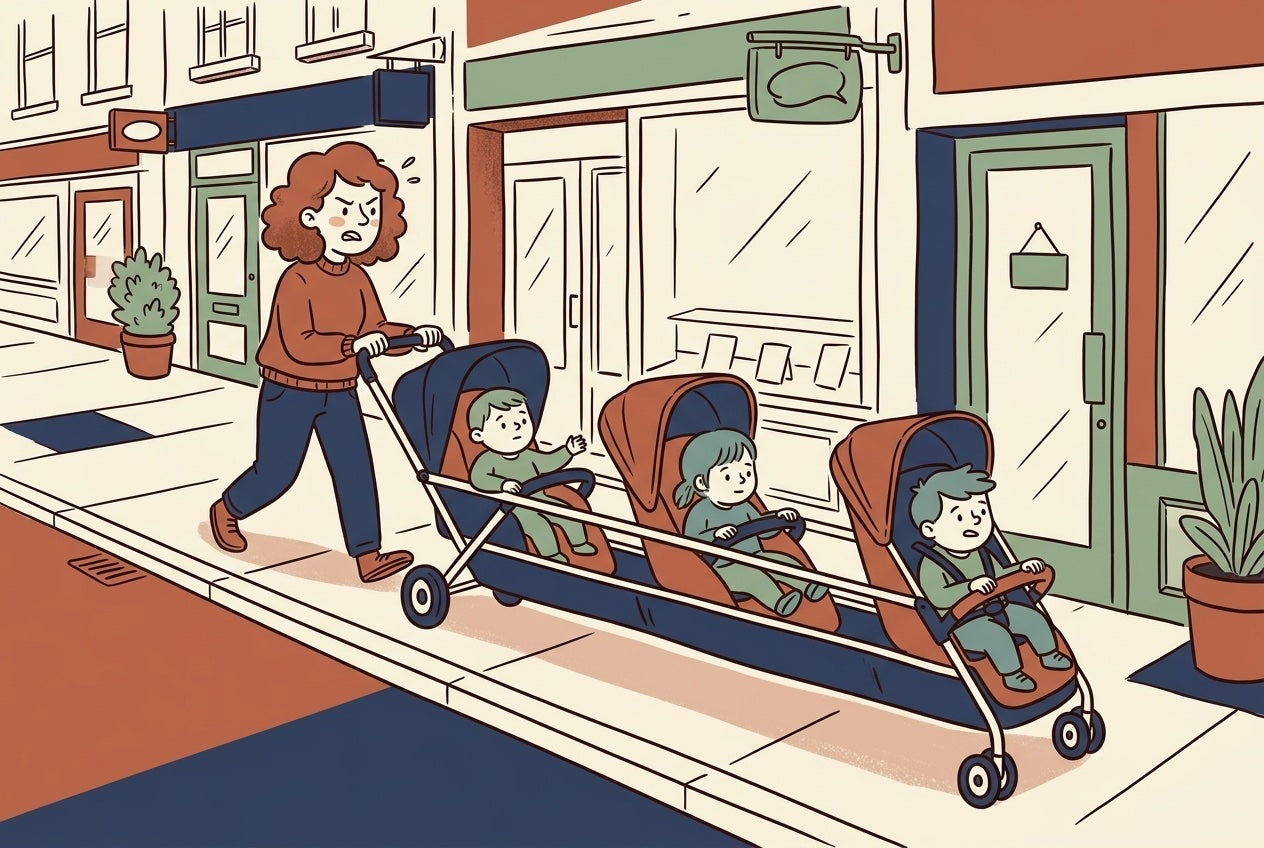
A tandem stroller sounds like the obvious answer when you have two young children. One stroller, two seats, done. But for many families, a tandem turns out to be heavier, longer, and more expensive than their daily life actually needs. This article gives you an honest look at when a tandem stroller makes sense — and when a smarter alternative works better.
Key Takeaways
Tandem strollers are long, heavy, and costly — and that matters a lot in city life.
They make most sense for families with two kids who both ride regularly on long outings.
For families with an older toddler who mostly walks, a single stroller plus a compact add-on seat is often a smarter fit.
Hoppie is designed for children from around 18 months to 5 years old, up to 20 kg / 44 lbs.
If you're unsure whether a hammock seat fits your stroller, tell us the exact brand and model of your stroller and we'll confirm whether Hoppie fits.
The 3 real drawbacks of tandem strollers
Tandem strollers are built for families who need two seated children at the same time, every day. They do that job well. But they come with trade-offs that catch many parents off guard — usually after the purchase, not before.
Length and city maneuverability
A tandem stroller places one seat directly in front of the other. That means the stroller is long — typically well over a metre from front wheel to rear handle. On a wide park path or a quiet suburb street, that's fine. In a city, it becomes a daily obstacle course.
Café doorways, shop aisles, lifts, and public transport all have one thing in common: they were built before tandem strollers were popular, and they didn't leave much room. Many parents with a tandem learn their local geography quickly — not because they want to, but because they have to. Which doorways require a reverse entry. Which lifts only just close with the stroller inside. Which supermarket aisles are single-file only.
Side-by-side double strollers have the same problem in the other direction — they're wide instead of long. But tandem strollers are rarely sold as compact. They are what they are: big strollers for two children.
If most of your daily outings involve tight spaces — city shops, busy school corridors, public transport — the length of a tandem stroller will make itself felt on almost every trip.
Weight and physical effort
A tandem stroller is designed to carry two children plus their combined kit. That engineering comes with weight. Most full-featured tandem strollers weigh considerably more than a standard single stroller — often more than twice as much. That matters when you're lifting it into a car boot, carrying it up stairs, or trying to fold it quickly in the rain with both kids standing beside you.
Pushing a loaded tandem also takes more effort than pushing a single stroller. Two children, two sets of gear, and the stroller's own frame create a total load that puts genuine strain on everyday use. Parents who do long school runs, uphill routes, or cobbled streets often report that tandem fatigue — the slow, building tiredness of pushing a heavy stroller daily — is real.
This doesn't make tandems bad products. It makes them honest products: they're built for a specific job, and that job requires structural weight. If that job matches your life, the weight is worth it. If it doesn't, the weight is just a daily inconvenience.
Cost
Tandem strollers sit at the higher end of stroller pricing. A solid, reliable tandem costs a meaningful amount — often equivalent to, or more than, a premium single stroller. For some families, that investment pays off across years of daily use. For others, especially those whose older child will outgrow the need for a stroller seat within a year or two, it represents a significant spend on something that won't be needed for long.
The cost question is also compounded by the fact that many parents already own a stroller they love. Buying a tandem means either replacing that stroller entirely or owning two strollers — one for everyday solo use, one for the two-kids scenario. Neither option is cheap.
There's also resale value to consider. Tandems are bulkier to store and harder to sell secondhand than single strollers. The market for used tandem strollers is smaller, and prices reflect that.

When a tandem stroller is still the right choice
None of this means tandem strollers are the wrong choice. For some families, they are exactly the right one. Here's when they make the most sense.
Long daily outings where both children need to ride
If both your children are genuinely too young or too tired to walk meaningful distances — think a two-year-old and a newborn, or twins — a tandem stroller earns its place quickly. When both seats are in use for most of an outing, the weight and size trade-offs become worthwhile.
Families who regularly cover long distances — full days at theme parks, long beach walks, countryside trails — also tend to get good value from a tandem. When the stroller is carrying two children for hours at a stretch, having a dedicated seat for each child is genuinely more comfortable for everyone.
It also helps when both children nap in the stroller. A tandem keeps each child in their own reclined seat, which is harder to manage with an add-on solution. If two-child napping on the go is a regular part of your routine, a tandem often handles that better than the alternatives.
Suburban or rural life with wide paths and large car boots
The urban maneuverability problem largely disappears in a suburban or rural setting. Wide pavements, large car parks, and detached houses with hallways that can actually fit a tandem make the length a non-issue. If your daily life doesn't involve tight city spaces, the stroller's footprint won't bother you.
The same applies to car boot space. A family with a large family car or SUV can often fit a tandem stroller in the boot without rearranging everything. For families with a smaller car, the equation changes — a tandem may simply not fit alongside the rest of daily family kit.
If your outings are mostly park walks, suburban errands, and weekend countryside trips where width and length rarely matter, a tandem stroller can work very comfortably in your routine.

The lighter alternative: single stroller plus add-on seat
For many families — especially those with an older toddler who mostly walks but tires quickly — a tandem stroller is more than they need. What they actually need is a backup seat: something compact that's there when little legs give out, not a full second seat running permanently alongside the main one.
How a hammock seat changes the picture
A hammock seat attaches to the rear of your existing single stroller, adding a second seat for your older child when they need it. The stroller stays compact. The weight stays manageable. And when your older child wants to walk again, the seat is simply there waiting.
This setup works well for the most common two-child scenario: a baby or young toddler in the main seat, and an older child who walks independently most of the time but needs somewhere to sit during longer outings. School runs, shopping trips, and travel days all fit this pattern.
Hoppie is designed for children from around 18 months to 5 years old, up to 20 kg / 44 lbs. It attaches to the rear of most standard strollers with a rigid rear frame, keeps the stroller's original width, and doesn't require a new stroller purchase. Always follow Hoppie's installation instructions and check your stroller manufacturer's maximum load capacity before use.
Hoppie is designed to fit most standard strollers with a stable rear frame. It is not recommended for ultra-light umbrella strollers without a reinforced rear frame. If you're unsure whether your stroller is compatible, tell us the exact brand and model of your stroller and we'll confirm whether Hoppie fits.
Cost and effort comparison
The cost difference between a tandem stroller and a hammock seat add-on is significant. A tandem requires either replacing your existing stroller entirely or keeping two strollers. An add-on seat works with the stroller you already have — no replacement needed, no second stroller to store.
The weight difference is also meaningful in everyday use. Your single stroller stays your single stroller. You're not lifting a heavier frame into the car every day. You're not navigating the café doorway at an angle. The stroller you already know how to fold, store, and push is still the stroller you're using.
For parents whose older child will need a stroller seat for another year or two before they reliably walk everywhere, a compact add-on seat often delivers most of the practical benefit of a tandem — without the size, weight, cost, or the need to replace a stroller they already love.

Which option fits your family?
The honest answer is that it depends on how your children actually use a stroller day to day.
If both children ride for most of every outing, a tandem stroller is built for that. If your older child mostly walks and only needs a seat occasionally — when tired, at airports, during long family days out — an add-on hammock seat is likely to be a better fit for your routine.
Ask yourself: on a typical busy day, how long does your older child actually sit in the stroller? If the answer is "most of the outing," think tandem. If the answer is "maybe twenty minutes here and there when they're flagging," a compact add-on solution is probably enough.
Always supervise your child while using Hoppie, and check that your stroller has a stable rear frame and enough rear clearance before use.
FAQs
Are tandem strollers worth it?
For families where both children genuinely need to ride for most of each outing — especially younger sibling pairs or twins — a tandem stroller is usually worth the investment. For families with an older child who mostly walks and only needs occasional support, the size, weight, and cost of a tandem can make it more than necessary.
How long is a typical tandem stroller?
Most full-featured tandem strollers extend well beyond a metre from front wheel to rear handle bar. The exact length varies by model, but as a category, tandems are noticeably longer than single strollers — which is worth checking against your car boot, hallway, and regular doorways before buying.
What is the lightest tandem stroller option?
Some compact tandem models are lighter than traditional full-feature tandems, but all tandem designs carry more weight than a comparable single stroller by the nature of their two-seat build. If weight is a primary concern, a single stroller with a lightweight add-on seat is usually the lighter combination overall.
Can a hammock seat replace a tandem stroller?
A hammock seat is a practical alternative for families whose older child walks most of the time but needs a seat when tired. It doesn't replace a tandem in situations where both children need to ride for long periods simultaneously. For the common scenario of one baby in the main seat and one walking toddler who occasionally needs a rest, a hammock seat covers most real-life needs without the size or cost of a tandem.
Is a side-by-side double stroller better than a tandem?
Side-by-side doubles avoid the length problem of tandems but introduce width instead — making narrow doorways and tight shop aisles tricky in a different way. Neither is universally better; it depends on your typical environment. Both are significantly larger than a single stroller with an add-on seat.
At what age can my older child use a hammock seat?
Hoppie is designed for children from around 18 months to 5 years old, up to 20 kg / 44 lbs. If your older child is within that range, a hammock seat is designed to give them a comfortable place to sit when tired, while keeping the stroller compact for your younger child in the main seat.
Will a hammock seat fit my stroller?
Hoppie is designed to fit most standard strollers with a stable, rigid rear frame. Compatibility depends on your stroller's specific frame shape, rear clearance, and total weight capacity. If you're unsure, tell us the exact brand and model of your stroller and we'll confirm whether Hoppie fits before you order.
Hoppie: tandem functionality without the tandem
You don't have to choose between your favourite stroller and a practical solution for two kids. Hoppie adds a compact second seat to the stroller you already own — designed for children from around 18 months to 5 years old, up to 20 kg / 44 lbs.
Keep the stroller you love. Add a second seat when you need it.
Disclaimer: Hoppie is an independent product and is not affiliated with, endorsed by, sponsored by, or approved by any stroller brand. Brand names, when mentioned, are used only to indicate potential compatibility with certain stroller models. Always follow Hoppie's installation instructions and check your stroller manufacturer's maximum load capacity before use.