
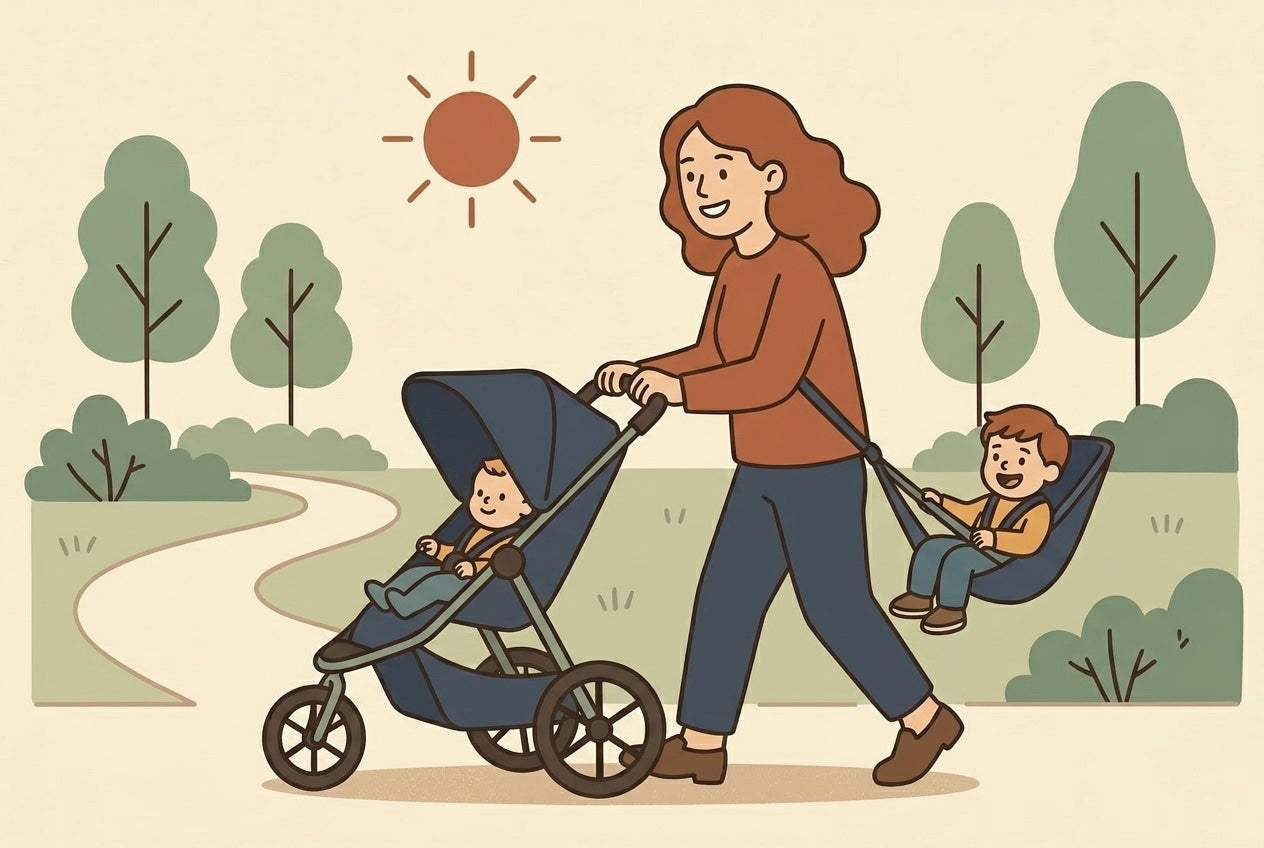
A hammock add-on seat can be safely fitted to most three-wheel jogging strollers — but only at walking pace. That's the single most important thing to know before you order. If you already own a jogging stroller and you're wondering whether it can pull double duty as a two-kid solution on your everyday walks, the answer is often yes. Here's what to check and what to keep in mind.
Key Takeaways
Most three-wheel jogging strollers have the strong rear frames and rear-bar geometry that a hammock seat needs.
A hammock seat on a jogging stroller is for walking only — never running or jogging.
Always check your stroller's total weight capacity before adding a second child on the rear seat.
Hoppie is designed for children from around 18 months to 5 years old, up to 20 kg / 44 lbs.
If you're unsure whether your jogging stroller is compatible, tell us the exact brand and model and we'll confirm whether Hoppie fits.
Why jogging strollers are usually compatible with a hammock seat
Jogging strollers are some of the most structurally solid single strollers on the market. They're built to absorb bumps, handle rough terrain, and maintain stability at speed. For parents looking to add a second seat for an older child on everyday walks, that structural strength is actually a big advantage.
Most three-wheel jogging strollers pass the compatibility checks that matter — not because they're jogging strollers, but because of the way they're built. Here's why.
Stronger frames, larger rear clearance
A hammock seat attaches to the rear of your stroller and holds the weight of your older child. For that to work safely, the rear frame needs to be genuinely rigid — meaning it shouldn't flex visibly when you press down on the handlebar with both hands and firm pressure.
Three-wheel jogging strollers are almost always built with thick aluminum or steel tubing that runs in a continuous structure from the rear axle to the handlebar. They don't use fabric back panels or thin flexible rods. When you press down on the handlebar of a typical jogging stroller, you feel a solid, stable frame underneath you. That's exactly what a hammock seat needs to anchor onto safely.
The larger rear wheel on most jogging strollers also tends to mean more rear clearance behind the main seat. That clearance is what lets the hammock hang naturally without pressing against the wheel or the basket. As a general guide, the hammock needs a little clear space behind the seat so it can hang freely — many three-wheel designs offer this without needing to reposition the basket at all.
Rear-bar geometry that works in your favour
The shape of the rear bar matters more than many parents expect. A flat or gently curved horizontal bar gives the hammock seat's straps a solid, secure grip. Sharply angled bars, very narrow bars, or bars with unusual cross-sections can let straps slip or prevent an even connection.
Most jogging strollers have a wide, flat horizontal rear bar — the kind you grip naturally when pushing. This shape tends to work well with rear hammock seats because the straps can sit flush and tighten evenly across the bar's surface. Compare this to some ultra-compact city strollers where the rear bar is shaped more like a curved spine or a folding hinge — those geometries are much harder to attach to reliably.
Run through the basic checks: press down on the handlebar firmly with both hands, check the rear clearance, and confirm your stroller's total weight capacity can handle your older child in addition to your usual setup. If those three pass, a jogging stroller is often a very good candidate for a hammock seat.

Why you must never run or jog with a hammock seat attached
Here's where the conversation shifts completely. Everything above is about whether your jogging stroller can physically hold a hammock seat. This section is about what you should never do once it does.
A hammock seat is designed for walking pace only. It is not designed for running, jogging, trail use at speed, or any kind of faster movement. This isn't a minor caution — it's a hard rule, and understanding why makes it easier to respect.
Vibration, momentum, and what they do to a rear seat
When you walk, the forces on a rear hammock seat are relatively gentle. Your child sits in the fabric seat, the stroller moves at a steady pace, and the load stays predictable. The seat does what it's designed to do.
When you run or jog, everything changes. Each stride sends a vertical jolt through the frame. On trail or uneven ground, lateral forces add to that. The child in the hammock seat has a 3-point harness rather than the main seat's harness, and they're sitting in a suspended fabric seat that depends on the geometry staying stable. At running pace, the seat swings, the child's body moves forward and back with each stride, and the load becomes dynamic rather than static.
Jogging strollers are brilliantly designed to absorb that kind of movement for a child in the main seat, with a proper harness holding them secure. They are not designed to absorb it for an older child sitting in a hammock seat behind the stroller at running pace, even with Hoppie's 3-point harness fastened.
The physics are simple: more speed means more movement, more movement means more force on the seat straps and rear bar, and more force means less margin for safety. A hammock seat kept at walking pace sits within its design limits. One used at running pace does not.
Child supervision while moving
There's a second reason that's just as important. When you run, your attention is divided — your eyes are forward, your breathing is working, and you're managing your own movement. Supervising a child sitting behind your stroller is much harder at running pace than at walking pace.
At walking pace, you can glance back easily, you can hear your child, and you can stop quickly if something feels wrong. At jogging pace, none of that is as easy. A child who feels uncomfortable, who shifts their weight, or who tries to stand up is harder to notice and harder to respond to quickly.
Always supervise your child while using Hoppie. At walking pace, that's straightforward. At running pace, it becomes genuinely difficult. That's reason enough to keep the hammock seat as a walking-only tool, even on a jogging stroller that could physically handle it otherwise.
The practical approach most parents settle on: use your jogging stroller with the hammock seat on the school run, at the park, on weekend walks, and anywhere else you're moving at a comfortable pace. When you want to run, remove the hammock seat first — it takes only a moment — and enjoy your jogging stroller the way it was designed to be used.

What to check before you install
If you've decided you want to use a hammock seat on your jogging stroller for everyday walks, run through these checks before you order.
Rear frame rigidity. Press down on the handlebar with both hands. The frame should not flex visibly or creak. Let go — the frame should return cleanly to its original position. Jogging strollers almost always pass this test.
Rear clearance. Look from the rear axle straight up. There should be a little clear space before any obstacle, so the hammock can hang freely. Check with the basket in its normal position, or repositioned if it blocks the rear zone.
Rear bar shape. Look at the rear bar your hands rest on when pushing. Is it flat and horizontal? Straps grip well there. Is it sharply angled, very narrow, or an unusual shape? Check more carefully before assuming it will hold the seat securely.
Total weight capacity. Find your stroller's maximum load — usually on a sticker near the rear wheels or in the manual. Add up the weight of your younger child, any accessories, and your older child on the hammock seat. The total must stay within your stroller's limit.
Locking the front wheel. Many jogging strollers have a swivel front wheel that can be locked for jogging. When using the hammock seat at walking pace, you can leave the front wheel in its normal walking mode. When you're jogging without the seat, lock it as usual.
Hoppie is designed for children from around 18 months to 5 years old, up to 20 kg / 44 lbs. Always follow Hoppie's installation instructions and check your stroller manufacturer's maximum load capacity before use.
If you're unsure whether your jogging stroller is compatible, tell us the exact brand and model of your stroller and we'll confirm whether Hoppie fits.

Getting the most out of your jogging stroller with a hammock seat
A jogging stroller with a hammock seat is a genuinely useful everyday setup for families with two young children. You get the structural strength of a jogging stroller — wide wheelbase, robust frame, smooth ride over varied surfaces — combined with a compact second seat that folds away in seconds when you don't need it.
For school runs, park days, and weekend walks, this combination works well. Your younger child sits in the main seat. Your older child walks when they can, and hops into the hammock when tired little legs need a break. You keep your stroller compact and easy to manage without the bulk of a double stroller.
The routine most parents find works best: install the hammock seat for the walk out, remove it when you want to jog or run, and reinstall it for the walk back. Once you're used to the installation, that process takes very little time.
Hoppie should only be used with strollers that have a stable rear frame and enough rear clearance. Always supervise your child while using Hoppie.
FAQ
Can I add a hammock seat to my jogging stroller?
In most cases, yes. Jogging strollers tend to have the rigid rear frames, wide rear bars, and rear clearance that a hammock seat needs. Run through the checks in this guide — rear frame rigidity, rear clearance, rear bar shape, and total weight capacity — to confirm your specific stroller is a good fit.
Is it safe to run or jog with a stroller hammock attached?
No. A hammock seat is designed for walking pace only. Running creates vibration and movement that the seat is not built to handle, and supervising a child in the rear seat at running pace is much harder. Always remove the hammock seat before jogging.
Do all jogging strollers fit a hammock seat?
Not every jogging stroller is compatible. The frame usually passes the rigidity test, but rear clearance and rear bar geometry vary between models. Some jogging strollers have fixed baskets that block the rear zone, or rear bars with unusual shapes that prevent a secure strap connection. Check your specific stroller before ordering, and if you're unsure, tell us the exact brand and model and we'll confirm whether Hoppie fits.
What pace is safe with a hammock seat on a jogging stroller?
Walking pace only. A comfortable, steady walk — the kind you'd do on a school run or a park visit — is what a hammock seat is designed for. If you want to jog or run, remove the seat first.
What age and weight is Hoppie designed for?
Hoppie is designed for children from around 18 months to 5 years old, up to 20 kg / 44 lbs. The weight limit matters more than the age — once your child reaches 20 kg / 44 lbs, it's time to stop using the hammock seat regardless of their age.
Do I need to lock the front wheel on my jogging stroller when using Hoppie?
At walking pace, you can leave the front wheel in its normal walking mode. The swivel function is useful for navigating turns and tight spaces. Only lock the front wheel when jogging — and if you're jogging, the hammock seat should already be removed.
Will a hammock seat damage my jogging stroller's rear bar?
Used correctly at walking pace and installed as instructed, a hammock seat is unlikely to damage a rigid rear bar. Whether to remove the seat before folding depends on the stroller: on most compact strollers, take it off first to avoid straining the straps; on many standard strollers you can fold with it attached. Check your stroller's rear bar for any unusual coatings or materials that straps might affect before your first use.
How do I know my jogging stroller has enough rear clearance?
Look straight up from the center of the rear axle. The hammock needs a little clear space before you hit the basket, canopy bar, or any other obstacle, so it can hang freely. If the basket is in the way, check whether it can be repositioned — most jogging stroller baskets can be moved or removed easily.
Hoppie is designed for walking pace — keep your jogging sessions stroller-light
Your jogging stroller is a great base for a second seat on everyday walks. It has the strong frame, the rear clearance, and the wide handlebar geometry that a hammock seat works best with. For school runs, park days, and family walks, it's a practical combination that keeps your setup compact without buying a bulky double stroller.
When it's time to run, remove the seat and go. Hoppie is for walking — and your jogging stroller is for both.
Keep the stroller you love. Add a second seat when you need it.
Disclaimer: Hoppie is an independent product and is not affiliated with, endorsed by, sponsored by, or approved by any stroller brand. Brand names, when mentioned, are used only to indicate potential compatibility with certain stroller models. Always follow Hoppie's installation instructions and check your stroller manufacturer's maximum load capacity before use. Hoppie is designed for walking pace only and must not be used during running or jogging. Always supervise your child while using Hoppie.