

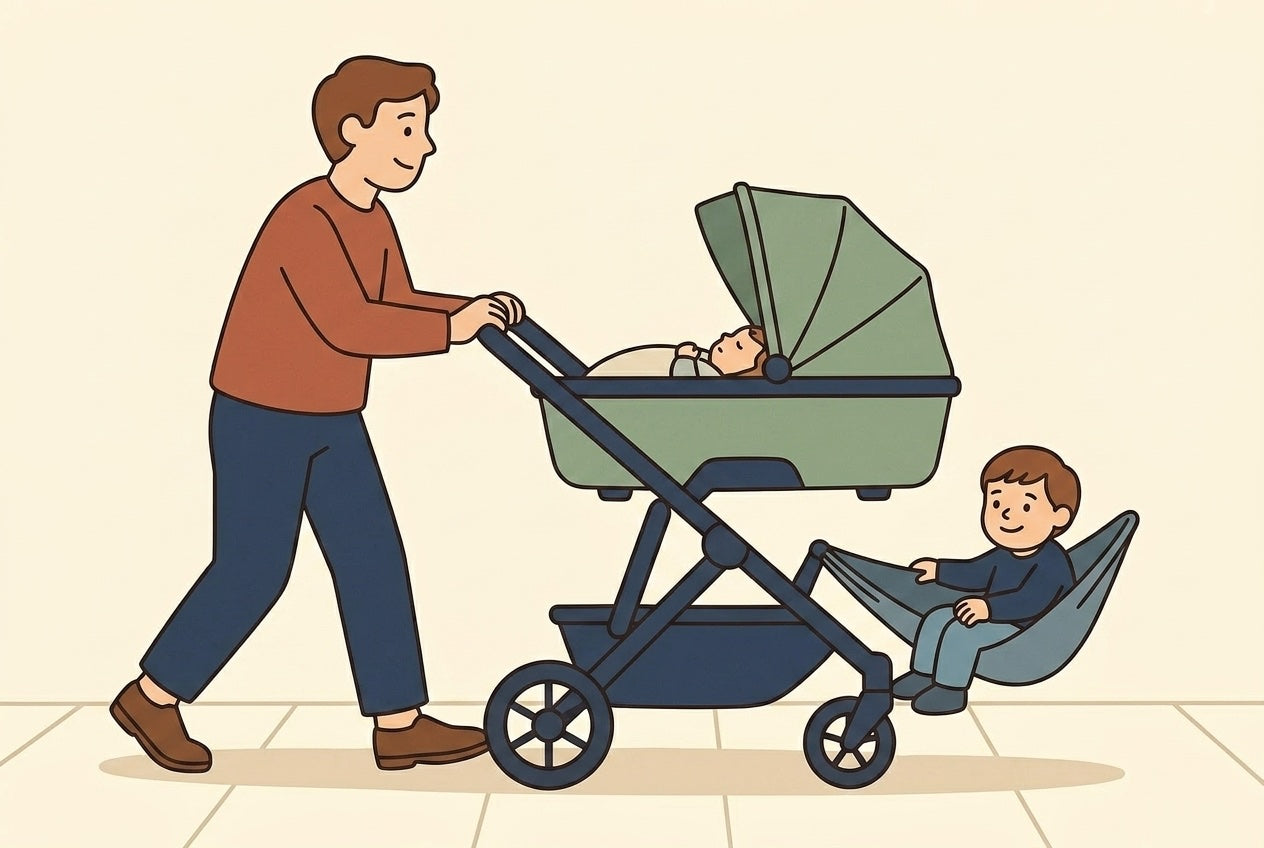
A hammock seat can be used alongside a bassinet or carrycot on some strollers, but not all — and three conditions have to be met first. The carrycot must leave enough clear space at the rear, the rear frame of your stroller must stay rigid with both loads on it, and the stroller's total weight capacity must not be exceeded. If all three are true, the setup is straightforward. If any one of them fails, it is not the right setup. This guide explains how to check in a few minutes.
Key Takeaways
A hammock seat can work alongside a bassinet or carrycot on some strollers, provided the carrycot leaves enough rear space, the rear frame stays rigid and total load capacity isn't exceeded.
The bassinet sits up front; the hammock seat hangs at the rear — they don't share the same attachment point.
Hoppie is designed for children from around 18 months to 5 years old, up to 20 kg / 44 lbs.
Hoppie must always be used with a child in the stroller's main seat. If your stroller can't take a bassinet and Hoppie together, wait until your younger child can use the regular seat.
If you're unsure whether your stroller will work, tell us the exact brand and model and we'll confirm whether Hoppie fits.
Bassinet up front, hammock at the back: when it works
Most standard strollers are designed so the bassinet or carrycot sits near the front of the frame — where the main seat reclines. The hammock seat, meanwhile, attaches to the rear of the stroller behind the seat. On some strollers these two positions don't overlap and both can be in use at the same time; on others (the Babyzen YOYO, for example) the carrycot takes up the rear space and Hoppie only works with the child seat.
The key thing to understand is that the loads sit at opposite ends of the stroller. The bassinet and baby are near the front wheels. Your older toddler in the hammock seat is near the rear. Knowing this changes how you think about the weight and balance — and it's what we'll walk through next.
Weight distribution rules
Every stroller has a total maximum load printed in the manual or on a sticker near the frame. That number covers everything: the child in the main seat or bassinet, any accessories clipped on, what's sitting in the storage basket, and any additional seat added to the rear.
With a bassinet setup, the weight calculation typically looks like this:
The bassinet itself — most weigh somewhere between 3 and 6 kg depending on the model
Your baby lying in it
Anything stored in the basket beneath
Your older toddler on the hammock seat at the rear
Add those up and compare against your stroller's rated capacity. The total must stay comfortably under the limit. A bassinet-and-carrycot setup already uses a meaningful portion of that budget before your toddler sits down. Run the numbers before you assume you're fine.
The good news is that many full-size strollers designed for use with a bassinet are also built with a strong rear frame and a generous total load rating — precisely because parents use them across two children. These are the strollers where the bassinet-plus-hammock-seat combination usually works well.
Stability when stationary vs walking
Stability is the concern parents raise most often with this setup — and it's a fair one. Here's how to think about it clearly.
When you're walking and pushing the stroller, the forward motion and your hands on the handlebar keep everything balanced. The stroller is stable in motion because the forces are distributed and controlled. Stability is not a concern while walking on any stroller with a solid rear frame.
When you stop, the habit that matters is the parking brake. A toddler who wriggles or shifts their weight while the stroller is stationary can make it roll a little, especially on a slope. This is why always engaging the parking brake whenever you stop is a non-negotiable part of using a rear hammock seat safely. We'll cover that in more detail in the practical rules section below.
Hoppie hangs vertically behind the stroller, so your toddler's weight goes down onto the rear frame rather than pulling the stroller backward the way a bag hung on the handlebar would. What matters is a solid rear frame, the parking brake whenever you stop, and keeping the stroller's total load within its rated limit.

When it doesn't work — and what to do instead
Not every stroller is built to carry a bassinet and a rear hammock seat at the same time. There are two clear situations where this combination isn't a good idea.
Strollers that can't hold both loads
If your stroller's rear frame flexes noticeably when you press down firmly on the handlebar with both hands, it isn't suitable for a hammock seat at all — with or without a bassinet up front. A flexible frame can't reliably hold the rear-loaded weight of a toddler over time. This applies even if the stroller is rated for a high total load, because the rating assumes the weight is distributed across the whole frame, not concentrated at the rear bar.
Ultra-light umbrella strollers with thin tubing and fabric-back seats typically fall into this category. Compact travel strollers vary: many, like the Babyzen YOYO or Bugaboo Butterfly, have a rigid frame and work with Hoppie in their seat configuration. Hoppie is not recommended for strollers without a stable rear frame.
The second situation is simpler: even if the frame is solid, some strollers have bassinets that extend far enough back toward the rear of the frame that they physically block the rear clearance you need for the hammock seat. If there isn't enough clear space at the rear, the seat can't sit and hang properly. In this case, check whether the bassinet can be repositioned or swapped for a stroller seat before assuming the whole plan won't work.
If your stroller can't take both: what to do instead
If your stroller isn't the right fit for this combination, here's how to think about it.
Hoppie must always be used with a child sitting in the stroller's main seat. It isn't designed to be used on an otherwise empty stroller, so wearing your baby in a carrier while your toddler rides in Hoppie is not the right setup.
The simplest option is to wait until your younger child is old enough to use the stroller's regular seat. On many strollers the seat leaves more rear space than the carrycot, and it removes the carrycot's own weight from the total load. Until then, keep your toddler walking or use a separate solution for them.
If you're unsure whether your stroller will work with or without the bassinet in place, tell us the exact brand and model of your stroller and we'll confirm whether Hoppie fits.
Practical rules for safe use
If your stroller passes the weight check and the rear-frame check, and you're ready to use a bassinet and hammock seat together, these are the habits that matter.
Always engage the parking brake when stationary
This is the single most important habit with any loaded rear-seat setup. Whenever the stroller stops — even for a few seconds — engage the parking brake before you let go of the handlebar. A toddler who shifts their weight suddenly while you're reaching for something or looking away can move the stroller on a slope or even on flat ground.
Make it automatic. Brake first. Then do everything else. It takes one second and removes the biggest risk from this kind of setup entirely.
Lift the bassinet end first when parking on a slope
When you need to park the stroller on a slope — a pavement camber, a ramp, a park path — position the front (bassinet) end facing uphill wherever possible. This keeps the heavier front weight working with gravity rather than against it. It also means that if the brake were ever to slip (it shouldn't, but still), the stroller rolls toward the wall or incline rather than away from you.
On flat ground it matters much less. But on any noticeable slope, this habit adds a practical layer of confidence.
Check the total load before every outing
Babies grow fast. A baby who was 4 kg when you first set this system up may be 6 kg three months later. Your toddler is getting bigger too. Run the weight check every few months — or any time one of your children has had a growth spurt — to make sure you're still within your stroller's rated limit.
Always follow Hoppie's installation instructions and check your stroller manufacturer's maximum load capacity before use. Hoppie is designed for children from around 18 months to 5 years old, up to 20 kg / 44 lbs. Always supervise your child while using Hoppie.
Folding the stroller with Hoppie
Whether Hoppie needs to come off before folding depends on your stroller. On most compact strollers, remove it first to avoid straining the straps; on many standard strollers you can fold with it attached. Unclipping takes only a few seconds once you're used to the routine.

FAQ
Can I use a stroller hammock at the same time as a bassinet?
Sometimes. Hoppie is designed mainly for strollers with a standard seat. It can work with some carrycots, as long as the carrycot leaves enough clear space at the rear, the stroller has a rigid rear frame, and the combined weight of the bassinet, baby, toddler, and any basket contents stays within the stroller's total load rating — but not with all of them. On some strollers (the Babyzen YOYO, for example) Hoppie fits with the child seat but not with the bassinet. Run the weight calculation before use, and do the rear-frame flex test to confirm your stroller is suitable.
Is a carrycot heavier than a regular stroller seat?
Usually, yes. A carrycot or bassinet adds its own structural weight to the stroller — typically several kilograms on top of your baby's weight. A regular stroller seat tends to be lighter because it's part of the frame rather than a separate unit. This means your total load budget is used up faster with a bassinet setup, which is why the weight check matters more, not less.
Will the stroller tip if both seats are loaded?
No. Hoppie hangs vertically behind the stroller, so your toddler's weight goes down onto the rear frame rather than pulling the stroller backward — unlike a heavy bag hung on the handlebar. What you do need is a solid rear frame, a total load within the rated capacity, and the parking brake every time you stop, so the stroller can't roll if your toddler shifts their weight.
How much total weight can a stroller carry?
It depends entirely on your specific stroller. The maximum total load is printed in the manual or on a sticker near the rear wheels. It covers everything — the child in the main seat or bassinet, the bassinet itself, basket contents, and any rear add-on seat. Check this number before assuming your setup is within limits. If you can't find the rating, contact the stroller manufacturer directly.
Does the bassinet or carrycot interfere with the hammock seat straps?
Not usually — the bassinet sits near the front of the stroller and the hammock seat attaches at the rear. They don't share an attachment point. The main thing to check is that the bassinet doesn't extend so far back that it takes up the rear clearance the hammock seat needs to hang and work properly.
My stroller can't hold both loads — what should I do?
Hoppie must always be used with a child sitting in the stroller's main seat, so wearing your baby in a carrier while your toddler rides in Hoppie is not an option. The practical answer is to wait until your younger child can use the stroller's regular seat (which usually leaves more rear space and weighs less than a carrycot), and to keep your toddler walking in the meantime.
Can I use Hoppie with a bassinet on an umbrella stroller?
Hoppie is not recommended for ultra-light umbrella strollers without a stable rear frame. If your umbrella stroller has thin tubing or a fabric-back seat structure, it is unlikely to pass the rear-frame flex test — and that's before adding a bassinet to the equation. Use the flex test first: press firmly down on the rear handlebar with both hands and check whether the frame flexes visibly. If it does, a hammock seat is not suitable for that stroller.
What is the weight limit for Hoppie?
Hoppie is designed for children from around 18 months to 5 years old, up to 20 kg / 44 lbs. This is the limit for the seat itself. You also need to account for your stroller's total maximum load capacity, which includes every other weight on the stroller at the same time.
Hoppie with a bassinet: possible on some strollers, so check the rear space first
On some strollers, you don't need to choose between keeping your baby in the bassinet and giving your toddler a place to sit when tired. The setup works as long as the carrycot leaves enough rear space, the frame is solid and the numbers add up. On others (the Babyzen YOYO, for example), Hoppie fits with the child seat but not with the bassinet.
Hoppie is designed for children from around 18 months to 5 years old, up to 20 kg / 44 lbs. It attaches to the rear of your existing stroller, behind the main seat or bassinet. Keep the stroller you love. Add a second seat when you need it.
If you're not sure whether your stroller will work with a bassinet still in place, tell us the exact brand and model of your stroller. We'll confirm whether Hoppie fits before you order.
Disclaimer: Hoppie is an independent product and is not affiliated with, endorsed by, sponsored by, or approved by any stroller brand. Brand names, when mentioned, are used only to indicate potential compatibility with certain stroller models. Always follow Hoppie's installation instructions and check your stroller manufacturer's maximum load capacity before use. Always supervise your child while using Hoppie.