

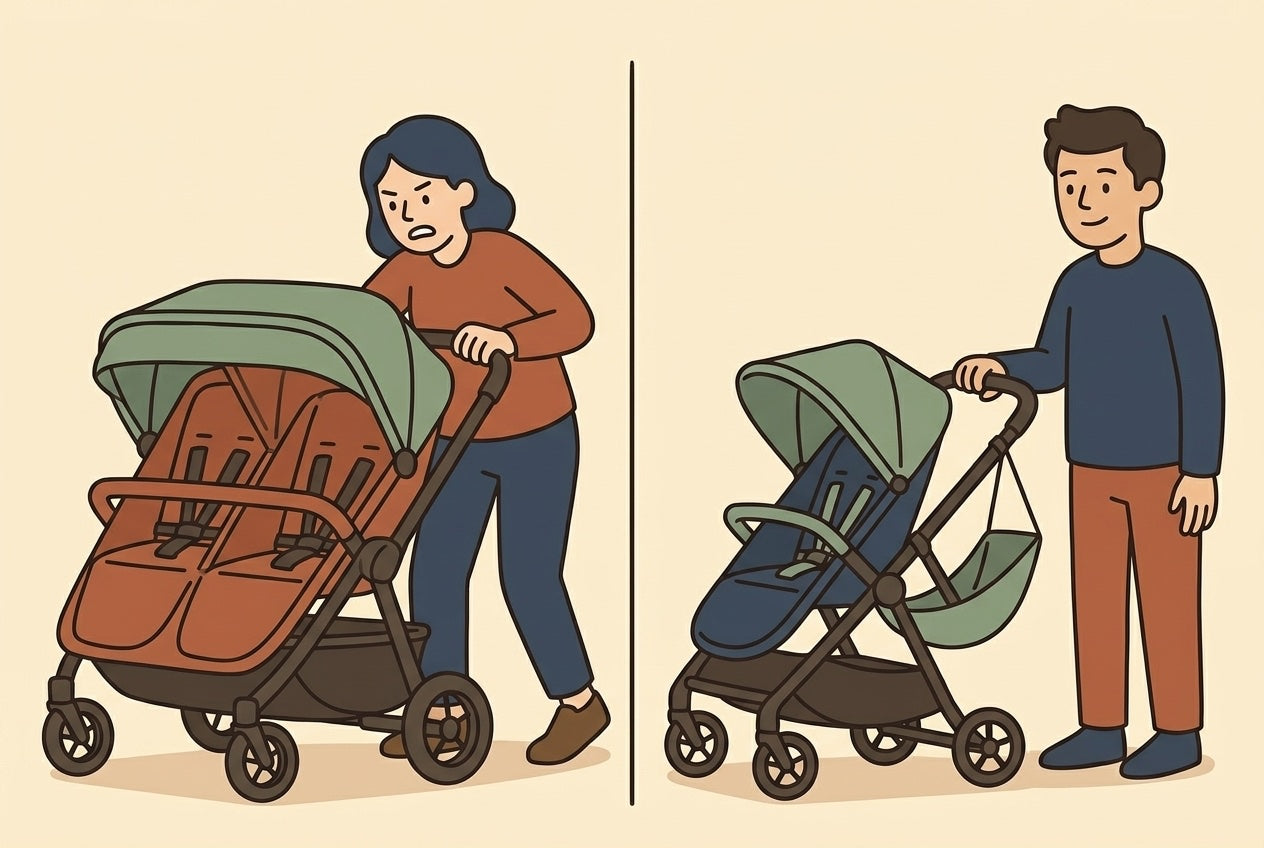
A double stroller can cost several times more than a hammock seat, takes up far more boot space, and often ends up gathering dust once the older child learns to walk confidently. If you're weighing up whether to buy a second stroller or find a smarter workaround, this comparison covers everything: price, storage, comfort, and the situations where each option genuinely makes sense.
Key Takeaways
A stroller hammock seat costs a fraction of a new double stroller — without sacrificing day-to-day practicality for most families.
Double strollers are bulkier, heavier, and harder to manoeuvre through shops, lifts, and narrow doors.
A hammock seat turns your existing stroller into a smart tandem solution — no new frame to buy, store, or push.
Hoppie is designed for children from around 18 months to 5 years old, up to 20 kg / 44 lbs.
A double stroller still wins in a small number of specific situations — twins, and very long daily walks with two young children who both need a seat all day.
Price, weight, and storage compared
Most parents asking this question already have a stroller they like. The real question is whether the extra expense — and the extra bulk — of a double stroller is worth it for how they actually live. Let's look at the numbers side by side.
Average price range of each
Double strollers sit at one of the most expensive points in the baby-gear market. Entry-level tandem or side-by-side doubles start at around €300–400, but the models most parents actually want — the ones with a proper recline for the younger child, a decent canopy, and a frame that doesn't wobble — tend to cost €600 to well over €1,000. Add a second set of accessories (footmuff, rain cover, cup holder) and the total climbs further.
A stroller hammock seat sits at a completely different price point. Instead of buying a new stroller, you're adding a compact accessory to the one you already own. The saving can run into hundreds of euros depending on which double you were considering — money that stays in your pocket, or goes toward something your family actually uses every week.
For parents who already love their stroller and don't want to replace it, the cost argument alone is often decisive.
Folded volume and boot space
Double strollers are large. Even the most compact tandem models are noticeably deeper and wider than a single stroller. Side-by-side doubles are wider still — often too wide for standard shop doorways, restaurant aisles, and some lifts. Folded, most doubles take up the majority of a standard car boot, leaving little room for a pushchair bag, a changing bag, or anything else you'd normally carry.
A hammock seat folds flat when removed and fits into a small tote bag. Your stroller folds exactly as it always did. The boot space situation doesn't change. The pavement-width situation doesn't change. You keep the stroller you already know how to fold one-handed in the rain.
This matters more than it sounds on paper. A stroller that fits through a café door without a second thought, that slides into a standard lift without asking another passenger to wait, and that fits in the boot alongside the weekly shop — that's the stroller you actually use every day.
Daily weight to push
Double strollers are heavier than singles — sometimes significantly so. A double frame, two seats, and two sets of harness hardware add up. If you're navigating kerbs, stairs, escalators, and uneven pavements daily, that extra weight is something you feel by lunchtime.
A hammock seat adds the weight of your older child to your existing stroller, but the frame you're pushing is still the same compact single you started with. The total load increases, but the pushing experience — manoeuvrability, kerb-stability ease, lift access — stays close to what you're used to.
Always check your stroller's total weight capacity before use, and make sure the combined weight of both children and any cargo stays within the manufacturer's rated limit.

Comfort and capacity
Price and storage are easy to compare. Comfort is more personal — and it depends on which child you're thinking about.
For the baby in the main seat
In a tandem double stroller, the younger child typically sits in the forward or lower position. Depending on the model, this can mean a slightly restricted view, less canopy coverage, or a seat that doesn't recline as fully as your existing single. In a side-by-side, both seats are equal — but the frame is wider.
With a hammock seat, your baby stays exactly where they always were — in the main seat of the stroller you chose for them. The recline, the canopy, the harness, the mattress — nothing changes. Your younger child's comfort is not a compromise in this setup.
For the toddler in the rear or second position
In a tandem double, the older child usually sits at the back. Depending on the stroller, this can feel slightly cramped for a child who's used to walking and having room to wriggle. Many double strollers designed with the older child at the rear don't have the same recline or legroom as the front seat.
A hammock seat gives the older child a supported, hammock-style perch at the rear — a compact seat that's designed for a child who walks most of the time and only needs to sit when tired. It's not a full reclining seat, and it's not meant to be. It's a comfortable resting spot for a child who's done enough walking for now but isn't ready to be carried.
Hoppie is designed for children from around 18 months to 5 years old, up to 20 kg / 44 lbs — which covers most of the years when a toddler occasionally needs a ride but doesn't need to sit down for the entire walk.
Long-walk endurance
For long days out — theme parks, airports, city holidays, full-day events — the question is how long both children need to be seated. If your older child is three or four years old and genuinely walks well for stretches, they may only need the hammock seat for twenty or thirty minutes at a time. That's exactly what it's built for.
If you're planning days where both children will need to be seated for the majority of the outing — long museum visits, very early mornings, full-day travel — a double stroller may offer more sustained comfort for the older child. That's an honest trade-off worth knowing.
For most everyday outings — the school run, the market, a weekend park visit, a shopping trip — a hammock seat handles the tired-toddler problem without any of the bulk.

When a double stroller is still the right call
This comparison isn't about saying one option is always better. There are situations where a double stroller is the right tool. Here's when to buy one.
Twin scenarios
If you have twins, or two children very close in age who both need full-time seating from day one, a double stroller is the obvious choice. A hammock seat is designed for an older child who walks independently and only needs to sit occasionally. It's not a replacement for a second full seat for a very young child or a non-walking toddler who needs to be seated for every step of every walk.
Daily walks of two or more hours with two young children
If your daily routine involves genuinely long walks — two hours or more, every day — and your older child is still young enough to need a seat for most of that time, a double stroller gives more sustained seated comfort. A hammock seat is best for a child who walks a good portion of the route and sits when their legs get tired. If the older child consistently needs to sit for the whole walk, a double seat may serve them better.
Resale potential
Quality double strollers from well-regarded manufacturers hold their value reasonably well on the second-hand market. If you're confident you'll sell it when your children outgrow it, the net cost after resale can be lower than the original purchase price suggests. It's worth factoring in if you're budget-conscious and plan ahead.
That said, a hammock seat has almost no net cost after use compared to a double stroller — the gap is simply much smaller to begin with.

Which one is right for your family?
Here's a simple way to think about it:
If you have twins, or two children under two who both need full seating all day — a double stroller is the right choice.
If your older child is 18 months to 5 years old, walks independently, and gets tired on longer outings — a hammock seat is likely all you need.
If you already own a stroller you love and don't want to replace it — a hammock seat lets you keep it.
If you live in a city and navigate shops, cafés, lifts, and narrow pavements — a compact hammock seat keeps your stroller the same width it's always been.
If you're travelling — airports, holidays, city breaks — a hammock seat packs flat and travels with you without a second frame to check in or haul through terminals.
Most parents with a walking toddler and a baby find that the double stroller is more stroller than they actually need. The hammock seat covers the tired-toddler problem — which is usually what triggered the search in the first place — without the cost, the bulk, or the learning curve of a new stroller.
Always follow Hoppie's installation instructions and check your stroller manufacturer's maximum load capacity before use. Hoppie should only be used with strollers that have a stable rear frame and enough rear clearance. Always supervise your child while using Hoppie.
FAQs
Is a stroller hammock a real alternative to a double stroller?
For most families with a baby and a walking toddler, yes. A hammock seat handles the situation where the older child is tired and needs to sit, without replacing the stroller you already have. It works for school runs, shopping, travel, and everyday walks. It's not a full-time seated solution for a very young child who can't walk yet — for that, a double stroller makes more sense.
How much does a typical double stroller cost?
Entry-level double strollers start at around €300–400, but most parents find the models they actually want — with proper reclining seats, good canopies, and a sturdy frame — cost €600 or more. Premium double strollers often exceed €1,000 before accessories. A hammock seat is a fraction of that cost and attaches to the stroller you already own.
Can a hammock seat replace a double stroller long-term?
It depends on your routine. For families where the older child walks independently most of the time and only needs occasional rests, a hammock seat works well for the full period from around 18 months to 5 years old. If your older child consistently needs full-time seating for every outing, a double stroller may serve you better over the long run.
Is a hammock seat lighter than a double stroller?
The stroller you're pushing with a hammock seat is still your existing single stroller — with your older child sitting at the rear. The total weight you're pushing increases with your child's weight, but the frame itself stays light and compact. A double stroller adds both a heavier frame and a second full seat. For most city parents, the pushing experience with a hammock seat is noticeably easier than with a double.
Will a hammock seat fit my stroller?
Hoppie is designed to fit most standard strollers with a rigid rear frame and enough rear clearance. It's not recommended for ultra-light umbrella strollers without a stable rear frame. The key things to check are your stroller's rear frame rigidity, rear clearance space, and total weight capacity. If you're unsure, send us a photo of your stroller and we'll help you check.
What do parents usually prefer — a double stroller or a hammock seat?
Parents who try a hammock seat after using or considering a double stroller often say the same thing: they hadn't realised how much of the double stroller's bulk they didn't need. For families where the older child genuinely walks most of the time, the hammock seat matches their actual routine far better. Parents of twins or very young pairs of children tend to stay with double strollers — the use case is different.
Does a hammock seat work for airports and travel?
Yes — and this is one of the strongest use cases. A hammock seat folds flat, fits in a bag, and travels with you without a second stroller frame to check in or haul through terminals. Your stroller stays the same compact size it's always been. For airports, holidays, and city breaks with young children, it's a practical travel-friendly solution that a double stroller can't match.
When is a double stroller definitely the better choice?
If you have twins, two children who are both too young to walk independently, or a routine that requires both children to be fully seated for the entire duration of every walk, a double stroller is the right tool. A hammock seat is designed for a child who walks most of the time and needs a seat when tired — not for full-time seating of two very young children at the same time.
If you already own a stroller you love, Hoppie can save you hundreds
You don't need a new stroller. You need a smarter solution for the days your toddler's legs give out halfway through the park. Hoppie attaches to the back of your existing stroller, gives your older child a comfortable place to rest, and keeps your setup compact enough to fit through every door you already walk through.
Hoppie is designed for children from around 18 months to 5 years old, up to 20 kg / 44 lbs. It's a practical double stroller alternative for parents who love their stroller and don't want to replace it.
Keep the stroller you love. Add a second seat when you need it.
Disclaimer: Hoppie is an independent product and is not affiliated with, endorsed by, sponsored by, or approved by any stroller brand. Always follow Hoppie's installation instructions and check your stroller manufacturer's maximum load capacity before use. Hoppie is designed for children from around 18 months to 5 years old, up to 20 kg / 44 lbs, and should only be used with strollers that have a stable rear frame and enough rear clearance.


