

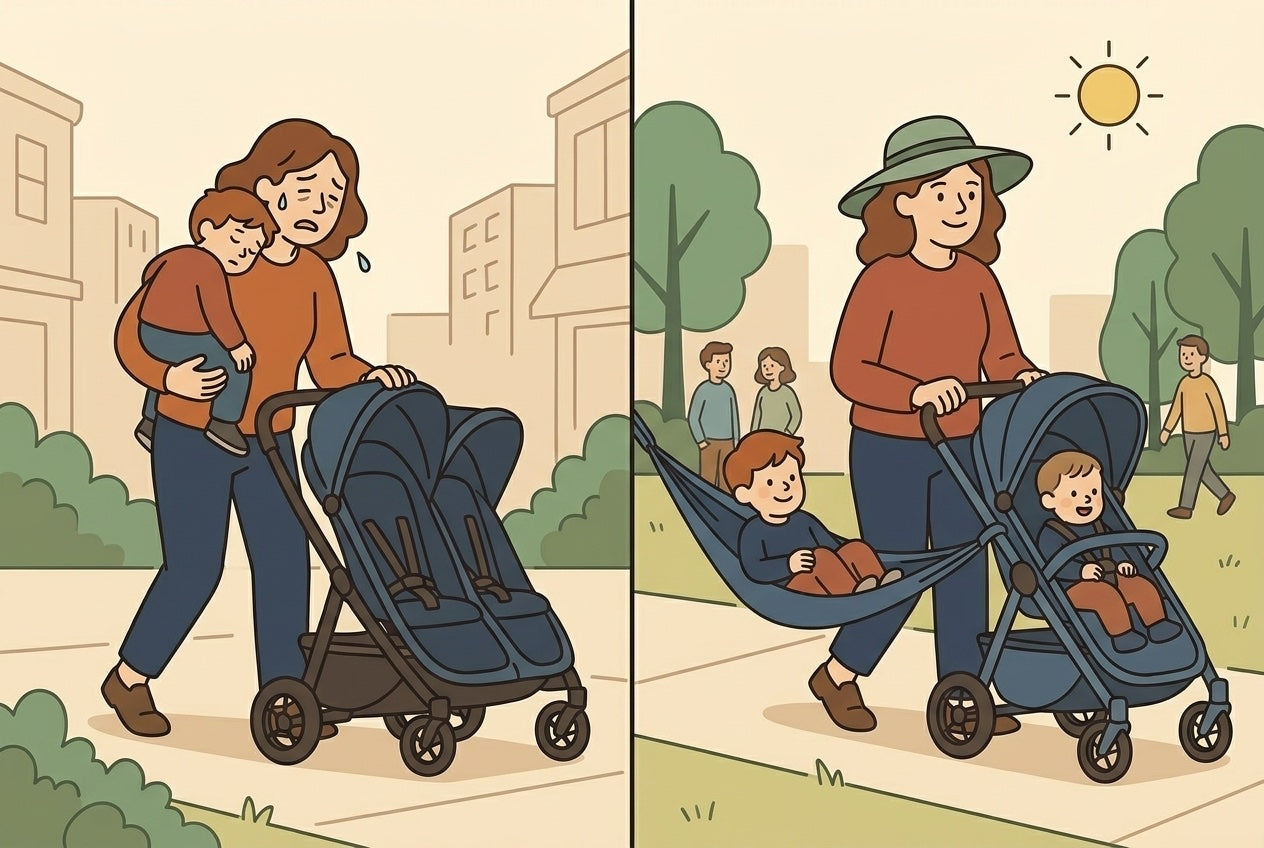
Your toddler is done walking. You can see it before they even say anything — the slowing pace, the dragging feet, the arms reaching up. So you pick them up. That's fine for a few minutes. But somewhere between the car park and the café, your back starts complaining too.
Carrying a tired toddler is one of those parenting moves that feels instinctive but gets harder fast. There are three realistic options when your child runs out of steam mid-walk: carry them, find somewhere to sit and wait, or have a second seat ready on the stroller. This article looks honestly at all three — and at when a hammock seat makes the most sense as a practical upgrade.
Key Takeaways
Carrying a toddler is natural and fine for short stretches — but weight, time, and pace stack up quickly on your body.
Most parents find carrying becomes genuinely uncomfortable within 10–15 minutes, especially while also managing a stroller.
A stroller hammock seat gives your tired toddler a place to rest without adding bulk or replacing the stroller you already use.
Hoppie is designed for children from around 18 months to 5 years old, up to 20 kg / 44 lbs.
Neither carrying nor a hammock seat is the "right answer" for every situation — but knowing the trade-offs helps you pick the right one.
Why carrying gets hard fast
Nobody decides to carry a toddler for 30 minutes. It usually starts as a quick lift — just to get past the next stretch of pavement — and then somehow you're still holding them outside the supermarket, one-handed, while trying to steer a stroller with the other.
The problem isn't the moment you pick them up. The problem is what happens to your body in the minutes that follow.
Weight × time × pace
A two-year-old typically weighs somewhere between 11 and 14 kg. A four-year-old is often 15–17 kg. These aren't heavy in the way a suitcase is heavy — but they're warm, wriggly, and they don't sit in a neutral position. They lean back, they shift, they grip around your neck or your hip. Every small movement changes your centre of gravity.
Carry a 14 kg toddler on your hip for five minutes at a walking pace and it's manageable. Add another ten minutes, and a heavier bag on the other shoulder, and a baby in a stroller to navigate — and the maths turns against you quickly. Your lower back starts rotating to compensate. Your hip flexors on the carrying side tighten. Your opposite shoulder drops.
The pace matters too. A slow shuffle while the toddler dangles is harder than walking purposefully, because you're holding a semi-static load rather than shifting it with movement. Ironically, the moments when you most want to stop — outside a café, in a queue, at a pedestrian crossing — are when carrying is most tiring.
The back-pain reality
Back pain from carrying children is one of the most common physical complaints among parents of toddlers. It's not a dramatic injury — it's usually a slow accumulation of asymmetric load, repeated daily across months and years. Holding a child on one hip rotates your pelvis and compresses the lumbar discs on one side. Do that for long enough and it stops being a minor ache and starts being a real problem.
This isn't a reason to never carry your child. It's a reason to carry them strategically — for short distances, when it genuinely makes sense — rather than by default whenever they stop walking.
The honest truth is that many parents don't have a good alternative. When your toddler refuses to walk and there's no room in the stroller, carrying is the only option left. That's the gap a hammock seat fills.

A hammock seat as the practical upgrade
A stroller hammock seat attaches to the back of the stroller your older child refuses to ride in — because they're too old for that, apparently — and gives them somewhere to sit when tired little legs give up. It doesn't replace the main seat. It doesn't make the stroller wider. It just adds a secondary perch at the rear, held by straps on the frame.
For most parents, the appeal is simple: you're already pushing the stroller anyway. Adding a seat to the back costs you nothing in effort — your hands are already on the handle bar, your pace is already set. The toddler sits, rests, and you keep moving.
When it makes sense
A hammock seat works best in the situations where carrying stops being realistic:
Long walks — school runs, shopping trips, park visits that go on longer than expected. Your toddler walks as far as they can, then climbs into the seat for the last stretch home.
Airports and travel days — lots of distance to cover, often in a hurry, with bags and a baby and no patience left for "carry me."
Days when you're already tired — because your back has its own limit, and it has nothing to do with how much you love your child.
When the toddler won't stay in a carrier — some children go through a phase of refusing to be worn, but are perfectly happy sitting at the back of the stroller watching the world go past.
The other benefit parents often mention is that the toddler stays involved in the walk. Sitting in a hammock seat at the rear of the stroller is an experience in itself — they're at a different height, facing the direction of travel, seeing things they don't see from the main seat or from being carried. It's often enough novelty to keep them happy while you cover the distance you need to cover.
Hoppie is designed for children from around 18 months to 5 years old, up to 20 kg / 44 lbs. Always follow Hoppie's installation instructions and check your stroller manufacturer's maximum load capacity before use.

The honest limits
A hammock seat is not a replacement for everything. Here's where it doesn't help:
When the toddler is asleep — a hammock seat is for a child who is tired but awake and able to hold themselves upright. It's not designed for sleeping, and it's not a substitute for a fully reclined stroller seat if your child needs to nap on the go.
When the child is upset — if your toddler is mid-meltdown and wants arms only, a seat at the back of the stroller is not going to help. Sometimes carrying is the only answer, and that's fine.
When the stroller doesn't have a stable rear frame — Hoppie is designed to fit most standard strollers with a rigid rear frame. It is not recommended for ultra-light umbrella strollers without a stable rear frame. If you're unsure whether your stroller works, send us a photo and we'll help you check.
For very short trips — if you're walking 200 metres, carrying is probably fine and faster than installing a seat. The hammock seat comes into its own on real outings, not door-to-door trips.
Hoppie should only be used with strollers that have a stable rear frame and enough rear clearance. Always supervise your child while using Hoppie.
How to think about the trade-offs
Neither carrying nor a hammock seat is the answer to every situation. The useful question is: what does your daily routine actually look like?
If you do short trips with one child and rarely cover more than 15 minutes on foot, carrying is probably fine. Your back will cope and the problem doesn't come up often enough to need a solution.
If you do long walks regularly — school run, market, park, weekend days out — and you're managing a baby in the stroller at the same time, carrying your older child for any meaningful stretch becomes physically unsustainable. That's not a parenting setup issue. It's physics.
The hammock seat makes the most sense when:
You're regularly covering real distances with two children.
Your older child still tires before you reach your destination.
Carrying is adding up on your back over days and weeks.
You don't want to buy a double stroller for a phase that'll pass.
It's a practical alternative — not a shortcut, not a miracle product, just a smarter option for parents who are already walking and already pushing a stroller.

What about a baby carrier?
Baby carriers are a great option — especially for the younger or smaller child. But most carriers are designed for infants and younger toddlers. Once your child is past two or three years old and heading toward 15–17 kg, even a well-designed soft-structured carrier puts significant load on your lower back and shoulders. Many parents find they use a carrier through the baby phase and then need something different once the older child grows out of it.
A hammock seat picks up roughly where a carrier leaves off — for the walking toddler who still has moments of needing a rest, rather than the baby who needs to be worn all day.
Comfort for the child
One objection parents raise is whether a hammock seat is actually comfortable for the toddler. It's a fair question. The honest answer is: it depends on how long they're in it and what they're doing.
A hammock seat is designed for resting, not extended sitting. Most children use it for 10–20 minute stretches at a time — enough to recover their energy for the next walking phase, or to get from the park back to the car. It's not designed as an all-day seat. For the purpose it's built for, most children find it comfortable enough that they ask to use it again.
The seated position in a rear hammock is slightly reclined and supported on both sides, which is naturally comfortable for a tired child. It's different from a stroller seat and different from being carried — but it works well as a rest stop during a longer day out.
FAQs
How long can I carry my toddler before it becomes a problem?
There's no universal answer — it depends on your build, your child's weight, and what else you're carrying. Most parents find that 5–10 minutes on one hip is manageable, but anything beyond that starts to strain the lower back and the hip flexors on the carrying side. If you're carrying regularly across a full day, the cumulative load adds up even if each individual stretch feels fine.
Is a stroller hammock seat easier than carrying?
For most parents, yes — provided you're already pushing a stroller. Adding your older child to a hammock seat at the back adds no physical effort beyond your usual walking pace. Carrying adds weight, changes your posture, and usually means steering the stroller one-handed. On any walk longer than a few minutes, the hammock seat is noticeably easier.
Does carrying a toddler hurt your back?
It can, especially with repeated or extended carrying over time. The most common issue is hip-carrying posture, which rotates the pelvis and places asymmetric load on the lumbar spine. Short, balanced carries are generally fine. Daily long-duration carrying of a heavy toddler — especially while managing a stroller at the same time — is one of the more common causes of parental lower-back pain in the toddler years.
When should I switch from carrying to a hammock seat?
When carrying regularly starts to hurt, or when you find yourself dreading the moment your toddler stops walking, that's a practical signal that you need a different tool. A hammock seat is designed for children from around 18 months to 5 years old, up to 20 kg / 44 lbs — so if your child is in that range and you're already pushing a stroller, it's worth trying as an alternative.
Is a hammock seat safe for a tired toddler?
Yes, when used correctly on a compatible stroller. Hoppie is designed for everyday family use and designed for stability and comfort on strollers with a rigid rear frame. Always supervise your child while they're using the seat, and follow the installation instructions. It is not recommended for sleeping children who cannot hold themselves upright.
Can I use a hammock seat instead of a double stroller?
For many families, yes — it's a practical alternative that keeps your existing stroller rather than replacing it. A hammock seat doesn't add width, costs significantly less than a double stroller, and works for the phase when your older child mostly walks but still needs an occasional rest. It's not a full replacement if both children need to sit for the whole outing — but for everyday use, many parents find it covers their needs completely.
What if my toddler is too heavy for the hammock seat?
Hoppie supports children up to 20 kg / 44 lbs. If your child is above this weight, the hammock seat should not be used. Most children reach this weight around their fifth birthday, though growth varies. At that stage, your child is also likely able to walk the distances that previously needed a rest solution.
Will my stroller work with a hammock seat?
Hoppie is designed to fit most standard strollers with a rigid rear frame and enough rear clearance. It is not recommended for ultra-light umbrella strollers without a stable rear frame. If you're not sure whether your stroller is compatible, send us a photo and we'll help you check.
Hoppie saves your back when carrying stops being realistic
Carrying your toddler is one of those things you do without thinking — until the day it starts costing you. If you're doing long walks regularly with two young children, a hammock seat at the back of your existing stroller is the most practical upgrade you can make.
You don't need a new stroller. You don't need a carrier that doesn't fit anymore. You need a second seat that goes where you go, takes up no extra space, and gives tired little legs somewhere to rest.
Hoppie is for parents who love their stroller but need a smart second seat. Designed for children from around 18 months to 5 years old, up to 20 kg / 44 lbs.
Disclaimer: Hoppie is an independent product and is not affiliated with, endorsed by, sponsored by, or approved by any stroller brand. Always follow Hoppie's installation instructions and check your stroller manufacturer's maximum load capacity before use. Always supervise your child while using Hoppie.


