

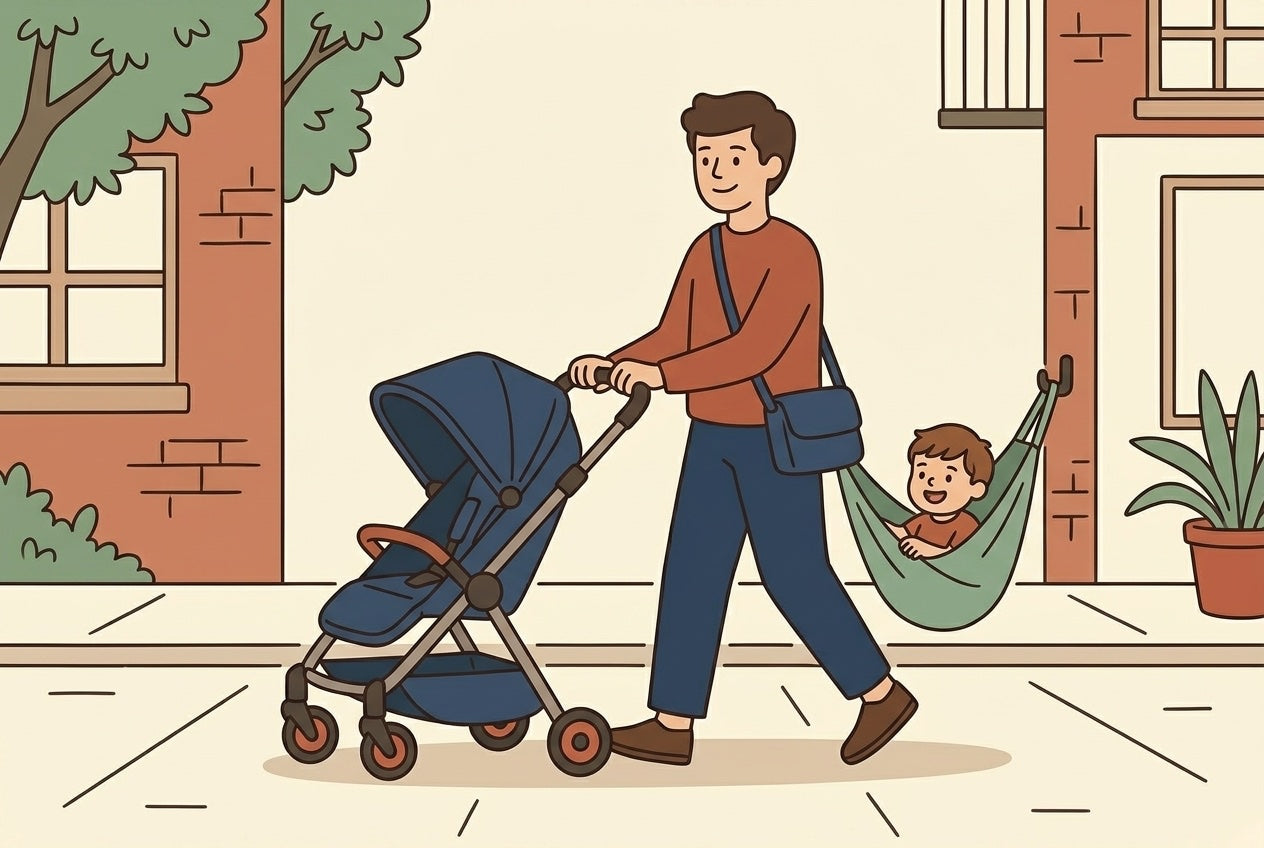
Many parents with a compact city stroller — a Babyzen YOYO or one of the many strollers built on the same kind of frame — wonder whether they can add a second seat for an older child who's run out of steam. The good news: yes, you can. The YOYO is one of the most popular strollers we see Hoppie on, and it works in every version. There is one rule to know before you order, and it's about the configuration of your stroller, not its size or weight. This guide explains that rule, walks through the setups parents try most often, and covers the few compact strollers where a hammock seat genuinely isn't the right answer.
Hoppie is an independent accessory and is not affiliated with, endorsed by, sponsored by, or approved by any stroller brand. Brand names, when mentioned, are used only to help parents understand compatibility.
Key Takeaways
- The Babyzen YOYO is compatible with Hoppie in every version: YOYO, YOYO², YOYO 6+, YOYO Connect, YOYO Riviera, and the Stokke YOYO³.
- Hoppie fits the YOYO with the child seat (6+ pack). It isn't designed for use with the YOYO carrycot, bassinet or 0+ newborn pack.
- Strollers built on the same tubular frame as the YOYO work with Hoppie too. Only true umbrella strollers, with thin tubes and a fabric-back seat, are unsuitable.
- Hoppie is designed for children from around 18 months to 5 years old, up to 20 kg / 44 lbs, and is always used with a child seated in the main stroller seat.
- If you're unsure, tell us the exact brand and model of your stroller and we'll confirm whether Hoppie fits.
Does a hammock seat fit a Babyzen YOYO? Yes
You love your compact stroller. It folds small, fits in the overhead bin, and navigates a busy coffee queue without drama. The last thing you want is to replace it just because your older child's legs are tired again. A hammock seat attached to the rear gives that stroller a second seat without giving up its compact footprint, and on a YOYO that's exactly what Hoppie does.
Compact doesn't mean flimsy. The YOYO is built around a rigid tubular aluminium frame with a proper handlebar and a solid lower frame on each side of the rear wheels. Those are the two things Hoppie attaches to, and they're the same on a first-generation YOYO, a YOYO², a YOYO 6+, a YOYO Connect or the current Stokke YOYO³. There is no YOYO generation that is excluded, and no version that needs a special test before you order.
The same goes for the strollers that copy the YOYO's design. Plenty of brands sell a cabin-size stroller with the same rear bar, the same compact fold and the same tubular frame. If your stroller looks like a YOYO from behind, it works like one as far as Hoppie is concerned. Judge the frame, not the brand or the price tag.
The one rule: child seat, not carrycot
Hoppie hangs behind the main seat of the stroller, and the child in it sits facing forward, with the back of the main seat in front of them. For that to work, the main seat has to be the YOYO's child seat, the 6+ configuration, with your younger child sitting in it.
The YOYO carrycot, bassinet and 0+ newborn pack are a different story. They fill the rear space that Hoppie needs, and a newborn lying flat isn't the setup Hoppie is designed around. So the rule is simple:
- YOYO with the child seat (6+ pack): compatible with Hoppie.
- YOYO with the carrycot, bassinet or 0+ newborn pack: not compatible. Wait until your younger child moves to the child seat.
In practice, most families reach that point around the time the older sibling is 18 months or more and the younger one has graduated to the seat, which is exactly when a second seat starts to matter. Hoppie must always be used with a child seated in the main stroller seat. It's a second seat, never a replacement for the first one.
What to check before you order
There's no rigidity test to run on a YOYO. The frame is fine. What's worth checking is your own setup, and it only takes a moment.
Your configuration
Is your YOYO currently set up with the child seat? If yes, you're ready. If it still has the carrycot or newborn pack on it, Hoppie isn't the right accessory yet.
Total load
Every stroller has a maximum total load, printed in the manual or on a label near the rear wheels. That figure covers everything on the stroller: your younger child in the main seat, the basket contents, and your older child on the hammock seat. Add them up and stay within the YOYO's own rating. Hoppie's limit for the child in the seat is 20 kg / 44 lbs, and that is a firm limit.
Your children's ages
Hoppie is designed for children from around 18 months to 5 years old. The child in the main seat can be younger, since that's the stroller's own seat; the child on the hammock needs to sit up confidently on their own.
How Hoppie attaches to a YOYO
Hoppie is a suspended hammock seat, not a board. It attaches with four straps, each ending in a metal carabiner: two clip to the handlebar, and two clip to the lower frame on each side, near the rear wheels. Once the straps are tightened, the seat hangs behind the main seat and your child sits in it facing forward, held by a 3-point harness.
Installation takes under 30 seconds and needs no tools. The first time, you'll spend a moment finding the right strap length; after a couple of goes it's second nature. Because the weight of the child goes straight down between the four straps rather than pulling back on the handlebar, the stroller behaves just as it did before, with a child in the main seat as always.
The YOYO's basket doesn't get in the way. Hoppie's lower straps clip to the frame near the rear wheels, not to the basket, and you can still reach the basket from the side. The hammock hangs vertically behind the stroller, so the width stays exactly the same as your single stroller: the same café doors, the same lifts, the same train aisles.
One YOYO-specific habit: because it's a compact stroller, unclip Hoppie before folding. The four carabiners release in seconds, and the seat folds flat into its pouch.
Common configurations parents try

Once parents with compact city strollers start thinking about a second child, a few different setups come up again and again. Here's an honest look at each one.
YOYO + hammock seat
This is the most popular option among parents who want to keep their compact stroller. Hoppie attaches to the rear and the older child sits behind, feet off the ground, while the younger child rides up front in the child seat.
The main appeal is that the stroller keeps its original width. You're not pushing a double stroller that won't fit through a café door, and you're not carrying a second stroller through an airport. It works well on school runs, shopping trips and travel days, and it fits in the same overhead bin as the YOYO itself.
YOYO + babywearing
Some parents combine a compact stroller with a soft-structured carrier: the younger child in the stroller, the older child in the carrier on a parent's back. This works for short stretches, but most parents with a three- or four-year-old find it exhausting for anything longer than fifteen or twenty minutes. It's a good backup plan for stairs and crowded spaces, not an everyday solution.
The reverse setup, baby in the carrier and the older child on Hoppie with the main seat empty, is not how Hoppie is used. Hoppie is always used with a child seated in the main stroller seat.
YOYO + sibling board
A sibling board (or buggy board) is a flat platform that clips onto the rear of the stroller so the older child can stand and ride. Some parents prefer this because it gives the older child more independence; they can hop on and off as they like.
The trade-off is that boards extend the stroller's length noticeably, which makes tight spaces harder, and they require the child to stand and balance, which tires some toddlers out faster than sitting. For older, confident walkers, a board works well. For a genuinely tired toddler who wants to sit, a hammock seat is usually more restful.
When to skip a hammock seat on a compact stroller
A hammock seat isn't right for every compact stroller. The YOYO isn't one of the exceptions, but here are the situations where it's better to look at a different solution.
True umbrella strollers
An umbrella stroller is a different design from a YOYO, even if the two look similarly small when folded. Umbrella strollers have thin tubes, a seat made entirely of fabric with no structure behind it, two separate handles instead of a handlebar, and a fold that collapses like an umbrella. There's no stable rear frame for Hoppie's straps to work with, so Hoppie isn't suitable for them.
Don't confuse the two categories. Cabin-size city strollers like the YOYO, the Bugaboo Butterfly, the UPPAbaby Minu, the Cybex Melio or the Nuna TRVL are compact, but they're built on a rigid frame with a single handlebar, and they're among the strollers we see Hoppie on most often. Being light or folding small is not a reason to rule a stroller out.
When the carrycot or bassinet is on the frame
This is the real limitation on a YOYO, and on most compact strollers. With the carrycot, bassinet or newborn pack fitted, there's no room behind the main seat and no seated child in front of the hammock. Hoppie isn't designed for that configuration. Once your younger child moves to the child seat, you're ready.
In the meantime, your practical options are a soft-structured carrier for the older child on shorter outings, or simply waiting a few months. Hoppie packs flat, so it's an easy accessory to have ready for the day the configuration changes.
Hoppie and compact city strollers: the honest summary
Compact city strollers like the Babyzen YOYO are one of the most popular Hoppie setups. The frame is compatible, in every version of the YOYO and on the many strollers built the same way. The only thing that matters is the configuration: use Hoppie with the child seat, not the carrycot, and keep both children within the stroller's total load.
Do that, and your stroller keeps its width, your older child gets a seat when they're tired, and your daily walk gets a lot less stressful. Installation takes under 30 seconds, and unclipping before you fold takes even less.
Always follow Hoppie's installation instructions and check your stroller manufacturer's maximum load capacity before use. Always use Hoppie with a child seated in the main stroller seat, and always supervise your child while using Hoppie.
FAQ
Can I add a second seat to a Babyzen YOYO?
Yes. Hoppie is compatible with the Babyzen YOYO when you use it with the child seat (6+ pack). It isn't suitable with the newborn carrycot or bassinet, because that fills the rear space and Hoppie must always be used with a child seated in the main seat.
Does the YOYO have a rigid rear frame?
Yes. The YOYO's tubular aluminium frame, with its single handlebar and solid lower frame on each side, is rigid enough to carry Hoppie and a child of up to 20 kg / 44 lbs. That's true of every YOYO generation. Always stay within the YOYO's own maximum total load.
Is the YOYO safe with a stroller hammock?
Yes, used as intended: with the child seat fitted, a child seated in it, your older child within Hoppie's 20 kg / 44 lbs limit, the four straps tightened, and the total within the YOYO's rated load. Always follow Hoppie's installation instructions and supervise your child while using it.
What's the weight limit for a YOYO with Hoppie?
Two limits apply. Hoppie's own limit is 20 kg / 44 lbs for the child in the hammock seat, and it's a firm limit. The YOYO also has its own maximum total load, printed in the manual or on a label near the rear wheels, and that figure has to cover the child in the main seat, the child on the hammock and anything in the basket. Check your specific YOYO's manual for the exact figure.
How does a hammock seat compare to a sibling board on a compact stroller?
A hammock seat lets your older child sit, which is more restful for a genuinely tired toddler. A sibling board lets them stand and hop on and off, which works well for more independent older children. The main practical difference is that a board extends the stroller's length, while a hammock seat hangs behind the main seat and keeps the stroller's width unchanged. For tight spaces — café doors, lifts, busy trains — a hammock seat is generally more practical.
Can I use Hoppie with the YOYO carrycot or bassinet?
No. Hoppie is designed for use with the YOYO's child seat (6+ pack). With the carrycot, bassinet or 0+ newborn pack fitted, there's no room behind the main seat and Hoppie shouldn't be used. Once your younger child moves to the child seat, Hoppie fits.
Does Hoppie work on all Babyzen YOYO versions?
Yes: YOYO, YOYO², YOYO 6+, YOYO Connect, YOYO Riviera and the Stokke YOYO³ are all compatible, in the child-seat configuration only. Strollers built on the same frame as the YOYO are compatible too. Hoppie is an independent product and isn't affiliated with Babyzen or Stokke.
What should I do if I'm not sure my compact stroller is compatible?
Tell us the exact brand and model of your stroller, and which seat is currently fitted, and we'll confirm whether Hoppie fits. It's the fastest way to get a confident answer without guessing.
Keep the stroller you love — and give it a second seat
You don't need a bulky double stroller to handle two children on a school run, a shopping trip or a travel day. On a Babyzen YOYO with the child seat, Hoppie adds a practical second seat for children from around 18 months to 5 years old, up to 20 kg / 44 lbs — without changing the stroller's width or your daily routine.
Keep the stroller you love. Add a second seat when you need it.
Disclaimer: Hoppie is an independent product and is not affiliated with, endorsed by, sponsored by, or approved by any stroller brand mentioned in this article. Brand names are used only to indicate compatibility with certain stroller models. Always follow Hoppie's installation instructions and check your stroller manufacturer's maximum load capacity before use.


