

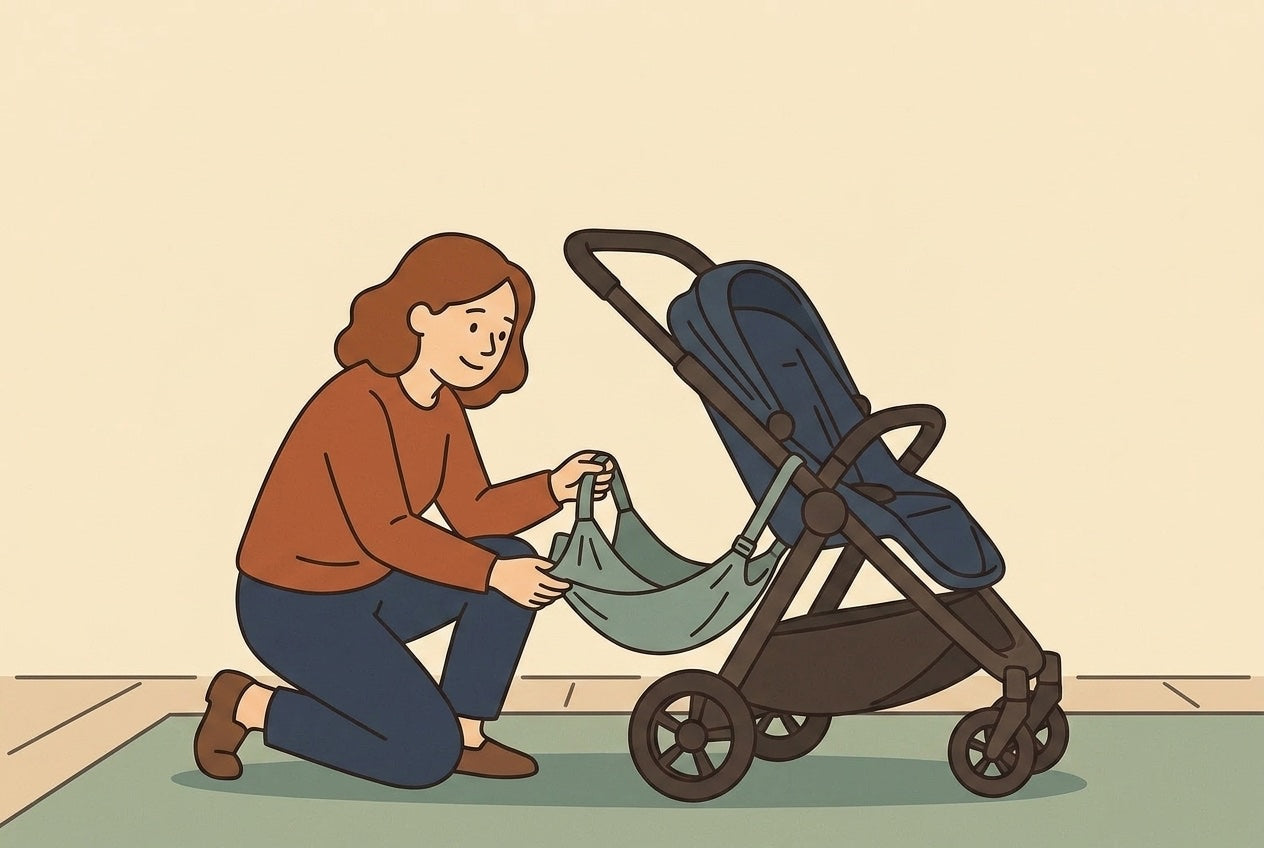
Hoppie is designed to fit most standard strollers with a stable rear frame. Before ordering, you can run a simple 60-second check using only your hands and your stroller's weight limit. This guide explains what to look for, which strollers usually work, and when another solution may be better.
Hoppie is an independent accessory and is not affiliated with, endorsed by, sponsored by, or approved by any stroller brand. Brand names, when mentioned, are used only to help parents understand potential compatibility.
Key Takeaways
Hoppie is designed to fit most standard strollers with a rigid rear frame.
Make sure there's a little clear space behind your stroller seat so the hammock can hang freely.
Hoppie is for children from around 18 months to 5 years old, up to 20 kg / 44 lbs.
Not recommended for ultra-light umbrella strollers without a stable rear frame.
If you're unsure, tell us the exact brand and model of your stroller and we'll confirm whether Hoppie fits.
Quick answer: what kind of stroller works with Hoppie?
You only need to check three things on your stroller:
A rigid rear frame.
Enough space behind the seat for the hammock to hang freely.
A total weight capacity that can handle your older child on top of your usual setup.
If your stroller has those three, Hoppie is usually a good fit. For very light or unusual stroller shapes, tell us the exact brand and model of your stroller and we'll confirm whether Hoppie fits before you order.
The 3 things your stroller needs
A stable rear frame
The rear of your stroller should feel solid. Press down on the rear handlebar with both hands — if the frame doesn't flex visibly or creak under pressure, it's a good sign. A stable rear frame helps the seat sit securely when Hoppie is correctly installed.
If the rear tubes bend, wobble, or feel soft, the stroller is probably too light for a hammock seat. That's most common on ultra-light umbrella strollers.
Enough rear space
Behind the stroller's main seat, you need room for the hammock seat itself plus your older child sitting in it. As a general guide, look at the space from the rear axle straight up: the hammock needs a little clear room there so it can hang freely.
The most common space-blocker is the basket. Many strollers have baskets that can be repositioned or removed in a few seconds — check yours before measuring.
Enough total weight capacity
Every stroller has a maximum total load printed in the manual or on a sticker near the rear wheels. The simple math:
Baby or toddler in the main seat
Bassinet or carrier weight, if used
Anything stored in the basket
Your older child on the hammock seat
The total must stay under your stroller's rated capacity. Most modern strollers are built according to strict safety standards, but compatibility with a rear hammock seat still depends on your stroller's exact frame, shape, and weight limit.

The 5-point compatibility check
If you have 60 seconds and your stroller nearby, here's the test that tells you whether to order Hoppie or look at another option.
Press down on the rear handlebar. Use both hands and about half your body weight. The frame should not flex visibly or creak. When you let go, the frame returns to its shape cleanly.
Check the rear clearance. Look straight up from the center of the rear axle. There should be a little clear space before you hit any obstacle — basket, canopy, or frame bar — so the hammock can hang freely.
Check the stroller's maximum load. Find the rating on the sticker near the rear wheels or in the manual. Subtract baby weight and basket contents — the remainder is the room you have for your older child on Hoppie.
Check whether the basket can be moved. Most baskets clip in or slide and can be repositioned in seconds. Fixed baskets that completely block the rear zone are worth checking with us first.
Look at the rear bar shape. Flat or gently curved horizontal bars hold straps reliably. Sharply angled or pinched bars don't.
If your stroller passes all five checks, Hoppie is likely to be a good fit. If you are unsure, tell us the exact brand and model of your stroller and we'll confirm whether Hoppie fits.

Which strollers usually work?
These categories tend to be compatible with Hoppie:
Standard single strollers with a metal rear frame and a real rear handlebar — the most common category and usually the easiest fit.
Full-size strollers and travel-system models, which generally have generous rear space and strong frames.
Reinforced lightweight strollers — newer compact-city models with thicker tubing despite the lightweight marketing.
Some three-wheel jogging strollers, when used at walking pace. The frame tends to be sturdy and the rear bar is usually flat.

Which strollers should you check more carefully?
Some stroller styles are worth checking more carefully before using Hoppie:
Ultra-light umbrella strollers with thin aluminum tubing and fabric-back seats. The frame typically flexes more than a hammock seat install needs.
Very compact travel strollers — judge the frame, not the size. Many cabin-size models (Babyzen YOYO, Bugaboo Butterfly, UPPAbaby Minu, Cybex Melio, Nuna TRVL) have a rigid frame and work well with Hoppie; only check more carefully if the rear frame feels soft.
Strollers with no rigid rear bar for the straps to grip.
Strollers with a fixed rear basket that fully blocks the rear zone.
Stroller wagons — they're built to be pulled, so there's no real rear frame for the seat to anchor on.
If your stroller is in one of these categories, tell us the exact brand and model and we'll confirm whether Hoppie is a good match.
Hoppie weight limit and age range
Hoppie is designed for children from around 18 months to 5 years old, up to 20 kg / 44 lbs.
The weight limit matters more than the age. Once your child reaches 20 kg / 44 lbs, Hoppie should no longer be used.
Hoppie is designed for children up to 20 kg / 44 lbs. Before use, always check both Hoppie's instructions and your stroller manufacturer's maximum load capacity.
What parents usually notice after installation
A few things consistently come up in parent reviews:
The first installation takes a little longer. Allow a moment the first time to read the instructions and double-check the strap routing. Once you know the setup, installation takes well under 30 seconds.
The straps should be tight. A correctly installed hammock seat sits taut against the rear frame, with very little slack. Loose straps let the seat shift under your child, which feels less stable and less comfortable.
The stroller keeps its original width. The hammock hangs vertically behind the stroller, not horizontally. Café doorways, mall queues, and elevator interiors that wouldn't accept a double stroller still fit your setup.
It's easier than expected in everyday life. School runs, shops, public transport, and travel days feel lighter compared with carrying a tired toddler or pushing a bulky double stroller.
Hoppie should only be used with strollers that have a stable rear frame and enough rear clearance. Always supervise your child while using Hoppie.
FAQs
Does Hoppie fit all strollers?
No. Hoppie is designed to fit most standard strollers with a rigid rear frame and enough rear space, but compatibility depends on your specific stroller's frame, shape, and weight limit. The 5-point check in this guide is the best way to know.
How do I know if my stroller has a rigid rear frame?
Press down on the rear handlebar with both hands and most of your body weight. If the frame doesn't flex visibly and doesn't creak, it's usually rigid enough. If it bends or wobbles, the stroller is probably too light for a hammock seat.
Can I use Hoppie with a foldable stroller?
Yes — most foldable strollers have a rigid frame when fully unfolded. Whether Hoppie needs to come off before folding depends on the model: on most compact strollers, remove it first to avoid straining the straps; on many standard strollers you can fold with it attached.
Can I use Hoppie with an umbrella stroller?
Hoppie is not recommended for ultra-light umbrella strollers without a reinforced rear frame. Some newer reinforced lightweight strollers do pass the 5-point check — run the test before assuming yours works.
What is the maximum weight for Hoppie?
Hoppie supports children up to 20 kg / 44 lbs. Always check your stroller's total load capacity in addition to Hoppie's rating.
Can I use Hoppie with a bassinet or carrycot?
Sometimes. Hoppie is designed mainly for strollers with a standard seat. Some strollers leave enough rear space with the carrycot installed, but others don't. The Babyzen YOYO, for example, works with Hoppie in its seat configuration only. Check the rear clearance with the bassinet in place before ordering.
Do I need to remove Hoppie before folding the stroller?
It depends on your stroller. On most compact strollers, remove Hoppie before folding to avoid straining the straps. On many standard strollers you can fold with it attached. Either way, unclipping takes only a few seconds.
What should I do if I'm not sure my stroller is compatible?
Tell us the exact brand and model of your stroller. We'll confirm whether Hoppie fits. It's the fastest way to know for sure.