

If you own a full-size travel-system stroller and a second child is on the way — or already here — you're probably wondering what your options are. The good news is that strollers in this category tend to have very strong, rigid rear frames. That makes them some of the best candidates for a compact second seat. This guide walks through the three main options, how they compare in cost and practicality, and what to check before you order anything.
Hoppie is an independent accessory and is not affiliated with, endorsed by, sponsored by, or approved by any stroller brand. Brand names, when mentioned, are used only to help parents understand potential compatibility.
Key Takeaways
Full-size travel-system strollers typically have a very strong rear frame — a major advantage for adding a second seat.
There are three main second-child options: a first-party rumble seat, a kiddyboard, or a hammock seat.
First-party rumble seats are brand-specific and tend to be the most expensive option.
A hammock seat like Hoppie is a compact, lower-cost alternative designed for children from around 18 months to 5 years old, up to 20 kg / 44 lbs.
If you're unsure whether your specific model is a good fit, tell us the exact model and we'll confirm whether Hoppie fits.
Why travel-system strollers handle second seats so well
Not every stroller is ready for a second child. Ultra-light umbrella strollers with fabric-back frames often lack the structural backbone needed for an add-on seat. Full-size travel-system strollers are a different story. They're built to handle weight, accessories, and real daily use — and their rear frames tend to reflect that.
The rear frame
Travel-system strollers like Uppababy's Vista or Cruz models are built around thick aluminum tubing that runs continuously from the rear axle up to the handlebar. Press down on the rear bar with both hands and most of your body weight — the frame should stay firmly in place. No flex, no creak, no sag. That's the baseline test for any stroller that's going to carry a second child at the back.
This rigidity isn't an accident. Travel-system strollers are designed to work with infant car seat adapters, bassinets, and additional accessories — all of which add weight and load to the frame. The engineering is already there. You're not asking the stroller to do something it wasn't designed for.
That said, every stroller is slightly different. Always check your specific model's maximum total load capacity — it's usually printed in the manual or on a sticker near the rear wheels. The total weight of your baby, your basket contents, and your older child all count toward that number.
Wheelbase and stability
Travel-system strollers also tend to have a wider wheelbase than compact models. That matters when you're adding weight to the rear. A wider wheelbase spreads that load more evenly. Either way, a child in a hammock seat loads the frame downward, not backward — unlike a heavy bag hung on the handlebar — so Hoppie doesn't unbalance the stroller.
This doesn't mean any travel-system stroller handles a rear seat automatically — you still need to check clearance behind the main seat and confirm the total weight stays within limits. But as a starting point, the architecture is favorable.
Most strollers in this category also have a real, continuous rear handlebar rather than two separate push handles. That matters because a hammock seat's straps need something solid and horizontal to anchor onto. A single rear bar is easier to work with than a split or fabric-handled design.

The 3 second-child options for travel-system stroller owners
Once you've confirmed your stroller's frame is solid, you have three realistic options for adding a second child to your setup. Each one works differently, costs differently, and suits a different kind of parent routine.
Option 1: First-party rumble seat
Some full-size strollers — including certain Uppababy models — offer a brand-specific second seat, sometimes called a rumble seat. On the Vista, for example, Uppababy sells a second seat unit that attaches to a specific slot on the frame and allows a second child to sit facing forward or rearward.
The appeal here is seamless integration. Everything is designed to work together, the fit is exact, and you get a full seat with a harness. The trade-off is significant cost — brand-specific second seats typically add a substantial amount to the original stroller purchase price, which is already high. You're also increasing the overall size of the stroller considerably, which makes navigation in tight spaces — café doorways, supermarket aisles, public transport — noticeably harder.
A first-party rumble seat makes most sense if you have two children close in age, both of whom regularly need to be seated at the same time, and space isn't a concern on your typical routes.
Option 2: Kiddyboard (ride-on board)
A kiddyboard — sometimes called a buggy board or ride-on board — attaches to the rear of the stroller and gives your older child a small platform to stand on while you push. Some models include a seat so the child can sit if they want to.
Boards are generally less expensive than first-party rumble seats, and they keep your stroller footprint relatively compact. The limitation is that they require your child to hold on and stand or perch — not ideal for a genuinely tired toddler who wants to be properly seated and contained. Boards also add length to the stroller, which can make tight turns in shops or crowded spaces more awkward than it might initially seem.
Compatibility with travel-system strollers varies by board brand and model. Always check whether the board is designed to work with your specific stroller before ordering.
Option 3: Hammock seat
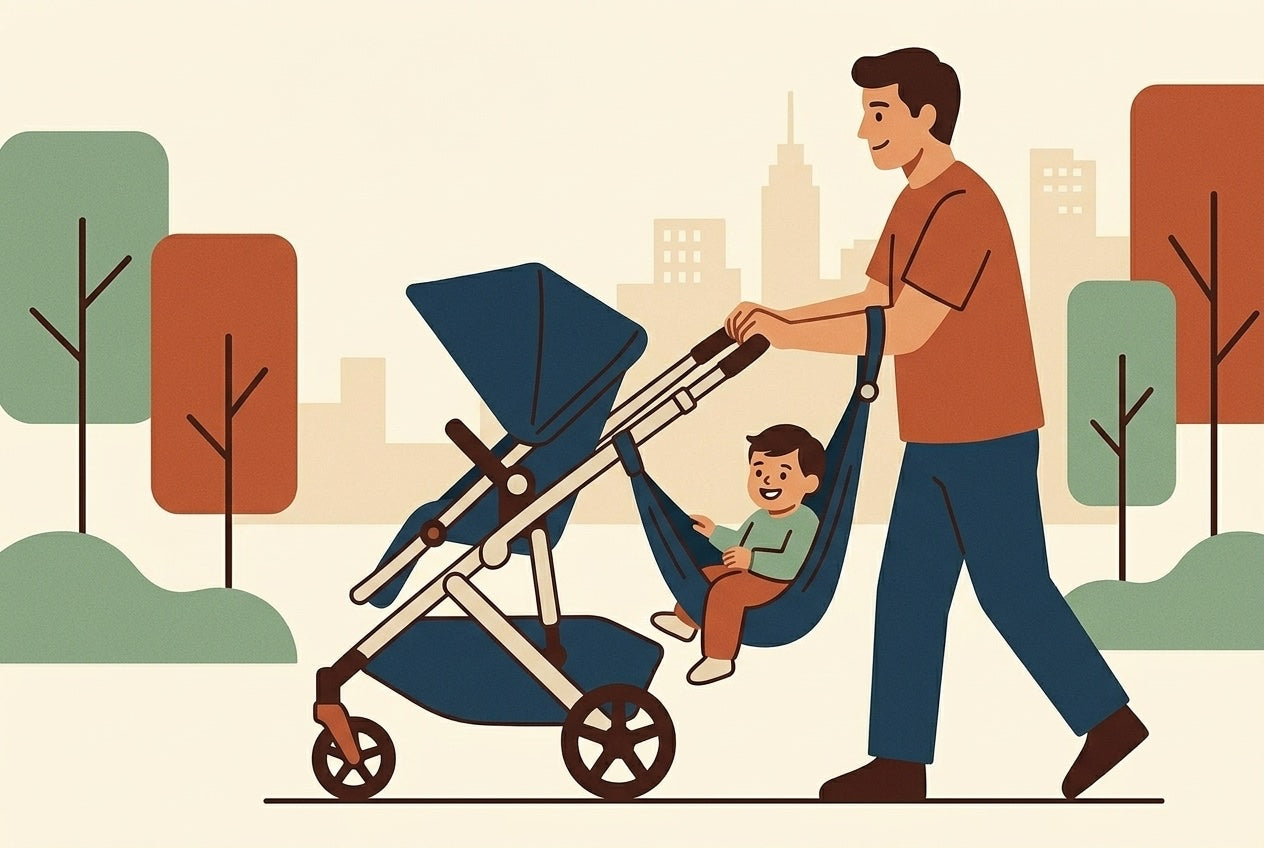
A hammock seat like Hoppie attaches to the rear frame of your stroller and gives your older child a proper seated position — suspended like a hammock between the rear bar and the underframe. It folds away compactly, keeps the stroller's original width, and fits through any space that your single stroller already navigates.
Hoppie is designed for children from around 18 months to 5 years old, up to 20 kg / 44 lbs. It installs without tools in a matter of seconds — four straps with metal clips — so it's practical for daily school runs, weekend trips, and travel days.
The key difference from a rumble seat is that the child sits in a hammock with a 3-point harness rather than a full stroller seat. That works well for short and medium distances — a toddler who's walked too far and just needs to rest their legs is the sweet spot. It's not designed as an all-day seat for a baby. It's designed for the older child who mostly walks but sometimes doesn't want to anymore.
For parents who love their travel-system stroller, don't want to add bulk, and are looking for a practical day-to-day backup seat, a hammock seat is a strong option.
If you're unsure whether your specific Uppababy model is a good fit, tell us the exact model and we'll confirm whether Hoppie fits.

Cost comparison: what are you actually paying for?
Budget matters here — especially because you've already made a significant investment in a premium stroller. Here's a plain-language look at the cost picture across the three options.
First-party rumble seat cost
Brand-specific second seats for full-size travel-system strollers tend to sit at the top end of the accessory price range. They're engineered specifically for that stroller model, which means the design and testing cost is priced in. If you bought your stroller new, adding a rumble seat can bring your total spend well above what most parents expect from a "stroller upgrade."
This option is worth considering if your two children will regularly both need a proper seat at the same time — the youngest not yet walking, the oldest not yet reliably walking far. If that's your situation, the brand-native fit and the full harness seat may justify the cost.
If your older child mostly walks and only occasionally needs a rest, it's harder to justify the price. You'd be paying for a full second seat that spends most of its time unused.
Hammock seat cost
A hammock seat is significantly less expensive than a first-party rumble seat. You're paying for a compact, practical accessory — not a full second-seat system with frame integration. The trade-off in features is real, but so is the price difference.
For parents whose older child still has good walking stamina most of the time and just needs a backup seat for tired moments, that trade-off makes practical sense. You're not buying a seat your child will use every minute. You're buying a seat for the moments when you need it.
Hoppie is a practical alternative to a double stroller — and to a first-party second seat — for parents who don't need a full tandem setup every day.
Keep the stroller you love. Add a second seat when you need it.
Always follow Hoppie's installation instructions and check your stroller manufacturer's maximum load capacity before use. Always supervise your child while using Hoppie.

FAQ
Can I add a hammock seat to an Uppababy stroller?
Many Uppababy models — including the Vista and Cruz — have a rigid aluminum rear frame and a continuous rear handlebar, which are the key conditions for a hammock seat. Compatibility still depends on your specific model's rear clearance and total weight capacity. Run the frame check described above, and if you're unsure, tell us the exact model and we'll confirm whether Hoppie fits.
What is an Uppababy rumble seat?
Uppababy offers a brand-specific second seat accessory — sometimes called a rumble seat — for select models like the Vista. It attaches to a dedicated slot on the stroller frame and gives a second child a full harnessed seat. It's the most integrated option for two children on the same stroller, but it comes at a higher cost and increases the stroller's overall size significantly.
Is a hammock seat cheaper than a rumble seat?
Yes. A hammock seat like Hoppie is noticeably less expensive than a first-party brand rumble seat. The functionality is also different — a hammock seat is a compact backup option for a tired toddler, not a permanent full stroller seat. For parents whose older child mostly walks and occasionally needs a rest, the lower cost and compact form factor often make more sense.
Does a hammock seat work with all Uppababy models?
Not automatically. Hoppie is designed to fit most standard strollers with a stable, rigid rear frame — and many Uppababy models qualify. But compatibility depends on the specific model's rear clearance, frame geometry, and total load capacity. Some Uppababy configurations include large baskets or accessories that reduce rear clearance. Always check your specific setup before ordering, and if you're not sure, tell us the exact model and we'll confirm whether Hoppie fits.
What age and weight is Hoppie designed for?
Hoppie is designed for children from around 18 months to 5 years old, up to 20 kg / 44 lbs. The weight limit matters more than the age — once your child reaches 20 kg, it's time to move on from the hammock seat regardless of age.
Can I still use my Uppababy bassinet with a hammock seat attached?
Hoppie is designed mainly for strollers used with the toddler seat. With a bassinet fitted, it can work only if there's still enough space behind for your older child's legs — check the rear clearance with the bassinet in place before ordering.
Do I need to remove the hammock seat before folding?
It depends on the model. On a full-size stroller like the Vista or Cruz you can usually fold with Hoppie attached; on most compact strollers, remove it first. If in doubt, take it off — it only takes a few seconds and protects both the straps and your stroller's frame.
What if my Uppababy basket is in the way?
Many Uppababy baskets can be repositioned or partially emptied to free up rear clearance. Before measuring rear space, reposition or remove the basket if possible. If the basket is fixed in a position that fully blocks the rear zone, tell us the exact model and we'll confirm whether there's a workable setup.
Hoppie: the compact second seat for parents who love their stroller
You already invested in a great stroller. You don't need to replace it, double it, or bulk it up to handle a second child. Hoppie adds a practical, compact second seat to the back of the stroller you already own — designed for children from around 18 months to 5 years old, up to 20 kg / 44 lbs.
It's not for every situation. If both your children regularly need a full harnessed seat at the same time, a rumble seat or a double stroller is the right call. But if your older child mostly walks and occasionally runs out of steam, Hoppie is a smart, low-cost backup that keeps your stroller compact, your routine manageable, and your tired toddler off the ground.
Hoppie is for parents who love their stroller but need a smart second seat. Keep the stroller you love. Add a second seat when you need it.
Disclaimer: Hoppie is an independent product and is not affiliated with, endorsed by, sponsored by, or approved by any stroller brand mentioned in this article. Brand names are used only to indicate potential compatibility with certain stroller models. Always follow Hoppie's installation instructions and check your stroller manufacturer's maximum load capacity before use.


