

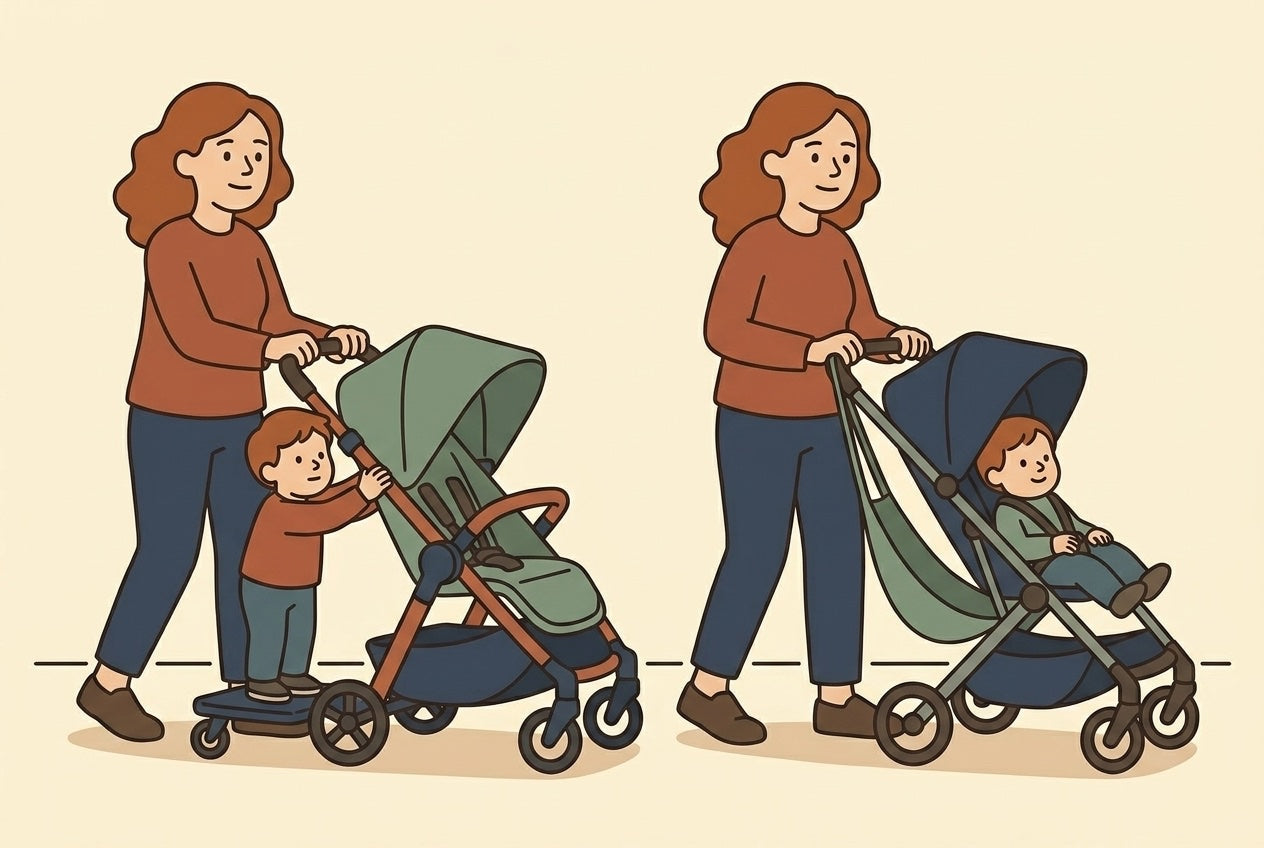
A stroller board is fine for short distances when your toddler wants to stand. A hammock seat is built for longer walks when they need to sit. That one sentence covers most of the decision — but the details matter, especially when you're trying to keep your existing stroller instead of buying a bulky double.
Here's an honest, side-by-side look at both options so you can pick the one that actually fits your daily routine.
Key Takeaways
Stroller boards let toddlers stand or perch at the rear; hammock seats let them properly sit and rest.
For tired toddlers on longer outings, a hammock seat is usually more comfortable than a standing board.
Both accessories add weight to the rear of the stroller — always check your stroller's total load rating before use.
Hoppie is designed for children from around 18 months to 5 years old, up to 20 kg / 44 lbs.
If you're unsure which fits your stroller, tell us the exact brand and model and we'll confirm whether Hoppie fits.
How each accessory actually works
Both accessories solve the same parent problem — you have one stroller, a baby in the seat, and an older child who wants a ride. But they solve it differently, and that difference adds up over a long walk.
Stroller boards (sit-and-stand boards)
A stroller board — sometimes called a buggy board or sit-stand board — is a small platform that clips under or behind the stroller. Your toddler stands on it while you push, holding onto the stroller frame for balance. Some boards include a small fold-down seat, giving your child a low perch rather than a proper seated position.
The attachment usually connects to the rear axle or to the stroller's frame near the back wheels. Most boards sit close to the ground, so your toddler's legs hang or dangle rather than bend at a natural seated angle.
Standing on a board is tiring faster than most parents expect. It works well for a ten-minute walk from the car park to the supermarket. For a two-hour day out or a long airport transfer, it tends to result in a tired, unhappy toddler who wants to be picked up — which defeats the purpose.
Hammock seats
A hammock seat hangs from the rear of the stroller, giving your older child a proper seated position with their weight supported from below. They sit in the hammock the way they'd sit in a chair — hips supported, legs hanging freely at a comfortable angle.
Because the child is seated rather than standing, a hammock seat is much more sustainable for longer walks. A tired toddler can rest, even doze slightly, without asking to be carried. The seat folds away when not needed. Its top straps attach to the stroller's handlebar and the bottom straps to the frame near the rear wheels.
Hoppie is designed to fit most standard strollers with a rigid rear frame and is designed for children from around 18 months to 5 years old, up to 20 kg / 44 lbs.

Comfort, safety, and compatibility compared
Comfort for tired toddlers
This is where the two options diverge most clearly.
On a board, your toddler stands — which means their leg muscles are working the whole time. Young children don't have the stamina for long periods of standing, especially when the stroller is moving and they're balancing. Many parents find their child lasts 10–15 minutes on a board before wanting off, or becoming unhappy and fussy.
A hammock seat puts your child in a supported sitting position. Their legs hang relaxed. Their back is supported by the seat fabric. They're not working to stay on — they're just resting. For a child who walks well but gets tired quickly, this is the difference between a calm outing and one that ends in tears.
If your child mainly wants to take the weight off their feet, a hammock seat wins on comfort every time.
Stability
Both accessories add weight at the rear of the stroller. That's worth understanding before you buy either one.
With a board, the weight sits low — near the axle — and is relatively close to the rear wheels. Stability is rarely an issue, especially on flat ground.
With a hammock seat, the child sits higher, but the seat hangs vertically behind the stroller, so their weight goes down onto the rear frame rather than pulling the stroller backward the way a bag hung on the handlebar does. The practical rule is straightforward: always check your stroller's total load rating, keep a child in the main seat, and don't hang bags from the handlebar while Hoppie is in use. These habits apply to both accessories.
A stable rear frame is non-negotiable for either accessory — but more so for a hammock seat, because the load point is higher. Always follow Hoppie's installation instructions and check your stroller manufacturer's maximum load capacity before use.
Compatibility with common strollers
Most stroller boards attach near the rear axle and are designed to work across a wide range of strollers. The main compatibility consideration is whether the board clears the stroller's rear wheels and whether it affects your walking stride — some boards sit close enough to the stroller that you kick them on every step.
Hammock seats need a rigid rear frame with enough rear clearance for the seat to hang freely behind the main seat. Most standard strollers with a solid metal frame pass this check. Ultra-light umbrella strollers without a reinforced rear frame are not suitable for either accessory, though a board is sometimes more forgiving of lighter frames because its load point is lower.
Hoppie is not recommended for ultra-light umbrella strollers without a stable rear frame. If you're unsure whether your stroller is a good fit, tell us the exact brand and model and we'll confirm whether Hoppie fits.

Which one to choose by use case
Most families don't need a long theoretical debate. They need a quick answer based on how they actually move through the world.
Short city errands
Fifteen-minute walk to the pharmacy. Quick trip around the supermarket. Short school run with a reliable route.
For these outings, a stroller board often does the job. Your toddler stands for a short stretch, gets off when you arrive, and nobody's tired enough to complain. The lower cost of many boards makes them reasonable for this kind of occasional use.
That said, if your child typically asks to be carried even on short outings, the board probably won't solve the problem — they want to sit, not stand.
Long walks, malls, airports
Half-day zoo trip. Weekend market walk. Shopping centre with a baby and a tired four-year-old.
This is where a hammock seat earns its place. Your toddler can hop on when they're tired, sit properly, and even rest — then hop off again when they want to walk. You keep both hands on the stroller, the buggy stays compact enough for lifts and narrow aisles, and you're not carrying anyone.
Airports are the clearest example. Long terminal walks, queues, gate changes — a standing board asks too much of a tired child. A hammock seat turns a stressful situation into a manageable one.
Travel
Family holidays, city breaks, days out in an unfamiliar place.
Both accessories pack down, but a hammock seat tends to take up less space when removed. More importantly, travel days are long and unpredictable — you often don't know how far you'll walk until you're already out. A hammock seat handles the full range of distances, while a board may leave you carrying a tired toddler through the second half of the day.
For families who travel regularly with two young children, a hammock seat is often the smarter long-term investment because it covers the situations where a board runs out of usefulness.

A quick side-by-side summary
Best for short trips: Stroller board — simple, low-cost, good for distances where standing is fine.
Best for longer outings: Hammock seat — proper seated rest, better for tired toddlers who need more than a perch.
Best for travel: Hammock seat — handles unpredictable distances better, stays compact.
Stroller frame needed: Both need a stable stroller. A hammock seat specifically needs a rigid rear frame with rear clearance.
Walking stride: Some boards interfere with your heel strike as you push — worth checking before buying. Hammock seats hang vertically behind the stroller and don't affect stride.
Child comfort: Hammock seats win for longer durations. A seated child is a calmer child.
Hoppie should only be used with strollers that have a stable rear frame and enough rear clearance. Always supervise your child while using Hoppie.
FAQs
Is a stroller board safer than a hammock seat?
Neither is inherently safer than the other — safety depends on the stroller you're using and how you install and use the accessory. A board sits lower and closer to the rear axle, which gives it a slightly lower centre of gravity. A hammock seat sits higher, so a stable rear frame is especially important. Both accessories require you to check your stroller's total load capacity before use. Always supervise your child with either option.
Can a 4-year-old use a stroller board?
Many 4-year-olds can stand on a board for short distances, but standing becomes tiring quickly for children that age, especially on longer outings. At 4, most children are also heavy enough that the extra rear weight is noticeable on the stroller. A hammock seat gives a 4-year-old a proper seated position and is generally more comfortable for extended use. Hoppie is designed for children from around 18 months to 5 years old, up to 20 kg / 44 lbs.
Are stroller boards better for short walks?
Yes, for genuinely short distances — a few minutes from the car to the shop, or a quick school drop-off — a board can work well. Your toddler stands briefly, you arrive, done. But if your child tends to tire quickly or asks to be carried even on short outings, a board won't solve that. They need to sit, not stand.
Which costs more — a board or a hammock seat?
Stroller boards vary widely in price, from budget options to premium models with folding seats. Hammock seats like Hoppie are positioned as a practical alternative to buying a double stroller — so while the upfront cost may be similar to or slightly above a quality board, the value comes from replacing something far more expensive. If you'd otherwise be looking at a double stroller costing several hundred pounds or euros, a hammock seat is a significantly smarter investment.
Can I use both a stroller board and a hammock seat?
Using both at the same time is not recommended. Each accessory adds weight to the rear of the stroller, and combining them could exceed your stroller's total load capacity. Choose the one that fits your child's age, weight, and typical outing length.
Does a hammock seat slow down folding?
It depends on the stroller. On most compact strollers, Hoppie should be removed before folding — it takes a few seconds and protects the straps. On many standard strollers you can fold with it attached. Many stroller boards also need to be detached before folding, so the practical difference is minimal.
What if my stroller doesn't have a rigid rear frame?
If your stroller has an ultra-light frame or a fabric rear panel, a hammock seat is not suitable. A stroller board may still work depending on where it attaches, but check the manufacturer's guidance. If neither accessory fits safely, a baby carrier for your older child or a compact second stroller may be the better route.
How do I know if Hoppie fits my stroller?
Check that your stroller has a rigid rear frame, a little clear space behind the seat for the hammock to hang freely, and a total load rating that covers your baby plus your older child's weight. If you're unsure, tell us the exact brand and model of your stroller and we'll confirm whether Hoppie fits.
If your toddler wants to sit, Hoppie is the smarter long-walk solution
You already have a stroller you like. You don't need to replace it with a bulky double stroller just because your older child's legs give out halfway through the day.
Hoppie adds a practical second seat to the back of your existing stroller — designed for children from around 18 months to 5 years old, up to 20 kg / 44 lbs. It keeps your stroller compact, fits through the same doorways, and means one less thing to carry when your toddler hits the wall.
Keep the stroller you love. Add a second seat when you need it.
Disclaimer: Hoppie is an independent product and is not affiliated with, endorsed by, sponsored by, or approved by any stroller brand. Always follow Hoppie's installation instructions and check your stroller manufacturer's maximum load capacity before use. Hoppie is designed for children from around 18 months to 5 years old, up to 20 kg / 44 lbs. Always supervise your child while using Hoppie.


