

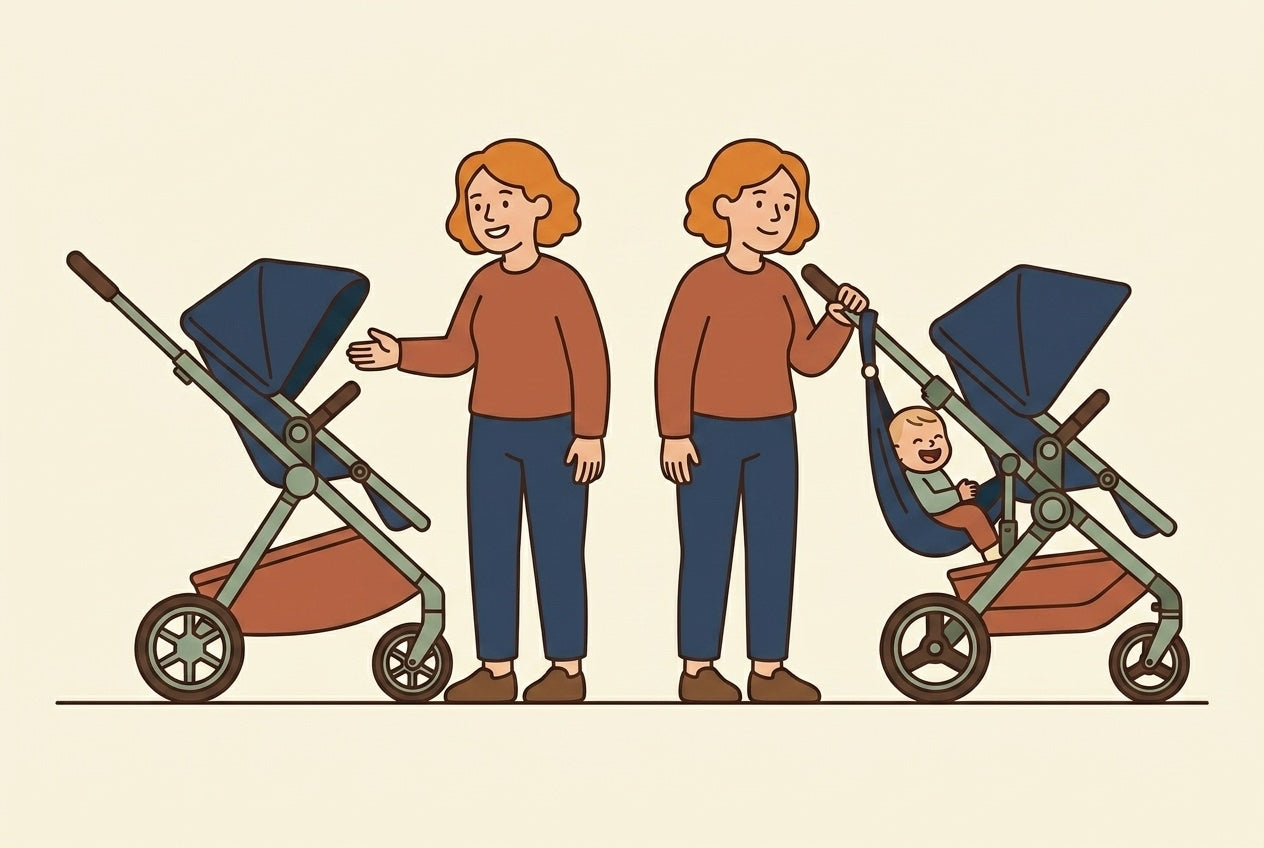
Most compact city strollers don't need to be replaced when a second child comes along — they need a smart add-on. If your stroller has a stable rear frame, enough space behind the seat, and capacity left in its load limit, a hammock seat can turn it into a two-kid solution today. No new stroller. No bulky double. Just a practical upgrade to what you already own.
Hoppie is an independent accessory and is not affiliated with, endorsed by, sponsored by, or approved by any stroller brand. Brand names, when mentioned, are used only to help parents understand potential compatibility.
Key Takeaways
Most compact strollers with a rigid rear frame can support a hammock seat for an older child.
Three checks decide compatibility: frame stability, rear clearance, and total load capacity.
Hoppie is designed for children from around 18 months to 5 years old, up to 20 kg / 44 lbs.
Popular compact strollers like the Babyzen YOYO, Bugaboo Butterfly, and Cybex Eezy S Twist are compatible with Hoppie — on the YOYO, use it with the child seat rather than the newborn carrycot.
If you're unsure, tell us the exact brand and model of your stroller and we'll confirm whether Hoppie fits.
The 3-check rule for compact strollers
Before you order anything, you only need to check three things. These three questions answer almost every compatibility concern parents have about adding a second seat to a compact stroller.
1. Frame — is the rear frame actually rigid?
A hammock seat hangs from the rear of your stroller — four straps with metal clips, two on the handlebar and two on the lower frame — and puts the full weight of your older child on that rear frame. That means the rear frame has to be solid — not soft, not fabric-backed, not made of thin plastic rods.
Here's the test: stand behind your stroller with it fully open and locked. Put both hands on the rear handlebar at shoulder width. Press down firmly — about half your body weight. Watch the rear tubes that run from the handlebar down toward the rear axle.
No visible flex, no creaking? Good sign. The frame is a strong candidate.
Visible bend or creaking? That stroller isn't suited to a hammock seat, regardless of how good the seat is.
Many compact city strollers — including the Babyzen YOYO 2, Bugaboo Butterfly, Joolz Aer, and Nuna TRVL — are built with aluminium or steel frames that pass this test. Some ultra-light models with fabric-back seats or thin flexible rods don't. The push test tells you which category your stroller falls into.
Hoppie should only be used with strollers that have a stable rear frame and enough rear clearance. Always supervise your child while using Hoppie.
2. Space — is there enough room behind the seat?
The hammock seat hangs vertically from the rear frame, behind your stroller's main seat. Your older child sits in it with their legs dangling — they need real room back there. As a general guide, you want a little clear space behind the seat, from the rear axle upward.
The most common blocker on compact strollers is the underseat basket. Many compact models position the basket quite far back to maximise storage, which can eat into the rear clearance zone. The good news: most baskets on popular compact strollers can be repositioned or removed in seconds — check yours before measuring.
If you're checking a Stokke YOYO or Uppababy MINU, also look at whether the seat recline position changes the rear clearance. A fully reclined seat can push backward and reduce the space your older child has to sit comfortably.
3. Load — what's left in the weight budget?
Every stroller has a maximum total load. On compact strollers, that number is often lower than on full-size models — sometimes as low as 15 kg total, sometimes higher. You'll find it printed in the manual or on a sticker near the rear wheels.
Do the simple addition:
Baby or toddler in the main seat
Anything in the basket
Your older child on the hammock seat (up to 20 kg / 44 lbs)
The total must stay under your stroller's rated capacity. If it doesn't, a hammock seat isn't the right solution for your specific setup — even if the frame and space checks pass.
Always check your stroller manufacturer's maximum load capacity before use. Hoppie's instructions also explain this step clearly.

How popular compact strollers typically perform
Parents most often ask about a handful of compact strollers. Here's what to expect — keeping in mind that every stroller needs the three-check test before ordering.
Babyzen YOYO / YOYO 2 / YOYO+ — One of the most-asked-about compact strollers, and a confirmed fit for Hoppie when used with the YOYO child seat (not with the newborn carrycot or bassinet). If you use the basket heavily, keep bulky items toward the front so your older child's legs have room.
Bugaboo Butterfly — Compatible with Hoppie. Compact but built with a solid frame, and parents report good rear clearance. The total load rating is worth checking against your specific setup before use.
Cybex Eezy S / Eezy S Twist — Compatible with Hoppie. Compact and lightweight, and the Twist variant's rotation mechanism is in the seat, not the frame, so the rear frame stays stable whichever way the seat faces.
Joolz Aer — A compact stroller with a metal frame designed for city use, and compatible with Hoppie. Check the basket before checking rear clearance.
Stokke YOYO (Stokke Stroller YOYO) — Same frame as the Babyzen YOYO, and compatible with Hoppie when used with the child seat.
True umbrella strollers — Strollers with thin tubing, a fabric-back seat and an umbrella-style fold are the ones that don't work. Being cabin-sized isn't the problem — the YOYO and Butterfly are cabin-sized and compatible — thin, flexible tubing is. Don't assume — test first.
If you're unsure whether your stroller will work, tell us the exact brand and model and we'll confirm whether Hoppie fits.
Installing a hammock seat on your compact stroller
Once your stroller passes the three checks, installation is straightforward. Even the first time, it takes well under a minute: four straps with metal clips, two on the handlebar and two on the lower frame.
Step by step
Read the instructions first. Spend two minutes with the instruction sheet before touching the stroller. The strap routing is simple once you've seen it, but easy to get wrong on a first attempt without reading.
Reposition or remove the basket if needed. If the basket sits in the rear clearance zone, move it out of the way before attaching the seat. Most compact strollers let you do this in seconds.
Clip the straps to the rear frame. The two upper straps clip to the handlebar and the two lower straps to the frame on each side, using the metal clips. On compact strollers, the bars are usually thinner — make sure the clips sit securely and don't slip on the bar shape.
Tighten fully before your child gets in. A correctly installed hammock seat should sit taut against the rear frame with very little slack. Loose straps let the seat shift under your child, which feels less stable and less comfortable for them.
Check the seat position. The seat should hang clear of the rear wheels and not drag on the ground when your child sits in it. Ask your older child to sit while the stroller is stationary and braked — check clearance and comfort before setting off.
Do a short test walk. Before a busy school run or a long day out, take a five-minute test walk around the block. Check that the seat stays taut, the stroller steers normally, and your child is comfortable.
Your first proper walk
A few things most parents notice after the first walk with a hammock seat on a compact stroller:
The stroller keeps its original width. Because the seat hangs vertically behind the stroller, you don't gain any width. Café doorways, shop aisles, and public transport that already worked for your compact stroller still work with Hoppie attached.
Steering feels very similar. The extra weight sits over the rear of the frame and goes straight down, which some parents notice as a very small change in push effort. Most people adjust to it within a few steps.
Your older child may need a moment to feel settled. The hammock seat has gentle movement — most toddlers love it within a minute. If your child is nervous, walk slowly for the first few minutes and let them hold the rear handlebar or your hand until they're comfortable.
Remove Hoppie before folding a compact stroller. Most compact strollers need the seat taken off before folding — it takes a few seconds and protects both the stroller frame and the seat's straps. (On larger standard strollers you can usually fold both together.) Forgetting this is the most common mistake parents make early on — and the easiest to avoid.

What changes and what doesn't
The honest reality of using a compact stroller with a hammock seat for two kids:
What stays the same: your stroller's footprint in tight spaces, its fold size (when the seat is removed), its seat for your younger child, and the stroller you already love.
What changes for the better: no more carrying a tired toddler on your hip, no more meltdowns halfway through a school run, and no need to buy and store a bulky double stroller.
What to watch for: total load weight over time as your children grow, and making sure your older child stays within Hoppie's designed range — around 18 months to 5 years old, up to 20 kg / 44 lbs.
Always follow Hoppie's installation instructions and check your stroller manufacturer's maximum load capacity before use.

When a hammock seat isn't the right answer
A hammock seat works well for most compact strollers with solid frames — but it isn't the right answer for every situation. Here's when to consider something else:
Your stroller's rear frame isn't rigid. If the rear frame flexes under firm hand pressure, never attach a hammock seat to it, regardless of how practical it would be. Safety comes first.
Your stroller's load capacity doesn't leave enough room. If the numbers don't add up after the weight check, a babywearing carrier or a compact second stroller for your older child may be a better fit.
Your older child is outside Hoppie's designed range. Hoppie is designed for children from around 18 months to 5 years old, up to 20 kg / 44 lbs. If your child is below 18 months or above the weight limit, this isn't the right solution for them right now.
You have an ultra-light umbrella stroller without a reinforced frame. These strollers are designed to be as light as possible — not to carry accessory loads at the rear. Hoppie is not recommended for this category.
FAQ
Can a compact stroller really carry two kids?
Many compact strollers can — if they have a stable rear frame, enough rear clearance, and enough total load capacity for both children. The three-check rule in this article is the quickest way to find out. It's not about the stroller being "compact" or "large" — it's about those three specific things.
Does adding a hammock seat slow down the stroller?
Most parents notice very little difference in push effort after the first few steps. The extra weight sits at the rear and goes straight down onto the frame, so it doesn't unbalance the stroller, and compact strollers with solid frames handle it well. You'll adjust naturally within a short walk.
How long does installation take?
Under a minute, even the first time: four straps with metal clips, two on the handlebar and two on the lower frame, then a quick tighten. Read the instructions once before you start, and it only gets quicker from there.
Will I need to replace anything on my stroller?
In most cases, no. Hoppie attaches using straps that loop around your stroller's existing rear frame — no drilling, no permanent modifications. You may need to reposition or temporarily remove the underseat basket to free up rear clearance, but the stroller itself doesn't need any changes.
What if my compact stroller has a low total weight limit?
Some compact strollers have lower total load ratings than full-size models. Always check the rated capacity in your manual and do the weight addition: your younger child plus your older child plus basket contents. If the total exceeds your stroller's rating, a hammock seat is not suitable for that specific setup.
Do I need to remove the hammock seat when I fold the stroller?
On most compact strollers, yes — remove Hoppie before folding. This protects the frame and the seat's straps, and it keeps the fold clean and compact. It only takes a few extra seconds. On larger standard strollers you can usually fold both together.
My stroller isn't listed here — how do I know if it works?
Run the three-check rule: push test on the rear frame, check there's a little clear space behind the seat, and check the load capacity. If all three pass, Hoppie is likely to be a good fit for your stroller. Still not sure? Tell us the exact brand and model of your stroller and we'll confirm whether Hoppie fits.
Hoppie turns most compact strollers into a smart two-kid solution
You don't need a new stroller. You don't need a bulky double. You need a second seat that works with the compact stroller you already love.
Hoppie is designed for children from around 18 months to 5 years old, up to 20 kg / 44 lbs. It attaches to the rear of most standard strollers with a stable frame — no tools, no permanent modifications, no replacing the stroller you chose.
Keep the stroller you love. Add a second seat when you need it.
Disclaimer: Hoppie is an independent product and is not affiliated with, endorsed by, sponsored by, or approved by any stroller brand mentioned in this article. Brand names are used only to indicate potential compatibility with certain stroller models. Always follow Hoppie's installation instructions and check your stroller manufacturer's maximum load capacity before use.