

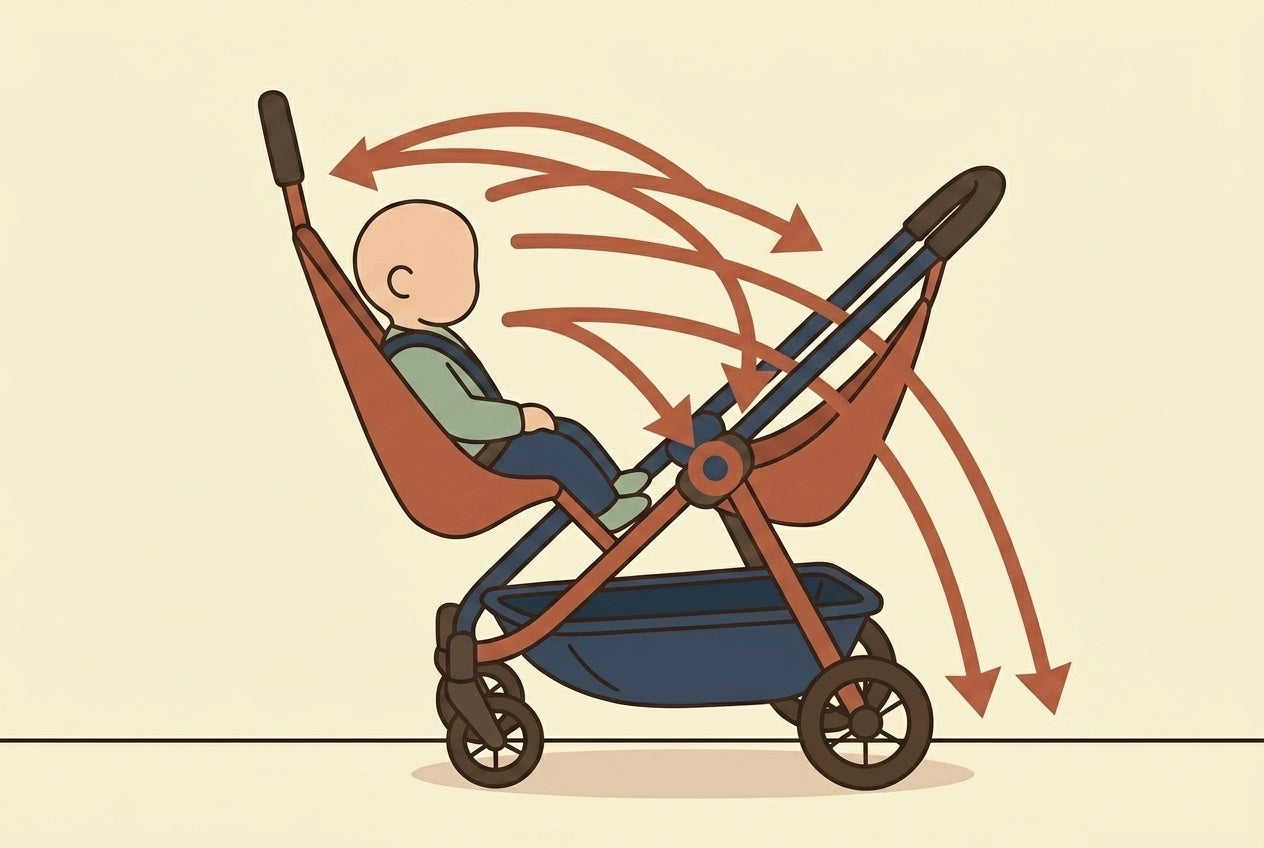
A rear add-on seat changes how your stroller feels to push. That's not a reason to avoid one — it's a reason to understand what actually changes, and what doesn't. Hoppie hangs low, between the stroller's rear wheels, so your older child's weight goes down onto the frame rather than out behind it. That is very different from a heavy bag hooked on the handle. On a compatible stroller, with a child under 20 kg / 44 lbs and the main seat in use, the stroller stays balanced. A few good habits still make every walk smoother: brake whenever you stop, take kerbs slowly, and keep the basket light.
Key Takeaways
- Hoppie hangs low between the rear wheels, so the child's weight goes down onto the frame — not backward like a bag on the handle.
- On a compatible stroller, with a child under 20 kg / 44 lbs and the main seat occupied, the stroller stays balanced.
- Three habits make every walk smoother: brake at every stop, take kerbs slowly, keep the basket light.
- Hoppie is designed for children from around 18 months to 5 years old, up to 20 kg / 44 lbs.
- If your stroller still feels wobbly after a few outings, the issue is almost always the stroller's rear frame or the total load — tell us your stroller's brand and model and we'll check.
How weight balance changes with a rear seat
Adding any load to a stroller changes how it sits and how it moves. Understanding where that load goes helps you stay in control — and takes the mystery out of the first few walks.
Where the weight actually goes
Every stroller is engineered with a certain weight distribution in mind: a child in the seat, a few items in the basket, maybe a bag on the handle. Most of that load sits over the front and rear axles — which is exactly where you want it.
The classic way to upset that balance is to hang a heavy bag on the handlebar. The bag sits high and behind the rear axle, and it pulls the handle down and back. Every parent has felt a stroller rear up when they lifted the child out and left the bag hanging.
Hoppie works differently. The seat hangs from four straps with metal carabiners — two on the handlebar, two on the lower frame on each side — and your child sits low, between the rear wheels, facing forward. Their weight presses down onto the frame, over the rear axle, rather than levering the handle backward. That's why a child in Hoppie doesn't tip a stroller the way a loaded changing bag on the handle can.
The stroller's footprint — the distance between the front and rear wheels — stays exactly the same. With a child under 20 kg / 44 lbs in the seat, a child in the main seat as always, and a stroller with a rigid rear frame, the stroller stays balanced in normal walking use.
What you will notice
What changes is simply the total weight you're pushing. Most parents describe the first few walks the same way:
- Starting and stopping. The stroller carries a little more momentum, so you'll want to slow down a touch earlier before you stop, rather than braking suddenly.
- Kerbs. The stroller is heavier to tilt and roll up a kerb, the same way it is with a bigger child in the main seat. Slow down and take it in one controlled movement.
- Uphill. More weight means a little more effort on inclines. That's physics, not instability.
None of these moments require special equipment or a new technique. They just ask for a little more attention the first few times — which is easier once you know the weight is going down, not back.
Three habits for smooth, steady handling
These aren't complicated techniques. They're small adjustments that become second nature within a few outings — and most of them are things you already do with any loaded stroller.
Engage the parking brake every stop

This is the most important habit — and the easiest to skip when you're in a hurry.
When you stop with two children on board and let go of the handle to pay, check a phone, or manage the baby, the stroller has no anchor. If the ground is even slightly sloped, or if your older child wriggles, the stroller can start to roll. That's true of any stroller, with or without a rear seat; with two children on board it simply matters more.
Engaging the parking brake takes one second. It locks both rear wheels completely. The habit is simple: every time your hands leave the handle, the brake goes on first. Every time. Not most of the time — every time.
If your stroller has a one-step foot brake, build a reflex: stop walking, foot hits the brake, then let go. In a week, it will feel as automatic as putting a car in park before opening the door.
Take kerbs slowly
The standard way to go up a kerb with any stroller is to tilt it gently back onto its rear wheels, roll the front wheels up, then push the rear wheels up behind them. That technique still works with a child in Hoppie — the seat hangs between the rear wheels, so tilting onto those wheels doesn't move the child's weight anywhere unusual.
What changes is the weight you're tilting. So:
- Slow right down before the kerb, with both hands on the handle.
- Tilt gently and deliberately — no quick jerks on the handle.
- Roll the front wheels up, then the rear wheels, in one controlled movement.
Going down a kerb, the same rule applies: slow, both hands, step down in control. Dropped kerbs and ramps make all of this a non-event, so use them whenever the route allows. It feels a little heavier the first time. By the third or fourth kerb, it's just how you do it.
Keep the basket light
The basket sits under the main seat, which means everything you put in it adds to the total load. A changing bag, two water bottles, snacks, a folded rain cover, and a pair of shoes can easily add several kilograms without you really noticing — and with a second child on board, the total is what counts toward your stroller's maximum load.
The simple fix is to treat the basket as a light-load zone when the rear seat is in use. Take what you need for the outing and leave the rest at home, or carry heavier items in a backpack on your own shoulders. Avoid hanging heavy bags on the handlebar while Hoppie is in use: a bag on the handle is precisely the kind of load that pulls a stroller backward.
Reorganising what you carry takes five minutes before you leave the house. It makes a noticeable difference to how the stroller handles.

What to do if your stroller still feels wobbly
If you've been out a few times and the stroller still doesn't feel steady, the cause is usually the stroller itself rather than the way you're using it. A wobbly feeling almost always points to one of three things: the rear frame isn't rigid enough, the total load is too high, or the seat isn't installed tightly.
Small adjustments that help
- Check strap tension. A loosely installed hammock seat lets the child hang lower and swing more than it should. Tighten all four straps so the seat sits snug against the frame and holds its shape when you press down on it. This is the single most common fix.
- Check the total load. Add up your baby, your older child, and everything in the basket. The total needs to stay within your stroller manufacturer's rated maximum, and your older child needs to be under 20 kg / 44 lbs.
- Keep the main seat occupied. Hoppie is designed to be used with a child sitting in the stroller's main seat. Never use it with the main seat empty.
- Lighten the basket. As covered above, a light basket makes the whole stroller easier to handle.
These adjustments help on strollers that are close to right. They are not a fix for a frame that genuinely isn't rigid enough to carry a rear seat.
When to switch solutions
Very basic umbrella strollers — the kind with fabric slung between two thin poles, a fabric-only backrest, and no rigid rear frame — aren't built to carry a rear seat. Compact travel strollers are a different story: many of them, like the Babyzen YOYO (with the child seat, not the bassinet), the Bugaboo Butterfly, the UPPAbaby Minu, the Cybex Melio or the Nuna TRVL, have a rigid frame and work well with Hoppie. Being small or light doesn't rule a stroller out; a flimsy frame does.
If your stroller feels unstable even after you've tightened the straps and lightened the load, the rear frame is probably flexing under the added weight. In that case, a rear hammock seat isn't the right solution for your setup. A few alternatives work well for parents in the same situation:
- A babywearing carrier for the older child on shorter outings.
- A compact second stroller that one parent can fold and carry when not in use.
- A stroller board that attaches to the rear axle rather than the rear frame, if your stroller model supports one.
If you're unsure whether your stroller's frame is the issue, tell us the exact brand and model of your stroller and we'll confirm whether Hoppie fits — or whether another solution makes more sense for your setup.
Always follow Hoppie's installation instructions and check your stroller manufacturer's maximum load capacity before use. Hoppie should only be used with strollers that have a stable rear frame and enough clearance behind the main seat, always with a child in the main seat.
FAQs
Does a hammock seat make my stroller more likely to tip?
No. Hoppie hangs low between the rear wheels, so the child's weight goes down onto the frame rather than backward — unlike a heavy bag on the handlebar. On a compatible stroller with a rigid rear frame, a child under 20 kg / 44 lbs in Hoppie and a child in the main seat, the stroller stays balanced. What you'll notice is extra weight when starting, stopping, taking kerbs and going uphill, which the three habits above take care of.
Should I weigh down the front of my stroller?
No. There's no need for counterweights, and we don't recommend hanging bags on the handlebar while Hoppie is in use. Keep the basket light, keep your older child under the weight limit, and make sure the main seat is occupied. Light and balanced is the goal.
Can I lift the rear of the stroller with a child on Hoppie?
Tilting the stroller onto its rear wheels to take a kerb is fine — do it slowly, with both hands on the handle. Lifting the whole stroller off the ground is a different matter: before stairs, escalators or a high step, take your child off the seat first and carry them through. The same goes for any surface you can't roll over smoothly.
What's the safest way to go up a kerb with a hammock seat?
The same way as always, just slower: both hands on the handle, tilt gently onto the rear wheels, roll the front wheels up, then the rear wheels, in one controlled movement. Use dropped kerbs and ramps whenever the route allows, and apply the brake if you need to stop at the edge.
What weight limit does Hoppie have?
Hoppie is designed for children from around 18 months to 5 years old, up to 20 kg / 44 lbs. Always check your stroller's total maximum load capacity as well — both Hoppie's limit and your stroller's rating need to be respected at the same time.
What should I do if my stroller feels unstable even after adjusting my habits?
Tighten the straps first, then check the total load. If the stroller still wobbles, the rear frame may not be rigid enough for a rear seat. Tell us the exact brand and model of your stroller and we'll confirm whether Hoppie fits, or whether another solution works better for your setup.
Does Hoppie affect how the stroller steers?
A little. Extra weight at the rear can make steering feel slightly heavier than you're used to, especially on tight turns — much like pushing with a bigger child in the main seat. Most parents adjust within a few outings. Keeping the basket light and a firm two-handed grip on the handlebar makes a noticeable difference.
Is it safe to use Hoppie on a slope?
Yes, with care. On downhill slopes, hold the handle firmly with both hands and walk at a controlled pace. Engage the brake whenever you stop, even briefly, and avoid stopping on steep inclines without the brake on. On uphill slopes, push from behind with both hands and keep the stroller close to you. If the slope is steep or the surface is wet, take your child off the seat before descending.
Hoppie is designed for stability — but your habits matter just as much
A rear hammock seat doesn't turn your stroller into something you need to wrestle with. Hoppie keeps the weight low and over the rear wheels, and on a stroller with a rigid rear frame the balance you're used to stays put. Three habits make every walk smoother: brake at every stop, take kerbs slowly, and keep the basket light. Most parents find the adjustment takes a few outings and then becomes automatic.
Hoppie is designed for children from around 18 months to 5 years old, up to 20 kg / 44 lbs — for everyday walks, school runs, travel days, and all the moments when tired little legs need a break without the bulk of a double stroller.
Keep the stroller you love. Add a second seat when you need it.
Hoppie is an independent product and is not affiliated with, endorsed by, sponsored by, or approved by any stroller brand. Brand names, when mentioned, are used only to indicate potential compatibility with certain stroller models. Always follow Hoppie's installation instructions and check your stroller manufacturer's maximum load capacity before use. Always supervise your child while using Hoppie.