

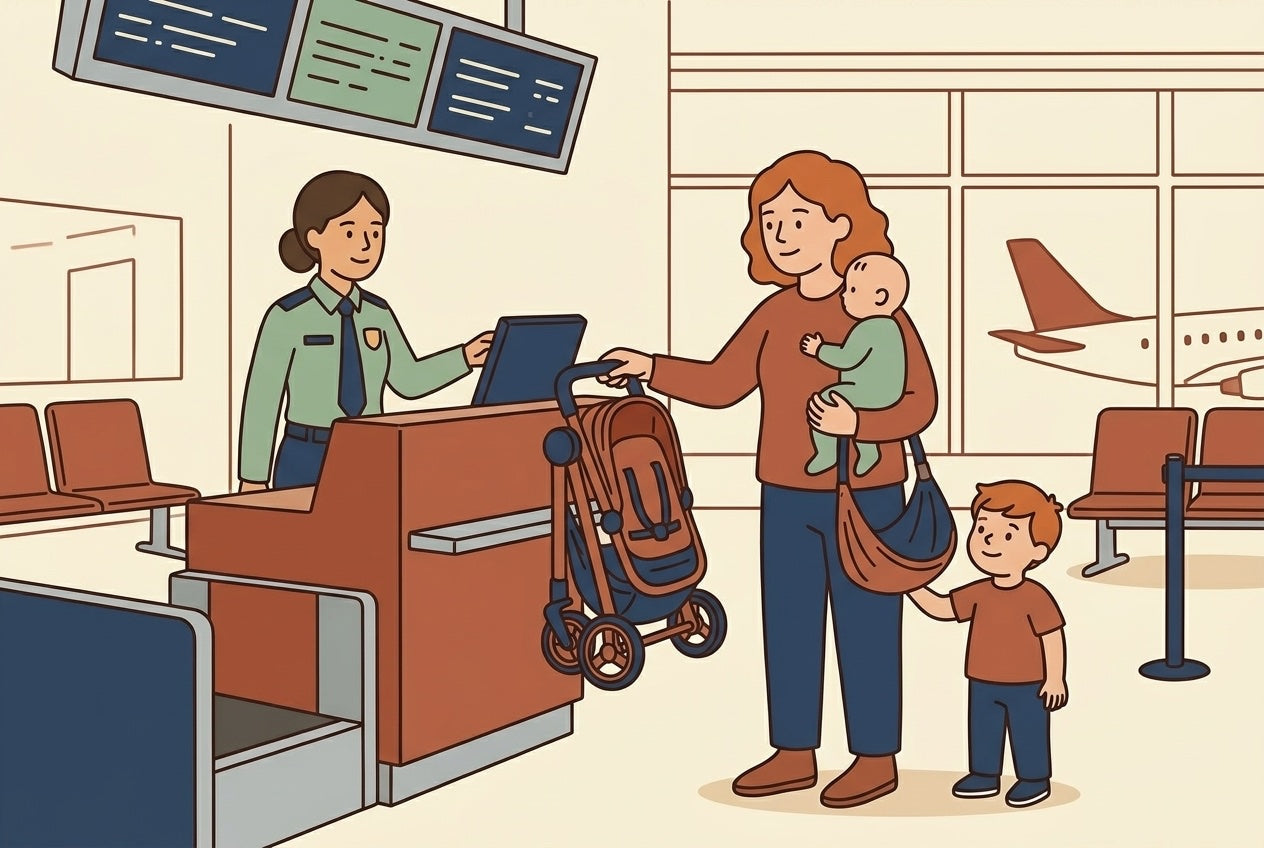
Most airlines let you gate-check your stroller right up to the aircraft door — and in most cases, a stroller hammock seat travels with it. But a little preparation goes a long way. Here are the four things to do before your flight, and what to know if something goes wrong on the other side.
Key Takeaways
Most airlines allow gate-checked strollers with accessories attached, but policies vary — always check your airline's specific rules before you fly.
Detaching your hammock seat and packing it in a bag is the safest way to protect it during handling.
Photograph your stroller and all accessories before handing them over at the gate.
A stroller hammock seat stored separately does not count as a carry-on item — it travels as part of the stroller.
If anything is damaged on arrival, report it at the airline's service desk before leaving the airport.
Airline rules at a glance
Gate-checking a stroller is one of the most parent-friendly policies in air travel. You roll it up to the aircraft door, hand it over, and collect it again on the jetway when you land. Accessories — including a hammock seat — usually travel as part of the stroller, not as a separate bag.
That said, policies differ between carriers, and the person checking you in may not know every detail of their own stroller policy. The best habit is to check your airline's website before you fly, confirm at check-in, and be prepared either way.
Major US carriers
The large US carriers — including the major full-service airlines — generally allow one stroller per child to be gate-checked free of charge. Accessories that are attached or bagged with the stroller are typically included, provided the total package fits within standard gate-check handling. A compact hammock seat packed inside a stroller bag, or folded flat and strapped to the stroller, rarely causes any issue.
Where US carriers differ is on size limits. A few airlines specify that gate-checked strollers should fold to a certain size. Most compact and mid-size strollers fold well within those limits, but it is worth confirming if your stroller is on the larger side.
Major European carriers
European full-service airlines follow a broadly similar approach. Gate-checking is available as standard on most routes, and a stroller with an attached or bagged accessory is generally treated as a single item. Some carriers on the continent ask that all accessories be secured to the stroller before handover — loose items may be turned away or classed separately.
If you are flying into or out of a busy hub, expect your stroller to be gate-checked into the hold rather than returned at the jetway. This is common at large European airports on wide-body flights. Budget extra time at baggage claim.
Low-cost carriers
Low-cost airlines can be stricter. Some charge for stroller check-in, even at the gate. Others allow one stroller free but count anything not attached to the stroller as a separate item that must go in the hold as paid baggage.
The safest approach with a low-cost carrier: detach your hammock seat, fold it flat, and place it inside the stroller bag alongside the stroller itself. Pack it tightly so the whole thing is clearly one unit when you hand it over. If in doubt, call the airline's customer service line the day before — agents on the phone often give clearer answers than what you find buried in the website FAQ.

How to prep before flying
A stroller that arrives at your destination undamaged starts with five minutes of preparation at home, not at the gate.
Detach or keep attached?
The honest answer: detaching is safer. When a stroller goes through gate-check handling, it is often moved quickly, stacked, and sometimes thrown into a cart. A hammock seat left attached gives baggage handlers more to catch on, pull at, or accidentally twist.
Detaching the hammock seat takes less than a minute. Fold it flat, wrap the straps around it, and tuck it inside a protective bag with the stroller. When you arrive, reattach it in the same time. This small step removes the most common source of travel wear on hammock-seat straps.
If you prefer to leave it attached — for example on a very short connection with no time to repack — make sure the straps are tucked in tightly and nothing is dangling. Loose straps catch on conveyor edges and can snap under sudden tension.
Use a protective bag
A stroller travel bag is one of the best investments for any family that flies regularly. Most strollers fit into a drawstring or zip travel bag that costs very little and protects the frame from scratches, the fabric from grease, and the straps from snagging.
If you don't have a stroller bag, a large heavy-duty bin bag secured with tape does a reasonable job for a short trip. It will not survive multiple journeys, but it gets you through one flight without arriving to a scuffed stroller.
Pack the detached hammock seat into the same bag as the stroller. This keeps everything together, reduces the point to check of anything being separated, and makes it obvious to airport staff that all items belong to the same unit.
Photograph everything
Before you hand your stroller over at the gate, take two photographs: one from the side and one from the rear. Show the stroller's overall condition, the hammock seat (if attached), and the bag if you're using one. Take a third photo of your gate-check tag once it's been attached.
These photos cost thirty seconds and could save you a long argument at the baggage desk if something goes wrong. Without them, it is your word against the airline's. With them, the condition of your stroller at handover is documented clearly.
Store the photos somewhere you can access without wifi — a screenshot saved to your camera roll works fine.

What to do if it gets damaged
Stroller damage during air travel is frustrating, but it is not rare. The handling that happens once a stroller leaves your hands can be rough. Knowing what to do before it happens makes the process much less stressful.
Reporting damage at arrival
If your stroller arrives damaged — a cracked frame, a bent wheel, a torn strap — do not leave the airport before reporting it. Airlines have a strict time window for damage claims, and once you pass through the arrivals doors, your window starts closing fast.
Find the airline's baggage services desk before you exit. Show the damage, show your gate-check tag, and show your photographs. Ask for a Property Irregularity Report (PIR) — this is the official damage form and you will need it for any claim. Get a copy before you leave the desk.
If the desk is closed or unmanned, report the damage at the airline's check-in counter or customer service line the same day. Email confirmation of your report is worth asking for.
The claim process
Once you have your PIR, the airline's baggage claims team will process your case. The timeline and outcome vary. Some airlines offer repair or replacement; others offer a cash settlement based on depreciation. For a relatively new stroller, the settlement may be close to replacement value. For an older one, it may be lower.
Keep all receipts — for the stroller, the hammock seat, and any protective bag. If you have travel insurance, check whether it covers stroller damage — many family travel policies do, and the payout can be faster than waiting for the airline.
If the hammock seat is damaged separately from the stroller, note it as a separate item on your PIR form. Even if it was packed inside the stroller bag, list it clearly with a brief description and an estimate of value.
The whole process is less stressful when you have the photographs, the tag, and the PIR. Parents who skip the documentation step often find themselves with little leverage after the fact.

Travelling with two kids and one stroller
A hammock seat is especially useful on travel days. Airports are long. Transfers are slow. A tired toddler who has been walking for forty minutes through a terminal is a hard thing to manage when you are also carrying bags and keeping an eye on a baby in the stroller.
Hoppie is designed for children from around 18 months to 5 years old, up to 20 kg / 44 lbs. On a travel day, having that second seat available means your older child can sit when the walking becomes too much, without you needing a second stroller or a carrier that is already doing double duty.
The key habit for travel is the same one that makes daily use easier: detach before folding, reattach once you are through security and your stroller has been returned at the gate. Once you have done it a few times, the whole process takes under two minutes and becomes automatic.
Always follow Hoppie's installation instructions and check your stroller manufacturer's maximum load capacity before use. Always supervise your child while using Hoppie.
FAQ
Can I gate-check a stroller hammock?
Yes, in most cases. Airlines that allow gate-checked strollers generally treat accessories packed with the stroller as part of the same unit. The safest approach is to detach your hammock seat, fold it flat, and pack it inside the same stroller bag. If you leave it attached, tuck all straps in tightly so nothing is dangling.
Should I detach the hammock seat before flying?
Detaching is the safer option. Baggage handling can be rough, and a hammock seat left attached gives more to catch, pull, or twist during loading. Detaching takes less than a minute. Pack the seat inside your stroller bag with the stroller and reattach it once you land.
Does the hammock seat count as a separate carry-on item?
No — when packed inside your stroller bag or secured to the stroller, a hammock seat is treated as part of the stroller unit. It does not count as a separate carry-on or checked bag. If you carry it loose in the cabin, however, it would count against your hand-baggage allowance, so it is always better to pack it with the stroller.
What if my stroller is damaged on the flight?
Report the damage at the airline's baggage services desk before you leave the arrivals area. Ask for a Property Irregularity Report (PIR) and keep a copy. Show the photos you took at the gate before handing the stroller over — these are your strongest evidence. If you have travel insurance, check whether stroller damage is covered.
Do low-cost airlines allow gate-checking a stroller with accessories?
Policies vary. Some low-cost carriers allow one stroller free at the gate with accessories included; others charge for stroller check-in or treat loose accessories as separate items. Check your specific airline's policy before you travel, and call their customer service if the website is unclear. Packing everything in one tidy stroller bag makes it much easier to get through the gate without discussion.
Can I use the hammock seat in the airport before boarding?
Yes. The hammock seat works the same way in an airport as it does on any walk. Your stroller will need to have a stable rear frame, and you should always supervise your child while using Hoppie. Once you reach the gate and it is time to check the stroller, detach the seat, fold it flat, and pack it in your stroller bag before handover.
What is the weight limit for the Hoppie hammock seat?
Hoppie is designed for children from around 18 months to 5 years old, up to 20 kg / 44 lbs. Always check your stroller's total load capacity in addition to Hoppie's own rating before use.
What if I'm not sure whether my stroller can take the hammock seat?
Check that your stroller has a stable rear frame and enough rear clearance. If you are unsure whether your stroller is a good fit, send us a photo and we will help you check before your trip.
Hoppie travels well — pack it smart
A hammock seat is one of the most practical things you can bring on a family trip with two young children. Long terminals, slow connections, and tired toddlers are a fact of travel — having a second seat ready to go makes all of it a little more manageable.
Detach before you check the stroller, bag it properly, photograph everything, and enjoy the other end. Hoppie is for children from around 18 months to 5 years old, up to 20 kg / 44 lbs — exactly the age that finds airports the most exhausting.
Keep the stroller you love. Add a second seat when you need it.
Disclaimer: Hoppie is an independent product and is not affiliated with, endorsed by, sponsored by, or approved by any stroller brand. Always follow Hoppie's installation instructions and check your stroller manufacturer's maximum load capacity before use. Airline stroller policies change regularly — always verify the current policy with your carrier before you travel.


