

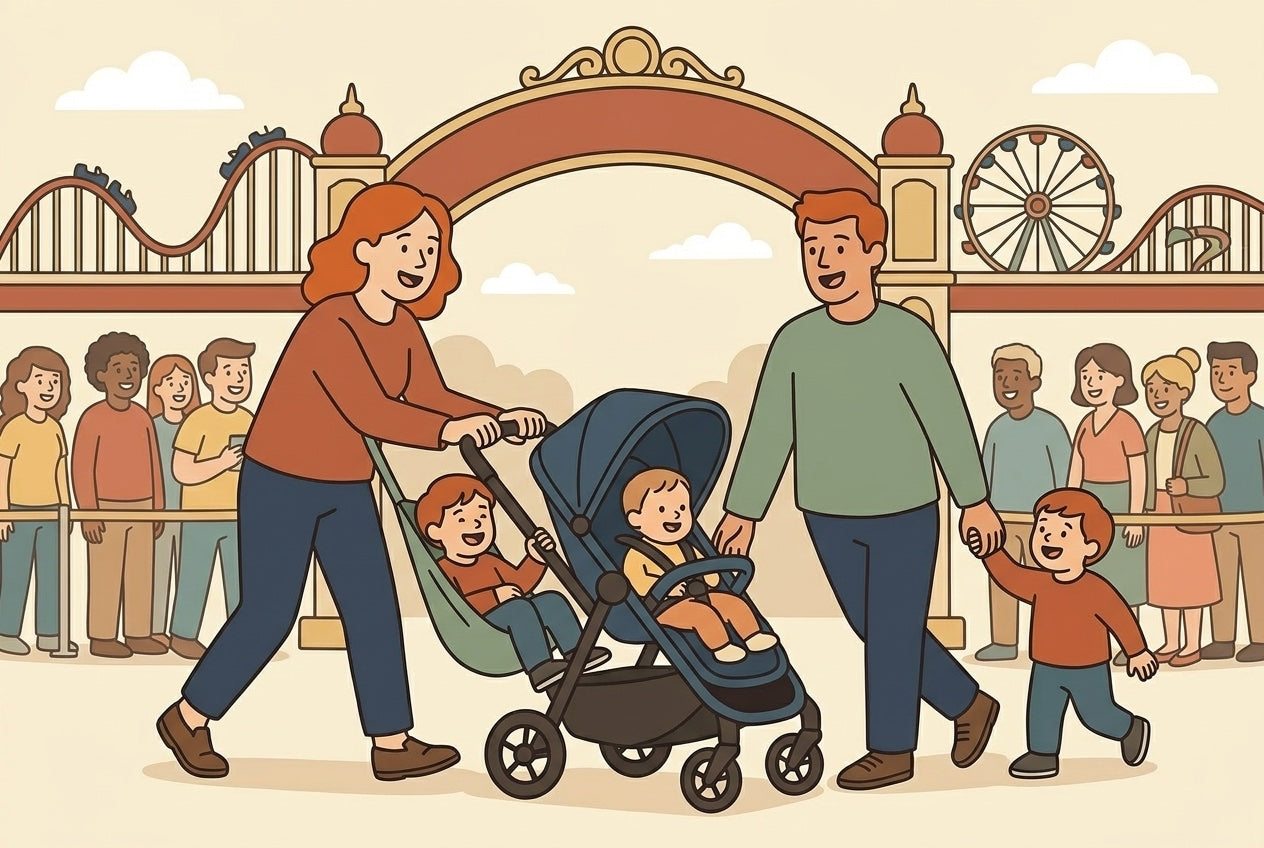
Theme parks are long days in tight spaces. Stroller-parking lanes have width limits, trams have narrow doors, and the queues wind through corridors barely wide enough for two adults side by side. A double stroller that works beautifully at the weekend farmer's market suddenly feels like a ship in a harbour when you're trying to navigate a park at capacity.
Here's the thing: you don't need a bigger stroller for a theme-park day with two kids. You need a smarter one. A single stroller with a hammock seat for your older child gives you three things a rental or a double stroller can't: the width to pass through gates without folding, the comfort your kids already know, and a seat that appears only when the walking stops.
Key Takeaways
Compact strollers navigate theme-park trams, gates, and queues far more easily than double strollers.
A single stroller with an add-on hammock seat is a practical alternative to renting a park stroller for two kids.
Hoppie is designed for children from around 18 months to 5 years old, up to 20 kg / 44 lbs.
Your older child can walk in the morning and rest on the seat when tired legs kick in — usually by mid-afternoon.
If you're unsure whether your stroller will work with Hoppie, send us a photo and we'll help you check.
Why compact wins at theme parks
Walk through any major theme park during a busy season and you'll spot the same scene: a parent wrestling an oversized double stroller around a corner, blocking half the path while the family behind stacks up like slow traffic. It's stressful for everyone — the parent most of all.
Compact strollers don't just feel easier. At theme parks, they are objectively easier, for three specific reasons that matter from the moment you arrive.
Width and tram rules
Most theme parks have a posted maximum stroller width for trams and shuttles — and many park buses are designed with a single stroller lane in mind. If your stroller is wider than the aisle, you fold it. If you have two young children and a fully loaded double stroller, folding is a multi-step operation that holds up everyone behind you.
A single stroller keeps your setup narrow by design. The hammock seat on Hoppie hangs behind the stroller — it doesn't add to the width. You roll through tram doors, turnstile lanes, and shop entrances the same way you would at home on a school run.
Park stroller-parking areas also tend to reward narrow setups. Double strollers take two spaces, get wedged between other pushchairs, and occasionally get moved by staff when the bay fills. A single stroller rolls in, parks in seconds, and is easier to retrieve on the way out.
Length of a typical day
A full day at a theme park is eight to ten hours of walking, queuing, sun, and stimulation. Young children hit their wall hard — usually mid-afternoon — and parents feel it too. The last thing you want at hour seven is to manage a heavy, awkward stroller setup on top of two overtired children.
A single stroller with an add-on seat stays manageable all day. The total footprint doesn't change when your older child climbs on. You don't need to reconfigure, rearrange bags, or find extra space. You just keep walking.
There's also a practical upside for bag storage. Double strollers often have shared basket space under both seats, which sounds useful until you realise the front seat's basket is unreachable with the rear seat occupied. A single stroller keeps your bag in one accessible place under the main seat, exactly where it always is.

The single + hammock seat routine for a park day
Here's what a typical theme-park day looks like with a single stroller and a hammock seat — and why the combination suits the rhythm of a park visit better than any fixed two-seat setup.
Morning energy
Kids arrive at theme parks buzzing. Your toddler or preschooler wants to walk, run ahead, and press every button on every interactive exhibit in the entrance plaza. Let them. In the morning, you don't need a second seat at all.
The baby or youngest child rides in the main stroller seat. Your older child walks alongside. The hammock seat folds flat or stays in your bag — it's not bulky. You push your regular stroller exactly as you would at home. No added width. No awkward second frame trailing behind.
Mid-afternoon collapse
Every parent who has done a full theme-park day with a child between two and five years old knows the mid-afternoon moment. It arrives without warning, usually in a queue far from the stroller-parking bay. "Carry me." "My legs hurt." "I want to go home."
This is where the hammock seat earns its place. You clip it to the rear of the stroller — installation becomes much faster once parents are used to it — and your older child climbs on and settles. They sit facing the crowd as the parade goes past. They watch the street performers from a comfortable, relaxed position. They rest while you keep moving.
Hoppie is designed for children from around 18 months to 5 years old, up to 20 kg / 44 lbs. For most families, that covers exactly the child who runs out of steam at hour five of a park day.
Evening light-show stamina
The evening parade or fireworks show is the reason most families stay until closing. But getting there with two tired children means the stroller needs to keep working long after the legs have stopped.
With both children riding — baby in the main seat, older child on the hammock — you navigate the crowd, find a viewing spot, and stand still for twenty minutes without anyone asking to be carried. Your older child watches the show from a comfortable rear-facing position. You watch it from behind the stroller handle, relaxed for the first time all day.
Always supervise your child while using Hoppie, and follow Hoppie's installation instructions and your stroller manufacturer's maximum load capacity before use.

Renting vs bringing your own stroller
Most large theme parks offer stroller rentals at the entrance. The price varies by park, but the product is almost always the same: a wide, heavy, plastic push-chair sized for a single child, or a side-by-side double for two.
When park rentals make sense
Rentals make sense when travelling light is the priority. If you flew to the destination, took a rideshare to the park, and simply can't carry a stroller, a rental solves the logistics without requiring you to gate-check a pushchair.
They also work if your children are very close in age and both need a proper seat — some park rental doubles are robust enough for a full day. And for families who visit rarely and don't own a suitable stroller, the rental removes the need to buy a travel stroller for one trip.
When they don't
For most families, rental strollers have real drawbacks. Your children don't know the stroller. There's no familiar smell, no favourite reclining angle, no trusted feel — which matters a lot when a tired toddler needs to nap in the seat at hour six.
Rental doubles are also usually wider than a standard single stroller. That means queuing at gates, squeezing through themed areas, and navigating stroller-parking bays all become harder, not easier. The stroller that looks convenient at the rental kiosk becomes a liability by lunchtime.
And the cost adds up. A day rental for a double stroller at a major park is a meaningful expense on top of park tickets, food, and accommodation. A hammock seat used across the whole holiday — hotel corridors, airport terminals, nearby restaurants — spreads that cost across every day you're away.
Hoppie is designed to fit most standard strollers with a stable rear frame. If you're unsure whether your stroller is suitable for a park day with the hammock seat attached, send us a photo and we'll help you check before you travel.

Practical tips for a park day with Hoppie
A few things that make the single + hammock seat combination work even better on a theme-park day:
Practice the installation before you travel. Install and remove Hoppie two or three times at home so it feels automatic. You don't want to read instructions in a stroller-parking bay with two tired children waiting.
Keep the basket accessible. Theme-park days mean bags, snacks, rain ponchos, and sunscreen. Position anything you'll need quickly in the top of the basket before Hoppie is installed, so you're not reaching past the seat mid-day.
Check the stroller's rear clearance. Some strollers have a lower basket that reduces the space available for the hammock seat. Make sure there's enough room behind the main seat when the basket is loaded.
Remove Hoppie before folding. If you're loading it into a park shuttle or folding at a ride entrance, remove the seat first. It takes seconds and protects both the seat and your stroller's frame.
Let your older child decide when to ride. Some children prefer walking for the first half of the day and riding later. Others want to alternate. The hammock seat is easy enough to clip and unclip that you can follow their lead without friction.
FAQs
What stroller is best for a theme park with two kids?
A compact single stroller with a stable rear frame works well for most families. It fits through turnstiles, tram doors, and stroller-parking bays without needing to fold. Adding a hammock seat for your older child gives you a second seat when needed, without the width penalty of a double stroller. The most important thing is a stroller your children are already comfortable in — a familiar setup makes long days much easier.
Can I bring a stroller hammock seat to a theme park?
Yes. Stroller hammock seats are treated like any stroller accessory at most major parks. They don't add meaningful width, and the stroller parks in the same space it always does. Always check the specific park's stroller policy before you visit, as some parks have width or type restrictions. Hoppie keeps your stroller compact, so it's unlikely to trigger any size limits.
Should I rent a stroller at the theme park?
It depends on your trip. If you flew in and can't bring a stroller, a rental is a practical solution. If you drove or are travelling by train, bringing your own stroller is usually better — your children know it, it stores your bags the way you like, and you avoid the rental cost across multiple days. A hammock seat turns your existing single stroller into a two-child setup for the whole holiday.
How wide can a stroller be at a theme park?
Width limits vary by park. Many major parks recommend a maximum width of around 31 inches (approximately 80 cm) for strollers on shuttles and trams. A standard single stroller is well within this. Double strollers — especially side-by-side models — are often at or above this limit. Always check the specific park's stroller policy on their website before visiting, as rules vary and can change between seasons.
When should my older child ride the hammock seat vs walk?
Let your child lead. Most children between two and five walk well in the morning when the energy is high. By early afternoon — especially after lunch, sun, and queuing — tired legs appear fast. That's the moment to clip on the hammock seat. You can leave it attached for the rest of the day and your child can climb on and off as they need. Hoppie is designed for children from around 18 months to 5 years old, up to 20 kg / 44 lbs.
Is it harder to push a stroller with a second child on the back?
You will notice the extra weight — that's honest. But the force is distributed evenly through the rear frame, and most parents find it manageable for a full day. The stroller's original width and turning radius don't change, which is the part that matters most in busy park environments. If you push smoothly and avoid sharp turns at speed, the extra weight is rarely an issue.
Can I use Hoppie on the stroller I'm bringing to the park?
Hoppie is designed to fit most standard strollers with a stable rigid rear frame and enough rear clearance. It is not recommended for ultra-light umbrella strollers without a stable rear frame. If you're unsure whether your stroller is suitable, send us a photo and we'll help you check before you travel.
Keep your stroller compact. Keep the day manageable.
Theme parks are where stroller setup decisions really show themselves. A compact single stroller with a hammock seat handles trams, turnstiles, stroller-parking bays, and tired-toddler moments without making the day harder for you.
Hoppie is for parents who love their stroller but need a smart second seat — for holidays, day trips, and long days at the park when tired little legs need somewhere to land.
Keep the stroller you love. Add a second seat when you need it.
Disclaimer: Hoppie is an independent product and is not affiliated with, endorsed by, sponsored by, or approved by any stroller brand mentioned in this article. Brand names are used only to indicate potential compatibility with certain stroller models. Always follow Hoppie's installation instructions and check your stroller manufacturer's maximum load capacity before use.


