

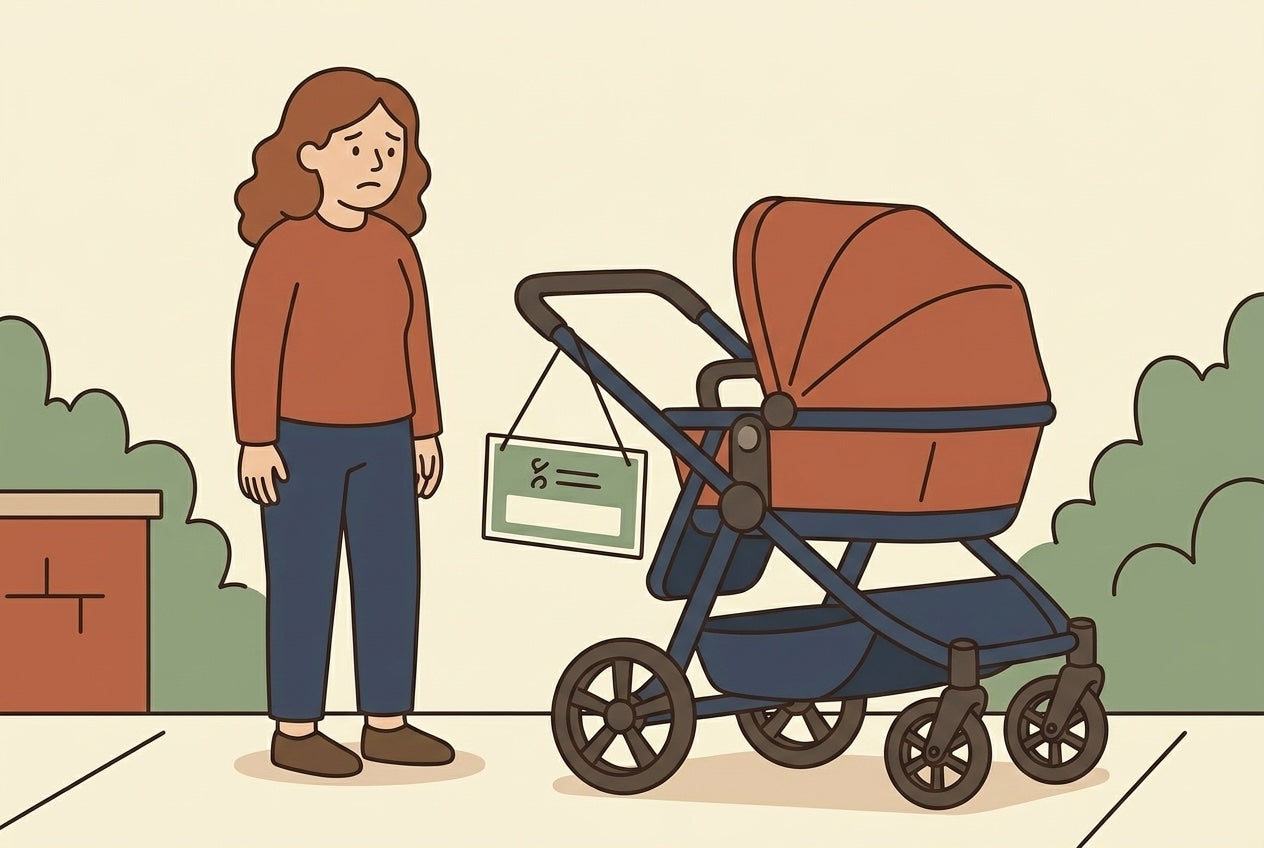
A double stroller sounds practical when you have two young kids. But the moment you start looking at resale listings, the picture changes fast. Double strollers lose a significant chunk of their retail value within the first year or two — and by the time your older child outgrows it, you may get back far less than you expected. Reusing the single stroller you already own, with a compact hammock seat for your older child, is often the smarter financial move from day one.
Key Takeaways
Double strollers depreciate quickly — resale values drop steeply within the first couple of years of use.
Reusing your existing single stroller avoids a large upfront cost and all of the resale risk.
A compact hammock seat costs a fraction of a new double stroller and takes up almost no storage space.
Hoppie is designed for children from around 18 months to 5 years old, up to 20 kg / 44 lbs.
If you're unsure whether your stroller works with Hoppie, tell us the exact brand and model of your stroller and we'll confirm whether Hoppie fits.
The resale math on double strollers
Double strollers are one of the bigger purchases parents make in the baby years. A decent new model can run anywhere from a few hundred to well over a thousand pounds or dollars. And for many families, the plan is simple: use it while you need it, sell it when you're done, and recoup some of that cost.
It's a reasonable plan. It just doesn't always work out that way.
How double strollers depreciate
Strollers, like most baby gear, drop in value fast. A double stroller that's used daily — through all weathers, folded in and out of car boots, scratched in shopping centres, faded in the sun — looks very different at 18 months than it did on day one.
Even well-kept models struggle on the resale market. There are a few reasons for that:
Double strollers have a narrower audience than singles. Not every buyer needs one, which limits competition and keeps prices low.
Buyers shopping second-hand are often cost-conscious by nature. They're looking for a deal, not paying close to retail.
Wear and tear on a double stroller tends to be heavier than on a single, because two children means twice the movement, twice the spills, and twice the frame stress over time.
New models and colours come out regularly, making older versions feel dated faster than parents expect.
Browse any second-hand marketplace in your area and you'll see the pattern: listings for double strollers tend to sit longer, and sellers often drop the price more than once before finding a buyer. The gear that seemed easy to shift at a good price often takes more time — and more compromise on price — than planned.
Which models hold value best?
Some double stroller brands do hold their value better than others. Premium-brand tandem models and side-by-side doubles from well-known manufacturers tend to attract more interest on the used market, especially in cities where those brands are popular.
But even the best-holding models rarely sell for anywhere near what you paid. And the models at the mid-range or budget end of the market can be very difficult to shift at all once they're a year or two old. By then, buyers can often find similar new models on sale for not much more than the asking resale price — which removes the incentive to buy second-hand entirely.
The result: even if you choose carefully, you're unlikely to recover a large share of your original outlay. The depreciation hit is real, and it's worth factoring into the decision before you buy.

Why reusing your single stroller makes financial sense
Here's the thing most parents already know but sometimes overlook when a second baby arrives: you already have a stroller. A good one, probably. One that you paid real money for, that you know how to fold, that fits in your car, that goes through your front door without a fight.
The question isn't really "should I get a double stroller?" — it's "do I actually need to replace the system I already have?"
For a lot of families, the honest answer is no.
No new stroller cost
The most obvious saving is the one you avoid entirely. Not buying a double stroller means not spending the money in the first place. There's no depreciation to worry about because there's nothing new to depreciate. Your existing single stroller holds whatever value it has, and you keep using it for as long as it works.
A compact hammock seat that attaches to the rear of your stroller costs a small fraction of what a new double stroller would. For many parents, that difference is several hundred pounds or dollars — money that stays in the family budget rather than sitting in a piece of gear you'll eventually sell at a loss.
Lower storage and transport costs
Double strollers are large. Even the most compact models take up significantly more car boot space than a single stroller. Side-by-side doubles in particular are wide enough to cause problems at café doorways, shop aisles, lifts, and public transport barriers — all the everyday situations parents navigate constantly.
Reusing your single stroller means none of that changes. Your boot space stays the same. Your stroller still fits through the same doorways. Parking it in the hallway doesn't suddenly become an issue. And if you travel by plane or train, you're still travelling light.
A hammock seat, by contrast, takes up almost no extra space. It packs flat, travels easily, and doesn't change the footprint of your stroller when it's in use. Your older child sits behind the seat rather than beside it, which keeps the whole setup narrow enough for everyday life.

The practical window matters
One thing parents sometimes underestimate is how short the window is when a double stroller is actually useful. You need it once your older child is too big for babywearing but still too young to walk reliably for long distances. That window is typically somewhere between one and three years, depending on your child's stamina and your daily routine.
After that, your older child walks independently most of the time. The double stroller moves from daily use to occasional use to storage — and then to the resale pile.
A hammock seat covers the same window. When your older child is tired, they hop on. When they're not, they walk. It's flexible in a way that a double stroller — which takes up the same space whether one or two children are in it — simply can't be. Hoppie is designed for children from around 18 months to 5 years old, up to 20 kg / 44 lbs, which maps almost exactly to that practical window.
Avoiding the buy-sell cycle
Some parents approach the double stroller question as a buy-used, sell-later strategy: pick up a second-hand model cheaply, use it for a couple of years, and sell it when you're done. In theory, this minimises the financial hit. In practice, it still takes time, energy, and some luck to find the right model in good condition at the right price — and then to find a buyer willing to pay what you're hoping for when you're done.
Reusing your single and adding a compact hammock seat sidesteps the whole cycle. There's nothing to source, nothing to resell, and no gap in the middle where you're hoping the gear holds its value.
Many parents discover that Hoppie helps them avoid the depreciation hit of a brand-new double stroller entirely — not by being a perfect replacement for every situation, but by covering the everyday moments that actually come up most: school runs, shopping trips, holiday walks, and the end-of-day commute home when tired little legs have had enough.
Always follow Hoppie's installation instructions and check your stroller manufacturer's maximum load capacity before use.

Is a hammock seat right for your family?
A hammock seat works best for families who:
Already own a standard single stroller with a stable rear frame.
Have an older child in the 18-month to 5-year range who walks most of the time but needs a rest on longer outings.
Want to keep their current stroller rather than switching to a bulkier double setup.
Don't want to take on the storage, transport, and resale headache of a full double stroller.
It's not the right solution for every family. If both children are very young and neither can walk independently, a double stroller or tandem system may still be the most practical option. But for many families with a baby in the main seat and a mobile toddler alongside, a hammock seat covers the everyday situations that actually come up — without the cost and commitment of a full second stroller.
If you're unsure whether your stroller is a good fit for Hoppie, tell us the exact brand and model of your stroller and we'll confirm whether Hoppie fits.
FAQ
How much do double strollers lose in resale value?
Double strollers tend to depreciate significantly within the first couple of years of regular use. How much you recover depends on the brand, the condition, and demand in your local market — but many parents find they get back a smaller share of the original purchase price than they expected. Premium brands in good condition fare better, but even those rarely sell quickly at a high price.
Which double stroller brands hold value best?
Well-known premium brands tend to hold their value better on the second-hand market, particularly in cities where those brands are popular. That said, even the best-performing models lose a meaningful chunk of their retail price once used. Mid-range and budget models can be very difficult to sell at a price that feels worthwhile.
Is it cheaper to buy a used double stroller instead of buying new?
Buying used does reduce the upfront cost, but it still involves finding the right model in good condition, inspecting it for wear, and then going through the selling process again when you're done. It also means you're still managing a large, heavy piece of gear for the next couple of years. Reusing your existing single stroller with a compact add-on seat avoids all of that.
What do parents typically do with a double stroller when they no longer need it?
Most parents list their double stroller on a second-hand marketplace, donate it, or pass it on to a family member or friend. Selling takes longer than many expect, and prices often need to be dropped to attract buyers. Some parents simply store it — which means the gear takes up space even after it stops being used regularly.
Can I really replace a double stroller with a hammock seat?
For many families, yes — especially when the older child is mobile and mostly walks independently. A hammock seat like Hoppie is designed for children from around 18 months to 5 years old, up to 20 kg / 44 lbs. It gives your older child a place to rest when they need it, without requiring you to push a double stroller on every outing. It won't suit every family or every situation, but it covers the everyday moments that come up most.
Does Hoppie work with my stroller?
Hoppie is designed to fit most standard strollers with a stable rigid rear frame and enough rear clearance. It's not recommended for ultra-light umbrella strollers without a reinforced frame. If you're not sure whether your stroller is compatible, tell us the exact brand and model of your stroller and we'll confirm whether Hoppie fits before you order.
Do I need to remove Hoppie before folding my stroller?
It depends on your stroller. On most compact strollers, take Hoppie off before folding — it takes a few seconds and protects both the stroller frame and Hoppie's straps. On many standard strollers you can fold with Hoppie still attached.
Keep the stroller you love. Skip the resale headache.
You don't have to buy a double stroller, take on the storage, manage the depreciation, and then spend time trying to sell it when your kids outgrow it. Hoppie is a practical alternative for parents who love their stroller and want a smart second seat for an older child — without the cost, the bulk, or the resale risk.
Hoppie is designed for children from around 18 months to 5 years old, up to 20 kg / 44 lbs. It attaches to the rear of your existing stroller and keeps your whole setup compact, narrow, and travel-friendly.
Keep the stroller you love. Add a second seat when you need it.
Disclaimer: Hoppie is an independent product and is not affiliated with, endorsed by, sponsored by, or approved by any stroller brand. Always follow Hoppie's installation instructions and check your stroller manufacturer's maximum load capacity before use. Always supervise your child while using Hoppie.


