

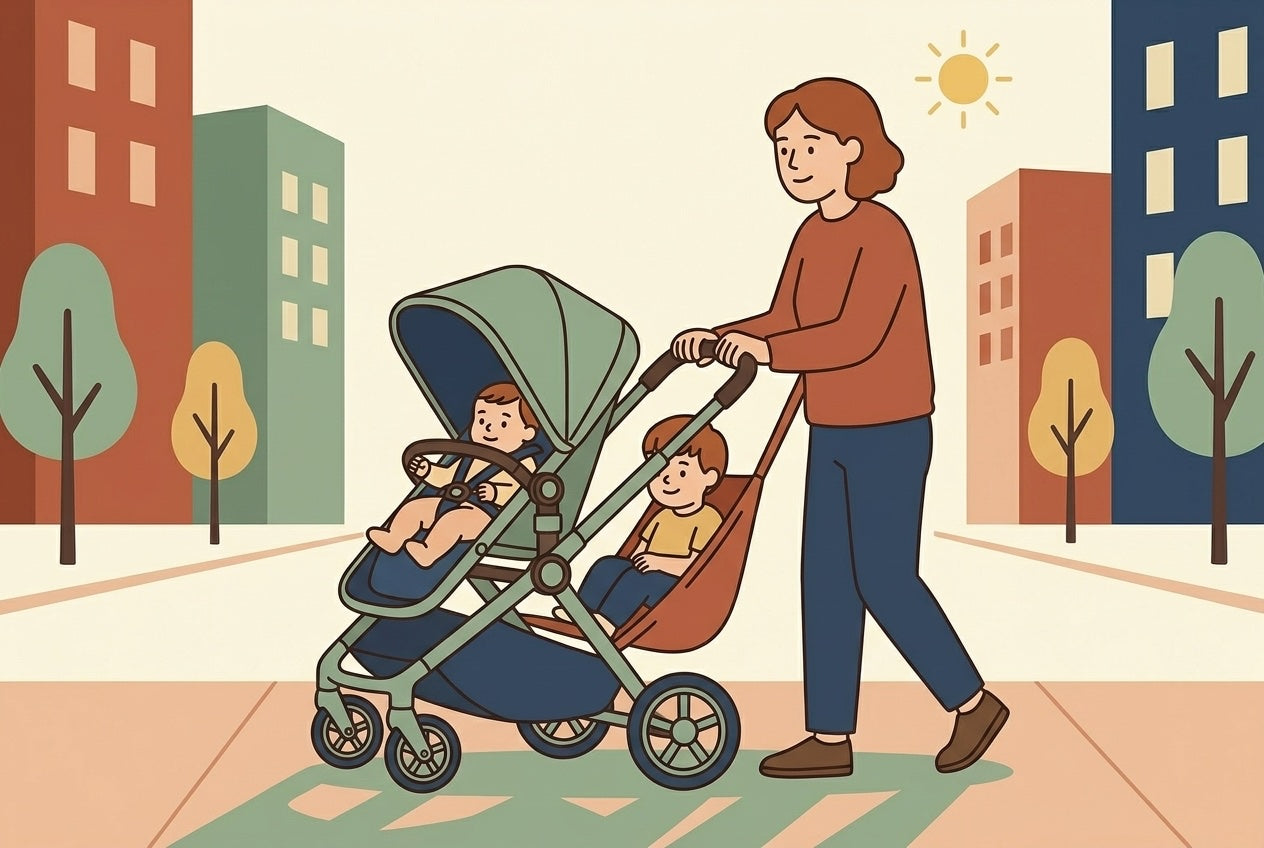
If you own a Cybex-style stroller and your family is growing, you've probably wondered whether you can add a second seat without trading in the stroller you already love. The good news: many Cybex-style strollers have a sturdy, well-built rear frame — exactly the kind that works well with a hammock seat. This guide walks you through what to check, which setups work best, and how parents are actually using these combinations day to day.
Hoppie is an independent accessory and is not affiliated with, endorsed by, sponsored by, or approved by any stroller brand. Brand names, when mentioned, are used only to help parents understand potential compatibility.
Key Takeaways
Many Cybex-style strollers have a rigid rear frame that makes them suitable for a hammock seat.
The rear-frame flex test takes 60 seconds and tells you whether your specific model is a good candidate.
Hoppie is designed for children from around 18 months to 5 years old, up to 20 kg / 44 lbs.
A hammock seat, a kiddyboard, and babywearing are the three main second-child setups for Cybex-style strollers.
If you're unsure whether your stroller will work, tell us the exact brand and model and we'll confirm whether Hoppie fits.
Cybex-style frame characteristics
Cybex has built a reputation around strollers that feel premium from the moment you unfold them — solid metal tubing, satisfying click-locks, and frames that hold their shape year after year. That build quality isn't just nice to live with; it also turns out to be a useful foundation when you want to add a second child to your setup.
Understanding what makes a Cybex-style frame tick helps you figure out which second-child solution will actually work for your family — and which ones to skip.
Rear frame design
Most Cybex strollers in the mid-to-premium range — models like the Gazelle S, the Mios, and the Eezy S Twist+ — are built around a continuous aluminum tube structure. The rear frame runs from the rear axle up through the chassis to the handle bar without a break. There's no fabric panel acting as the structural backbone, and no flimsy plastic rod pretending to be a frame.
What this means in practice: when you press down firmly on the rear handle bar with both hands, it doesn't flex. The frame returns to its exact starting position when you release. That's the single most important quality a rear frame needs for a hammock seat to sit safely and steadily behind it.
The rear bar itself — the horizontal tube the hammock straps grip onto — tends to be smooth and gently curved on most Cybex models. That profile holds straps reliably without letting them creep sideways during a walk. It's one of the reasons parents with these strollers often report a clean, stable installation experience with third-party hammock seats.
One thing worth checking before you order anything: the rear basket. Some Cybex models have a fairly deep basket that sits close to the rear axle. On certain configurations it can reduce the available clearance behind the seat. The general guide is to make sure there's a little clear space behind the seat so your older child's legs have room. On many Cybex models the basket can be repositioned or removed temporarily — worth testing with yours before measuring.
Always check your stroller's manual and maximum load capacity before adding any accessory. Cybex lists the rated total load for each model, and that number needs to account for your baby in the main seat, anything in the basket, and your older child on the hammock seat.

Folding mechanism
Most Cybex strollers fold via a one-hand mechanism that collapses the frame from the middle. It's quick and satisfying — but it does mean the rear zone compresses during the fold.
Whether you need to remove the hammock seat before folding depends on your model. On most compact strollers, take Hoppie off first — it only takes a few seconds and avoids straining the straps. On larger standard strollers, you can usually fold the two together.
The Gazelle S, Cybex's tandem-capable model, has a different frame geometry designed specifically to carry two seats in-line. If you own a Gazelle S, Cybex's own second-seat system is one option, and Hoppie works on the Gazelle S too, as it does on most of the Cybex range.
Setups for second-child use
Once you've confirmed your stroller's rear frame is up to the job, you have a few real options for carrying a second child. Each suits a different age gap, budget, and daily routine. Here's how they compare.
Hammock seat
A rear hammock seat — like Hoppie — hangs from the rear bar of the stroller and gives your older child a place to sit when tired little legs need a rest. It doesn't replace the main stroller seat, doesn't require tools, and keeps the stroller's original footprint in tight spaces.
This works well for parents whose older child is mostly walking but still needs a seat for longer stretches — think school runs, supermarket trips, or a morning at the farmers' market. The child hops on when needed and walks again when they want to. It's flexible in a way that a fixed second seat isn't.
Hoppie is designed for children from around 18 months to 5 years old, up to 20 kg / 44 lbs. As long as your Cybex-style stroller passes the rear-frame check and has enough rear clearance, it's usually a practical fit. If you're not sure, tell us the exact brand and model of your stroller and we'll confirm whether Hoppie fits.
One practical note: always follow Hoppie's installation instructions and check your stroller manufacturer's maximum load capacity before use. The total weight — baby plus older child plus basket contents — must stay within your stroller's rated limit.
Kiddyboard / stroller board
A stroller board (sometimes called a buggy board or kiddyboard) clips to the rear axle and gives your older child a platform to stand on while you push. It's better suited to children who are confident on their feet but still need a ride on longer walks.
On Cybex models, stroller board compatibility varies by model. Some Cybex strollers have their own branded board; others are compatible with universal board systems. Check your model's accessory list before buying — the rear axle shape and wheel distance matter for how cleanly a board attaches.
The trade-off with a stroller board is that your older child is standing, not sitting. For a child who tires quickly or is prone to wanting to be carried, a hammock seat often turns out to be the more restful option.
Babywearing
For parents with a very small age gap — where the younger child can also go in a carrier — reversing the setup sometimes works: younger child in a front carrier, older child in the stroller. This frees up the main seat entirely and makes a second attachment unnecessary.
It's physically demanding over long distances, but it's zero extra equipment and it keeps the stroller's full basket available. Many parents use it as a backup strategy when the hammock seat needs to come off for folding, or when conditions (busy escalators, crowded trains) make a seat attachment impractical.

Real-world use
Knowing the theory is one thing. What does it actually look like to use a hammock seat on a Cybex-style stroller during a normal family week?
City walks
City life with two young children is mostly about transitions: pavement to lift, café to park, school gate to supermarket. A hammock seat earns its place here because it handles those transitions without adding bulk.
Your stroller keeps its standard width. Café doorways, market aisles, and lift doors that comfortably fit your Cybex stroller still fit it with a hammock seat attached. That's a real difference from a double stroller, which often forces you to plan routes around wider gaps.
On school runs, parents typically find a rhythm: younger child goes straight into the stroller, older child walks the first stretch, hops onto the hammock seat when tired, walks again near the school gate. The older child gets some independence; the parent doesn't end up carrying anyone.
One small adjustment most parents make: the basket is slightly harder to access when the hammock seat is in use, because the seat hangs in front of the basket opening. Packing the bag you actually need before setting off — rather than grabbing things from the basket mid-walk — becomes habit pretty quickly.
Travel
Cybex strollers are popular travel companions because they fold compactly and often comply with airline cabin-baggage rules. Adding a hammock seat doesn't change that: Hoppie removes in seconds before folding, and packs into a small carry bag that fits in a suitcase or backpack pocket.
Airports are where parents notice the difference most. Long terminal walks, slow-moving queues, and gate waits are the situations that reliably push a tired toddler past their walking limit. A hammock seat covers all of those without requiring you to hire or borrow an airport stroller or wrestle a double pushchair through security.
For beach holidays, city breaks, and family visits where you know you'll be walking more than usual, packing Hoppie alongside your Cybex stroller takes up almost no extra space and covers a lot of eventualities. It's become a standard part of the travel kit for many parents who started using it at home.
Always supervise your child while using Hoppie, and make sure installation is secure before any extended walk.

FAQs
Can I attach a hammock seat to a Cybex stroller?
In many cases, yes. Most mid-to-premium Cybex strollers have a rigid rear aluminum frame that passes the flex test, and enough rear clearance for a hammock seat. Compatibility depends on your specific model's frame geometry, rear clearance, and total weight capacity. Run the 60-second flex test and check the rear clearance before ordering. If you're unsure, tell us the exact brand and model of your stroller and we'll confirm whether Hoppie fits.
Does Cybex make its own second-seat accessory?
The Cybex Gazelle S has a built-in second-seat system as part of its chassis design. For other Cybex models, Cybex offers stroller boards and seat accessories that are listed as compatible for specific models. Hoppie is an independent third-party product and is not made by or affiliated with Cybex. It is designed to fit most standard strollers with a rigid rear frame — including many Cybex-style models — but you should check your specific stroller before use.
Is the Cybex rear frame stable enough for a child to sit on?
On most mid-to-premium Cybex models, the rear aluminum frame is rigid and doesn't flex visibly under firm hand pressure. That's the baseline a hammock seat needs to sit safely. The best way to know for sure is to do the press-and-flex test: press down firmly with both hands on the rear handle bar. If the frame doesn't bend or creak and returns to position cleanly, it's a strong sign your model is a good candidate.
What load can a Cybex stroller handle with a second child?
Every Cybex model has a maximum total load printed in the manual and usually on a label near the rear wheels. That total includes the child in the main seat, accessories, basket contents, and any add-on seat. Check your model's rated capacity and subtract what's already in it — the remainder is the weight available for your older child on the hammock seat. Hoppie supports children up to 20 kg / 44 lbs, but your stroller's total capacity is the number that matters most.
Do I need to remove the hammock seat before folding my Cybex stroller?
It depends on your model. On most compact Cybex strollers, remove Hoppie before folding — the fold compresses the rear zone, and taking the seat off first avoids straining the straps. On standard strollers you can usually fold both together. Removal takes about ten seconds either way.
Will a hammock seat work with the Cybex Gazelle S?
Yes. The Gazelle S is compatible with Hoppie. Cybex's own in-line second seat is an option if both children need a full seat all day, but if your older child mostly walks and just needs a rest now and then, Hoppie gives you that second seat without the extra length or cost.
Is Hoppie officially endorsed by Cybex?
No. Hoppie is an independent product and is not affiliated with, endorsed by, sponsored by, or approved by Cybex or any other stroller brand. Cybex is mentioned in this article only to help parents understand potential compatibility with certain stroller models.
My child is 4 years old and nearly 20 kg — can they still use Hoppie?
Hoppie is designed for children from around 18 months to 5 years old, up to 20 kg / 44 lbs. The weight limit matters more than the age. Once your child reaches 20 kg, Hoppie should no longer be used. Check your child's current weight from time to time and stop using the seat when they reach the limit.
Keep the stroller you love
You don't need to replace your Cybex-style stroller to handle two kids. For most parents, a hammock seat is all it takes to turn a stroller they already love into a practical two-child setup — without the cost, bulk, or compromise of a double stroller.
Hoppie is designed for children from around 18 months to 5 years old, up to 20 kg / 44 lbs. It's designed to fit most standard strollers with a rigid rear frame — including many Cybex-style models. Check the rear-bar rigidity first, measure your rear clearance, and confirm your stroller's total load capacity. If everything lines up, you're likely a good fit.
Not sure about your specific model? Tell us the exact brand and model of your stroller and we'll confirm whether Hoppie fits before you order.
Keep the stroller you love. Add a second seat when you need it.
Disclaimer: Hoppie is an independent product and is not affiliated with, endorsed by, sponsored by, or approved by any stroller brand mentioned in this article. Brand names are used only to indicate potential compatibility with certain stroller models. Always follow Hoppie's installation instructions and check your stroller manufacturer's maximum load capacity before use.


