

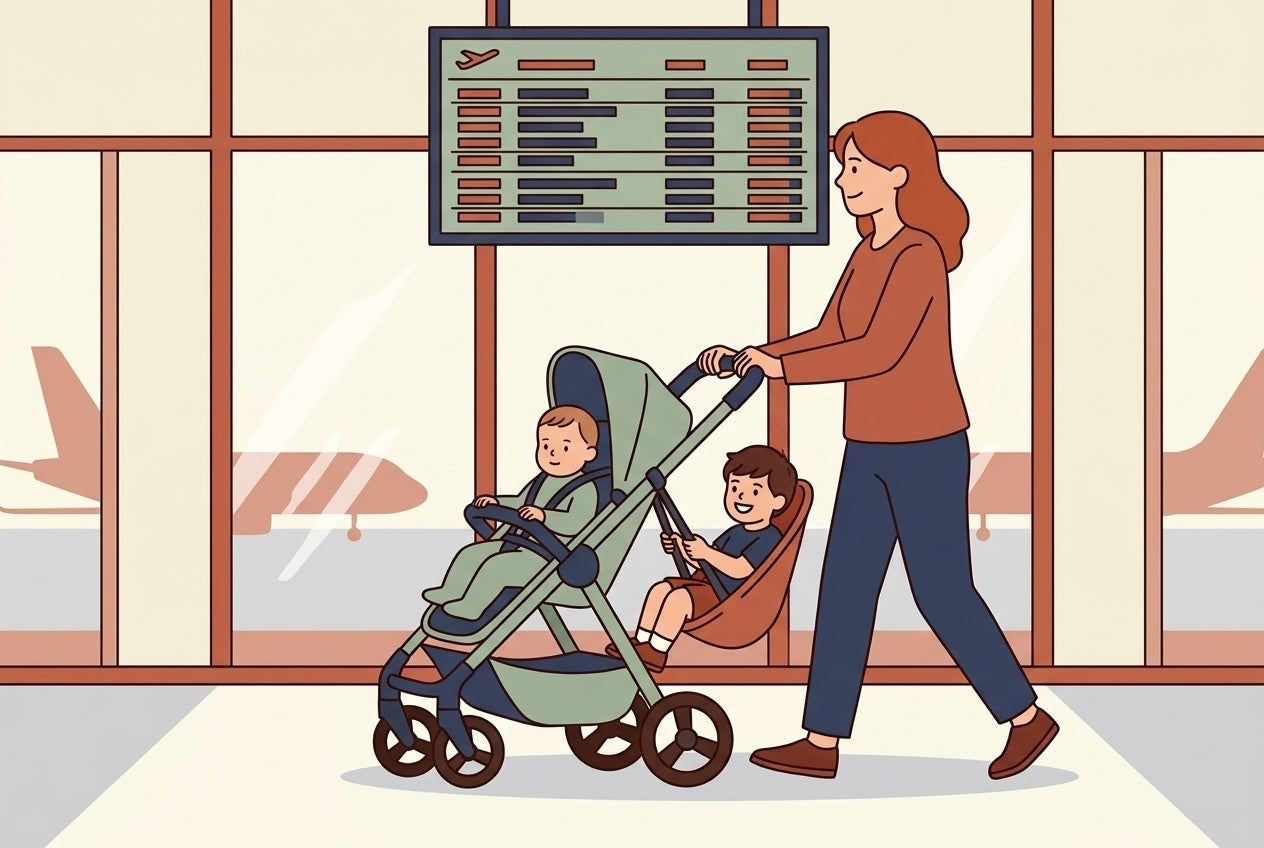
Airports with two young kids tend to fall apart at the same three moments: security, gate transitions, and boarding. Everything between those moments is fine — it's the pinch points that leave you sweaty, apologetic, and carrying a toddler with one arm while pushing a stroller with the other.
The good news is that all three moments are predictable. Which means they're survivable — with the right prep.
Below are 10 practical tips bucketed by travel stage. No fluff, no gear lists that cost a fortune. Just what actually helps when you're navigating a terminal with a baby and a toddler in tow.
Key Takeaways
Pre-pack everything the night before — airport mornings are not the time to improvise.
Snacks and a small screen are your best tools at the gate and during boarding.
Know your airport's stroller policy before you arrive — it saves time at security.
Gate-checking your stroller lets you use it all the way to the plane door.
Hoppie is designed for children from around 18 months to 5 years old, up to 20 kg / 44 lbs — it folds flat and gate-checks alongside your stroller.
Pre-airport prep: win the trip before you leave the house
Most airport disasters start at home. A missing dummy, a half-charged tablet, a snack bag left on the kitchen counter — small oversights become big problems when you're rushing through a terminal with two kids.
Pre-pack the night before
This is not optional. Pack everything — nappy bag, carry-on, entertainment, stroller accessories — the evening before your flight. Not in the morning. Not "mostly the night before." Everything, the night before.
A simple checklist to go through:
Nappies and wipes for at least double the expected journey time. Delays happen.
A change of clothes for each child — and one for yourself.
Baby's feeding supplies in the carry-on, not the checked bag.
Stroller accessories you plan to gate-check stowed in one bag or attached securely.
Documents — passports, boarding passes, travel insurance — in a single dedicated pocket you can reach in ten seconds.
The goal is to arrive at the airport with nothing to think about except your kids. If every item has a home in your bag, you're not searching — you're just reaching.
Snacks and entertainment
Pack more snacks than you think you need. Then add some more. A toddler who is hungry at a departure gate will not wait quietly. A toddler who is snacking will.
For entertainment, one small tablet loaded with downloaded content is worth more than a bag of toys. Keep it charged, keep it in an easy-reach pocket, and save it for the moments you need it most — security queues, boarding delays, and that long taxi to the runway.
Sticker books, small colouring pads, and a couple of familiar snack pouches round out a solid toddler kit. Keep it light. You're already carrying a lot.
If your older child uses a stroller hammock seat for tired moments, make sure it's packed in a way you can reach quickly — a compact seat that folds flat is much easier to manage than a bulky add-on when you're juggling bags and children at the same time.

Security and gate transitions: the hardest part
Security with two young children is the moment most parents dread. It doesn't have to be as bad as you're imagining — but it does require a plan.
TSA and EU security rules for strollers
In most airports, strollers go through the X-ray machine. That means folding it, placing it on the belt, and managing two children at the same time. Here's how to make that as smooth as possible:
Practise folding your stroller with one hand before the trip. Seriously — do this at home.
If your toddler can walk, brief them before you get in the queue: "When I say go, hold my hand and don't let go."
Put your toddler's shoes in your bag the night before if they're easy to slip on — security lanes where you're wrestling small shoes waste everyone's time.
Ask the security officer for help placing the stroller on the belt. Almost all of them will assist — they've seen this before.
In the US, TSA allows formula, breast milk, and baby food in quantities exceeding the standard liquids limit. They may ask to inspect them separately. In EU airports, similar provisions generally apply, but rules can vary by airport. Check the specific rules for your departure airport before you travel — official airport and airline websites publish current guidance.
Stroller add-on accessories — including hammock seats — typically go through the X-ray with the stroller or in a separate tray. They are not considered prohibited items. Detach them before folding so they don't snag on the belt.
Folding strategy
The most stressful stroller moment at security is trying to fold while holding a baby and watching a toddler. Avoid it with a two-step strategy:
Before you reach the belt: remove the hammock seat if attached, fold it flat, and tuck it under the stroller or into your bag. This takes ten seconds when you're not rushed.
At the belt: put your toddler down in a safe spot (beside you, holding your leg), fold the stroller with both hands, place it on the belt. Pick the toddler back up or guide them through.
If you're travelling with a partner, split roles clearly before you arrive: one adult handles the stroller and bags, one adult manages both children. Switching roles mid-security is how things get lost or dropped.
Keeping both kids close
The gap between security and the gate is often the point where toddlers decide to explore. Keep your toddler in the stroller during terminal transitions if possible — it's faster, safer, and uses less of your energy for later.
A tired toddler who walked the whole terminal arrives at the gate already depleted. A toddler who sat in the stroller for the terminal walk has energy left, which sounds counterintuitive — but a calm, comfortable toddler at the gate is much easier to manage during boarding than an overtired, melting-down one.
If your older child is past the age of sitting happily in the main seat but still tires quickly — which is exactly the 18-months-to-5-years window — a compact rear hammock seat gives them a place to rest without you carrying them. That frees your arms for bags, documents, and your baby.

Boarding and onboard: the final push
Boarding is the last high-pressure moment before you can sit down. It tends to involve a narrow jetway, a queue of impatient passengers, and a toddler who has decided now is a good time to not cooperate.
Gate-checking the stroller
Gate-checking means you use your stroller all the way to the plane door, then hand it to the ground crew, who store it in the hold. It's collected again on the jetway (or occasionally at baggage claim — confirm with your airline) when you land.
This is almost always better than bag-checking. Here's why:
You have the stroller for the whole terminal walk, security, and gate wait.
You're not carrying the stroller — it's carrying one of your children.
At landing, you get it back before you reach the terminal, not after baggage claim.
Most airlines allow gate-checking at no extra charge. Confirm with your airline before travel — policies vary, and some low-cost carriers have size restrictions. Ask at check-in if you're unsure.
Fold the stroller and attach a luggage tag (usually provided at the gate). Make sure all accessories are either stowed inside the stroller fold or in your carry-on before you hand it over.
Hammock seat handling at the gate
A compact hammock seat that folds flat is easy to manage at the gate. Remove it from the stroller before folding for gate-check, fold it flat, and either tuck it into your carry-on bag or fold it alongside the stroller (attached loosely so it doesn't fall off on the baggage belt).
Hoppie folds flat and is compact enough to fit alongside a gate-checked stroller or inside a standard carry-on. It is not a prohibited item and does not require special handling. When you collect your stroller at the gate on the other side, re-attach takes only a minute once you're used to it.
Always follow Hoppie's installation instructions and check your stroller manufacturer's maximum load capacity before use.
Onboard kid containment
Once you're on the plane, the stroller is gone and you're in a small seat with two children and whatever you packed in the carry-on. A few things that consistently make this easier:
Window seat for the toddler. They can look out, they can't escape into the aisle, and they feel like they have a special spot.
Save the screen for takeoff and landing. These are the two moments toddlers find most uncomfortable. A familiar show or game during those windows works better than before.
Snacks at altitude. Ear pressure during ascent and descent can be painful for small children. Drinking or chewing helps — have a snack pouch or a sippy cup ready before the seatbelt sign goes on.
Let go of quiet. Your kids will not be quiet the whole flight. That's normal. Most fellow passengers have children or were once small themselves. Focus on keeping your children comfortable, not silent.

One more thing: be kind to yourself
Flying with a baby and a toddler is genuinely hard. Not impossible, not something only "organised parents" can manage — just hard, for everyone, every time. The tips above make it easier. They won't make it effortless.
If your toddler melts down at the gate, that's not a setup issue. If you forgot the dummy and had to buy one overpriced one at the terminal shop, that's not a setup issue. If the whole thing was exhausting and you needed a glass of wine when the kids finally fell asleep — same as the rest of us.
The goal isn't a perfect airport experience. It's a manageable one. With the right prep and a few smart tools, it gets there.
Hoppie is designed for children from around 18 months to 5 years old, up to 20 kg / 44 lbs — a compact second seat that keeps your existing stroller useful through the whole terminal walk, so your tired toddler doesn't become a carried toddler before you've even reached the gate.
Always supervise your child while using Hoppie. Hoppie should only be used with strollers that have a stable rear frame and enough rear clearance.
FAQs
Can I bring a stroller hammock seat through airport security?
Yes. A hammock seat is not a prohibited item and goes through the X-ray machine the same way any stroller accessory does — either attached to the folded stroller on the belt or in a separate tray. Detach it before folding the stroller so it doesn't snag. Check the latest guidance from your specific airport or airline if you want to confirm before travel.
Should I gate-check or bag-check my stroller?
Gate-checking is almost always better when you have two young children. You keep the stroller for the entire terminal experience — security, the gate walk, the boarding queue — and collect it again on the jetway when you land. Bag-checking means carrying both children through the terminal without it. Confirm your airline's gate-check policy before travel, as some low-cost carriers have size restrictions.
What's the best airport routine with two kids?
Arrive early — at least two hours for domestic and three for international. Pack everything the night before. Keep your toddler in the stroller for all terminal transitions to save their energy for boarding. Save screen time and special snacks for the highest-stress moments: security queues, boarding delays, and takeoff. Have documents in one easy-reach pocket. Split roles clearly with your travel partner if you have one.
Are stroller attachments allowed on planes?
Stroller attachments — including hammock seats, boards, and organisers — are not prohibited items on planes. They travel in the aircraft hold when gate-checked with the stroller, or in your carry-on if they fold compactly enough. A flat-folding hammock seat typically fits in a standard carry-on alongside your other items. Check your airline's carry-on size limits if you plan to bring it on board rather than gate-checking it.
How do I manage security with a baby and a toddler on my own?
Practise folding your stroller one-handed before the trip. Ask the security officer for assistance placing the stroller on the belt — they will almost always help. Put your toddler's shoes in your bag the night before to save time at the tray. Brief your toddler in advance with a simple instruction: "Hold my leg until I say go." Security officers are generally patient with parents travelling solo — don't be afraid to ask for a moment.
Does Hoppie work for travel days and airport walks?
Hoppie is designed for exactly the kind of long walking days that travel involves — airports, train stations, theme parks, city breaks. It is designed for children from around 18 months to 5 years old, up to 20 kg / 44 lbs, and keeps your existing stroller compact rather than requiring a bulky second pushchair. It folds flat for gate-checking alongside your stroller. If you're unsure whether your stroller is compatible, send us a photo of the rear frame and we'll help you check.
What should I do if my toddler refuses to stay in the stroller at the airport?
Let them walk short stretches where it's safe and you have enough time — being allowed to walk gives toddlers a sense of control and reduces resistance. Then use the stroller for the longer terminal stretches. A hammock seat at the back can feel less "babyish" to a toddler who resists being in the main seat, which sometimes makes it easier to get cooperation. Having a snack or a small activity ready for the moment they get back in also helps.
Hoppie for travel days
Airports are one of the best arguments for a compact second seat. Long corridors, long queues, long waits — exactly the moments when a toddler who was walking fine ten minutes ago suddenly can't take another step.
Hoppie is a practical alternative to a double stroller for parents who don't want to replace the stroller they already love. It keeps your setup compact — narrow enough for airport queues and jetways — and gives your older child a place to rest when tired little legs give out.
Designed for children from around 18 months to 5 years old, up to 20 kg / 44 lbs. Folds flat. Gate-checks with your stroller.
Disclaimer: Hoppie is an independent product and is not affiliated with, endorsed by, sponsored by, or approved by any stroller brand. Always follow Hoppie's installation instructions and check your stroller manufacturer's maximum load capacity before use. Always supervise your child while using Hoppie.


