

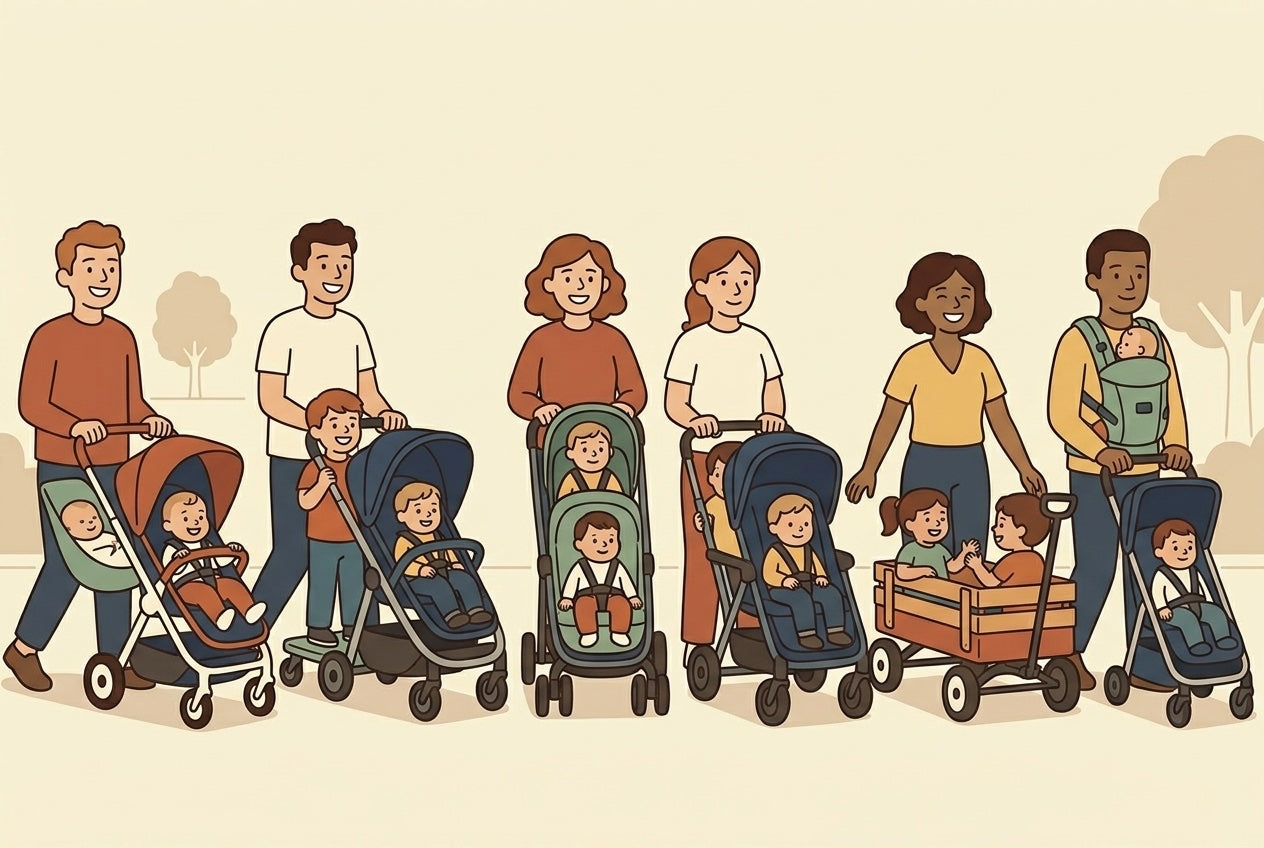
You don't want a double stroller. They're heavy, wide, expensive, and most families outgrow them faster than expected. But you have two kids — and the older one's legs give out at the worst possible moment.
Good news: there are now six compact alternatives that actually work, each suited to a different kind of family. This guide breaks them all down — what they cost, how they feel in real life, and which one is right for you.
Key Takeaways
A hammock seat is the lightest and most affordable option for parents who want to keep their existing stroller.
Stroller boards work well for short trips but aren't designed for tired children who need to sit.
Compact tandems and sit-and-stand strollers give you two full seats but add weight and bulk.
Wagons are brilliant in parks and beaches but impractical for city streets and public transport.
The right choice depends on where you live, how you travel, and how old your children are.
The 6 compact double-stroller alternatives reviewed
Here's the full lineup, from lightest to most substantial. Each has a real place in family life — none of them are the right answer for every parent.
1. Hammock seat
A hammock seat attaches to the rear frame of your existing single stroller and gives your older child a place to sit when their legs give out. The child sits in a compact fabric sling behind the main seat, facing the same direction.
Hoppie is designed for children from around 18 months to 5 years old, up to 20 kg / 44 lbs. It attaches to most standard strollers with a stable rear frame, and it comes off again without tools in seconds.
Best for: parents who already own a stroller they love and want the lightest possible add-on. City streets, shopping centres, airport runs, school pickups.
Typical price: lowest cost of all the options on this list.
Honest trade-off: it works with most strollers that have a rigid rear frame, including many compact travel strollers. The only real exception is the basic umbrella stroller with no rigid rear frame. If you're unsure whether your stroller is compatible, tell us the exact brand and model of your stroller and we'll confirm whether Hoppie fits.
2. Stroller board
A stroller board clips to the rear axle of your stroller and gives your older child a small platform to stand on. The child rides standing up, feet on the board, holding onto the back of the main seat or a grab handle.
Best for: children who can stand independently and cooperate — generally three years old and up. Short walks where the older child mostly wants to coast rather than be fully carried.
Typical price: budget-friendly, usually slightly more than a hammock seat.
Honest trade-off: when a child is genuinely tired, standing on a board is not comfortable for long. And a standing child who loses balance is harder to manage than one sitting in a secure seat. Boards work best for energetic older kids who want to feel independent, not for genuinely exhausted toddlers.
3. Compact tandem stroller
A compact tandem puts one child in front of the other in a narrow front-to-back arrangement. Both children sit. The total footprint is longer than a single stroller but no wider, which makes it more city-friendly than a traditional side-by-side double stroller.
Best for: families with two children close in age who both still need a full seat for longer outings — full days at theme parks, long travel days, extended family walks.
Typical price: significantly higher than a hammock seat or board. Budget for the mid-to-upper range of stroller pricing.
Honest trade-off: compact tandems are genuinely useful but they're a second stroller — more storage space needed, harder to lift into car boots, heavier to fold. They work best when both children are in a stroller-age phase at the same time, which narrows the useful window.
4. Sit-and-stand stroller
A sit-and-stand combines a traditional front seat for the younger child with a rear platform that the older child can either stand on or, in many models, fold out into a small seat. It's a popular middle ground.
Best for: families where the age gap is two to four years and the older child wants flexibility — sometimes sitting, sometimes standing, sometimes walking alongside.
Typical price: mid-range. More than a board or hammock seat, less than a full premium tandem.
Honest trade-off: sit-and-stand models are wider than a standard single stroller and longer than a hammock-seat setup. Some rear seats are quite small for older children who are genuinely tired. Worth checking seat dimensions before buying.

5. Family wagon
A family wagon is a four-wheeled, pull-handle cart with a spacious interior where two or more children can sit together with room for bags, snacks, and outdoor gear. In recent years, folding wagons have become increasingly popular at beaches, campsites, and theme parks.
Best for: outdoor settings where you have wide paths and flat ground — parks, beaches, festivals, campsites. Brilliant for families who spend a lot of time outdoors rather than in cities.
Typical price: varies widely, from budget to premium. The better-built folding wagons sit at the mid-to-high end.
Honest trade-off: wagons are genuinely uncomfortable on narrow city pavements, completely impractical on public transport, and struggle on kerbs. They're large to fold and take up serious car-boot space. If most of your daily life involves city streets, a wagon is a weekend toy, not a daily solution.
6. Babywearing + single stroller
This is the lowest-cost setup: baby goes in a soft-structured carrier or wrap, older child gets the stroller seat. Or vice versa — older child in the carrier (up to their weight limit), baby in the stroller.
Best for: families with a newborn or young baby and a toddler who still needs a stroller seat. Works surprisingly well in the early months before the baby is old enough to sit in the stroller.
Typical price: if you already own a carrier, this costs nothing extra.
Honest trade-off: carrying a baby for hours is physically demanding, especially on longer days. Back discomfort is common after two or three hours. This works well as a short-to-medium-distance solution, but most parents need something else for full days out.
Comparison: price, weight, and age range at a glance
Here's how the six options stack up on the factors that matter most to parents choosing between them.

Hammock seat
Cost: lowest on the list
Added weight to stroller: very light — the seat itself weighs very little
Age range for the riding child: around 18 months to 5 years, up to 20 kg / 44 lbs
Keeps stroller width: yes — the child sits behind, not beside
Stroller board
Cost: budget-friendly
Added weight: light, but child's standing weight shifts stroller balance
Age range: generally 3 years and up; child must stand unaided
Keeps stroller width: yes
Compact tandem
Cost: significantly higher — this is a second stroller purchase
Added weight: heavy — the stroller itself is a full unit
Age range: newborn to around 4 years in front; older toddler in rear
Keeps stroller width: yes, but adds length
Sit-and-stand
Cost: mid-range
Added weight: moderate — heavier than a single stroller
Age range: baby in front; toddler or preschooler in rear platform
Keeps stroller width: approximately, but wider than a standard single
Wagon
Cost: varies — budget to high-end
Added weight: heavy when folded; bulky to transport
Age range: wide — often from around 6 months with insert, up to school age
Keeps stroller width: no — wagons are wide
Babywearing + stroller
Cost: free if you own a carrier
Added weight: none to the stroller; parent carries the child
Age range: carrier limits vary — typically up to around 20 kg
Keeps stroller width: yes
Which option fits your situation?
No single solution is best for every family. Here's how to think about it based on where you live and how you spend your days.

If you live in a city
City life means narrow doorways, busy streets, lifts that barely fit one stroller, and public transport where a wide setup is a daily headache. For city parents, keeping your stroller's original footprint is almost always worth prioritising.
A hammock seat is the strongest choice here. It adds a second child without adding width. A stroller board also keeps the footprint small. Wagons and tandems are harder to manage in city daily life.
If you travel frequently
Travel parents — holidays, airports, long weekends away — need something that packs down small and doesn't create extra baggage. The last thing you want is a second large piece of equipment to manage at the check-in desk.
A hammock seat attaches and detaches quickly and takes up almost no space in a bag. Babywearing is also a great complement for airport walking, when a stroller sometimes can't be used right up to the gate. A compact tandem can work for frequent flyers who travel long-haul with young children, but it's a big commitment in terms of luggage.
If you live in the suburbs or countryside
More space, wider paths, a car available most of the time. Suburban and rural parents have more flexibility in what they can use day-to-day — and more likely to spend time in parks, beaches, and open green spaces.
A wagon is genuinely appealing for this lifestyle. A sit-and-stand or compact tandem is also easier to manage when you're not trying to squeeze through city corridors. That said, if school runs and shopping trips are part of the routine, the compact arguments still apply.
FAQs
What is the best double-stroller alternative in 2026?
There's no single best answer — it depends on your children's ages, your lifestyle, and your existing stroller. For parents who already own a stroller they love, a hammock seat is usually the most practical and affordable option. For families who need two full seats, a compact tandem or sit-and-stand tends to work better.
Is a wagon better than a double stroller?
In outdoor settings with wide paths — parks, beaches, campsites — a wagon can be more relaxed and spacious than a traditional double stroller. But in cities, on public transport, or anywhere with narrow spaces, wagons are much harder to manage than a stroller-based solution. They're brilliant for some families and impractical for others.
What's the lightest double-stroller alternative?
A hammock seat is the lightest option on this list. It adds very little weight to your existing stroller and keeps the original footprint intact. Stroller boards are also lightweight, though the standing child adds a different kind of load to the stroller's balance.
Are sit-and-stand strollers worth it?
They can be, especially when there's a two-to-four-year age gap and the older child still needs to sit regularly. The main limitations are that many rear platforms are quite small, and the overall stroller is heavier and wider than a single-stroller setup. Worth test-pushing in a shop before buying if possible.
At what age can a child use a hammock seat?
Hoppie is designed for children from around 18 months to 5 years old, up to 20 kg / 44 lbs. The right age depends more on whether your child can sit upright independently and hold a natural seated position than on the number itself.
Can I use a stroller board if my child is tired?
A stroller board works best for children who are happy to stand. When a child is genuinely exhausted, standing on a board is uncomfortable and they're more likely to fall or need to be carried. A seated solution — hammock seat, sit-and-stand, or tandem — is better for genuinely tired children.
Do any of these alternatives work with most strollers?
A hammock seat works with most standard strollers that have a stable rear frame. Stroller boards have varying compatibility depending on the rear-axle design of your stroller. Compact tandems and sit-and-stands are standalone strollers, so compatibility with your existing stroller isn't relevant. Always check compatibility details before buying any accessory.
Hoppie: the compact answer for parents who love their stroller
Among all the options on this list, a hammock seat sits at the lightest, most affordable end — and it's the only solution that keeps your existing stroller exactly as it is.
Hoppie is for parents who love their stroller but need a smart second seat. It attaches to the rear frame without tools, stays compact on city streets, and tucks away just as quickly when your older child decides they want to walk again.
Hoppie is designed for children from around 18 months to 5 years old, up to 20 kg / 44 lbs. It is designed to fit most standard strollers with a stable rear frame — not recommended for ultra-light umbrella strollers without a stable rear frame. If you're not sure whether your stroller is compatible, tell us the exact brand and model of your stroller and we'll confirm whether Hoppie fits.
Keep the stroller you love. Add a second seat when you need it.
Disclaimer: Hoppie is an independent product and is not affiliated with, endorsed by, sponsored by, or approved by any stroller brand mentioned in this article. Brand names are used only to indicate potential compatibility with certain stroller models. Always follow Hoppie's installation instructions and check your stroller manufacturer's maximum load capacity before use.


