

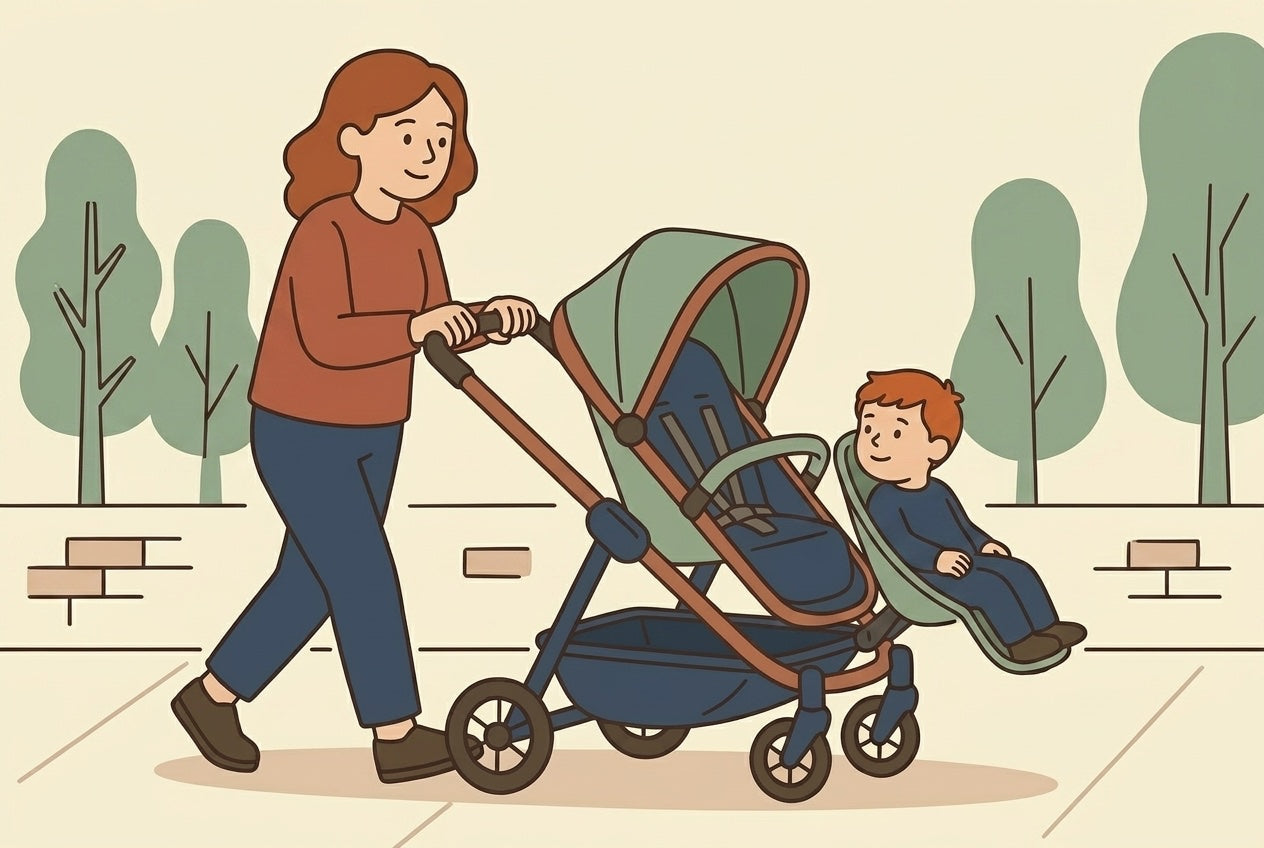
When your toddler is riding on a stroller hammock seat, supervision isn't a legal footnote — it's the most important thing you can do. A hammock seat is designed for walking-pace use with an attentive adult right there. These 7 rules keep that promise simple and easy to remember, every single walk.
Key Takeaways
Always keep at least one hand on the stroller handle when a child is in the hammock seat.
Hoppie is designed for children from around 18 months to 5 years old, up to 20 kg / 44 lbs.
Take your child off the seat before escalators, stairs, steep slopes, or busy road crossings.
Never leave a child unattended in a hammock seat — not even for a moment.
Apply the parking brake whenever the stroller is stationary and a child is in the seat.
The 7 supervision rules — your quick reference
Here they are, all in one place. The sections below explain each one in plain language.
Keep both hands on the handle at all times while moving.
Keep your child in your line of sight — always.
Walk at a steady, calm pace. No running, no sudden stops.
Apply the parking brake every time you stop.
Slow right down at curbs — step down carefully and in control.
On slopes, keep the stroller in front of you and your full weight on the handle.
Lift your child off the seat before escalators, stairs, or any difficult terrain.
The 7 rules — in detail
Rules 1–4: Hands, eyes, pace, and brake
Rule 1 — Both hands on the handle. When your child is in the hammock seat, the stroller needs full control at all times. That means both hands on the handle — not one hand texting, not a hand in a bag. Your grip is what keeps the stroller moving straight and stable. If you need to use your hands for something, stop first, apply the brake, and only then let go of the handle.
Rule 2 — Eyes on your child, always. A hammock seat sits behind the main stroller seat, which means your child is right in front of you — closer than they'd be in a double stroller side-by-side. This makes it easy to glance back regularly. Make it a habit: every time you look up at the road, look back at your child too. If something feels off — unusual quiet, a sudden shift in weight — stop and check immediately.
Rule 3 — Calm, steady walking pace. A hammock seat is designed for walking, not running. Sudden acceleration or a sharp, unexpected stop creates a jolt that can shift a small child forward. If you need to speed up — say, to cross before a light changes — take your child off the seat first. Steady, unhurried walking keeps the ride smooth and comfortable for everyone.
Rule 4 — Brake every time you stop. This one sounds obvious, but it's easy to forget in the middle of a busy school run. Any time you stop moving — whether to wait at a crossing, browse a shop window, or chat to another parent — apply the parking brake. Strollers can roll on any surface with even a tiny incline. With an older child in the back, an unbraked stroller that starts rolling is a serious risk. Brake first. Always.

Rules 5–7: Curbs, slopes, and transitions
Rule 5 — Slow down at curbs. Stepping down a curb with a loaded stroller is one of the most common moments for a stumble, and with two children on board there's simply more weight to control. Approach curbs slowly, tilt the stroller back gently onto the rear wheels, and step down in a controlled, deliberate movement. Don't rush it. A two-second pause at every curb costs you nothing.
Rule 6 — Keep control on slopes. On any downhill slope, let the stroller move in front of you — not beside you, not behind you. Keep your full weight on the handle. Use the brakes if your stroller has adjustable friction or a slope brake. If the slope is steep or the surface is wet, take your child off the seat before descending. Gravity works against you faster than you expect, and recovering a rolling stroller with two children on board is very hard.
Rule 7 — Lift your child off before difficult terrain. Some surfaces simply aren't right for a hammock seat: escalators, flights of stairs, very uneven cobblestones, gravel paths, or any surface where you can't roll the stroller smoothly. Before you approach any of these, stop, remove your child from the seat, and carry them through. It takes 30 seconds and completely removes the risk. The hammock seat is for calm, everyday walking surfaces — pavements, shopping centres, parks, airports. That covers the vast majority of your day.
When to take your child off the seat
Escalators, stairs, and busy crossings
Escalators and strollers are already a tricky combination. Add a child in a rear hammock seat and the geometry becomes even more awkward. Most transport authorities advise against using escalators with loaded strollers at all — use the lift whenever one is available.
If there is no lift and you must use the escalator, take your child off the hammock seat first. Hold your child, fold or manage the stroller separately, and use the escalator in a controlled way. No convenience is worth the risk of an escalator stumble with a child in your arms and a stroller behind you.
Stairs follow the same logic. If you're on public transport and need to carry the stroller up or down stairs, your child should be out of the seat before you start. Carrying a loaded stroller up a flight of stairs is exhausting and unstable. Always remove your child first.
At busy road crossings — particularly those with fast-moving traffic, narrow kerbs, or a rush of pedestrians — slow down, apply the brake at the edge, wait for a clear signal, and cross in a calm, controlled way. If the crossing feels chaotic or rushed, wait for the next signal. It's always worth the extra minute.

When your child falls asleep
This is a situation many parents don't think about in advance: what happens if your toddler falls asleep in the hammock seat?
A hammock seat is not designed for sleeping children. When a child is awake, they naturally hold their posture and shift their weight with the stroller's movement. When they're asleep, their head droops forward, their body slackens, and they can lean in directions that the seat isn't shaped to support safely.
If your child falls asleep in the hammock seat, move them to the main stroller seat as soon as it is safely possible, where they can recline and sleep in a supported position. If the main seat is occupied, carry your child or find a safe place to stop and settle them. Always supervise your child while using Hoppie — a sleeping child still needs your full attention.
The simplest prevention: on walks where your child is likely to fall asleep (long outings, post-lunch walks, travel days), put them in the main seat from the start and use the hammock seat for short bursts when they've woken up and want to ride.

A note on everyday reality
None of these rules are difficult. Most of them are things you already do instinctively — you brake when you stop, you slow for curbs, you keep your child in sight. The difference is making these habits automatic, so they happen even on your busiest, most distracted mornings.
Hoppie's weight goes down onto the frame, between the rear wheels, so the stroller stays balanced. What you'll notice is a little extra weight when pushing uphill or taking curbs — nothing dramatic, but worth being aware of the first few times you use it.
Most parents find that after a week of regular use, all of this becomes second nature. The stroller feels familiar again, and the extra supervision habits are just part of the walk. Hoppie is designed for children from around 18 months to 5 years old, up to 20 kg / 44 lbs — the age when toddlers are mobile, curious, and can communicate when something feels wrong. That helps.
Always follow Hoppie's installation instructions and check your stroller manufacturer's maximum load capacity before use. Hoppie should only be used with strollers that have a stable rear frame and enough rear clearance.
FAQs
Can I leave a toddler unattended on a stroller hammock seat?
No. A child should never be left unattended in a hammock seat — not even for a moment. The hammock seat is designed for use with an adult actively holding the stroller. If you need to step away, even briefly, take your child off the seat and apply the parking brake before you move.
Is it safe for a child to sleep in a hammock seat?
No. A hammock seat is not designed for sleeping children. When asleep, a child's head droops and their posture becomes unsupported. If your child falls asleep in the hammock seat, move them to the main stroller seat as soon as safely possible, where they can recline properly.
Can I use an escalator with a child in the hammock seat?
No. Always remove your child from the hammock seat before using an escalator. Most transport authorities advise against using escalators with loaded strollers at all. Use the lift wherever possible. If no lift is available, take your child off first and manage the stroller separately.
What should I do at a busy road crossing?
Approach slowly, apply the parking brake at the kerb edge, and wait for a clear signal before crossing. Don't rush a crossing even if the light is changing — it's always safer to wait for the next one. Step down the kerb in a slow, controlled movement with both hands on the handle.
Does having a child in the hammock seat change how the stroller handles?
Only a little. Hoppie's weight goes down onto the frame between the rear wheels, so the stroller stays balanced; you'll mainly feel the extra weight at curbs and on slopes, where a little more attention is needed. Most parents find they adapt quickly — typically within a few outings — and the stroller feels completely normal again.
How old and how heavy does a child need to be to use the hammock seat?
Hoppie is designed for children from around 18 months to 5 years old, up to 20 kg / 44 lbs. If your child is younger than 18 months, not yet steady enough to sit independently, or above the weight limit, the hammock seat is not the right solution at this stage.
What terrain is the hammock seat designed for?
The hammock seat is designed for calm, everyday walking surfaces — pavements, shopping centres, parks, and airport terminals. It is not designed for stairs, escalators, steep slopes, or very uneven surfaces such as heavy gravel or cobblestones. On those surfaces, remove your child from the seat first.
What if I'm not sure whether my stroller is right for a hammock seat?
If you're unsure whether your stroller will work, tell us the exact brand and model of your stroller and we'll confirm whether Hoppie fits. Compatibility depends on the stroller's rear frame, space, and total weight capacity — and our team can help you work through it before you order.
Use Hoppie with confidence — and a watchful eye
A hammock seat is one of the most practical tools a parent of two can have. It turns a tired toddler's "carry me" into a calm, comfortable ride — without a bulky double stroller, without the stress, and without replacing the stroller you already love.
The 7 rules above aren't complicated. They're the habits that make every walk — school runs, errands, travel days, weekend park trips — feel smooth and in control. Keep your hands on the handle, your eyes on your child, and your pace steady. That's the whole game.
Hoppie is designed for children from around 18 months to 5 years old, up to 20 kg / 44 lbs. Use it only at walking pace, always with active adult supervision, and follow the installation instructions each time.
Hoppie is an independent product and is not affiliated with, endorsed by, sponsored by, or approved by any stroller brand. Always follow Hoppie's installation instructions and check your stroller manufacturer's maximum load capacity before use. Always supervise your child while using Hoppie.


