

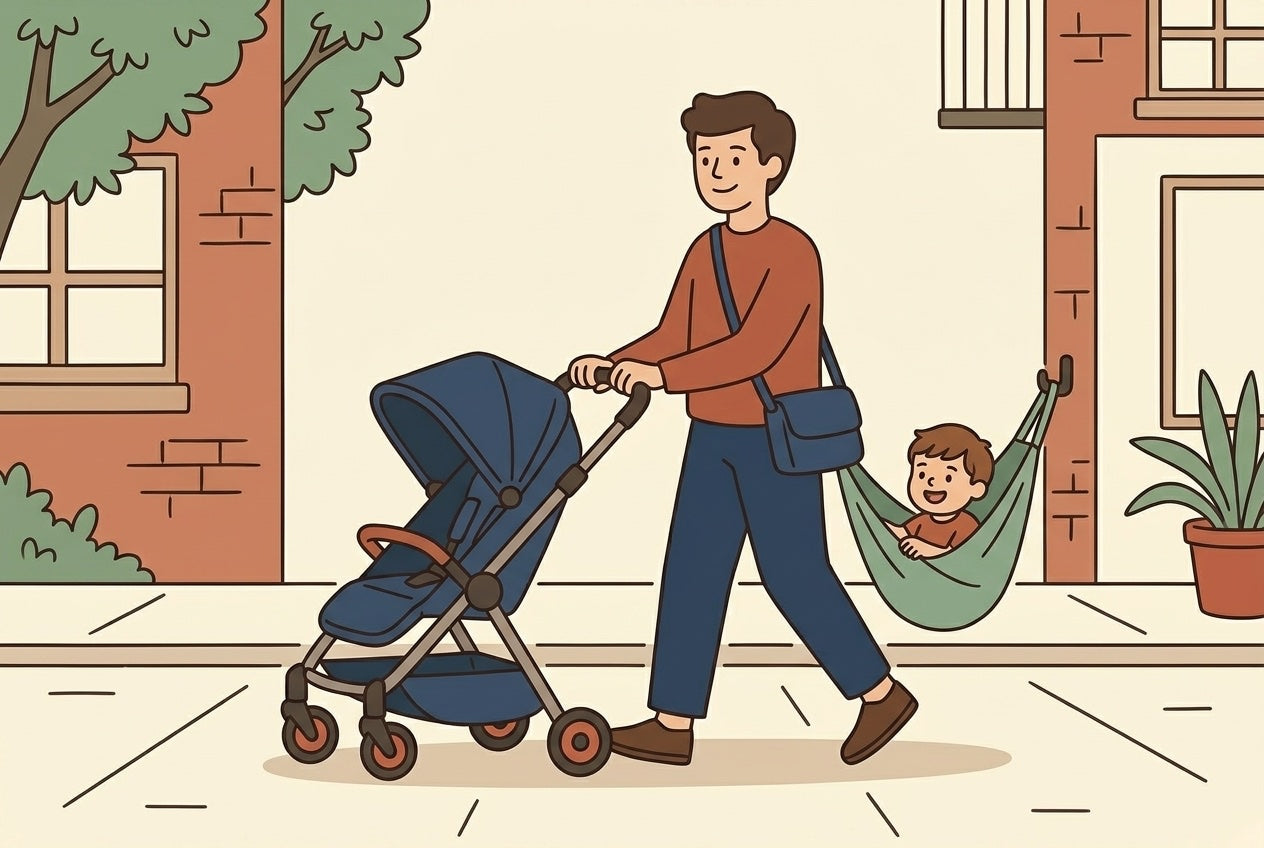
Many parents with a compact city stroller — like a Babyzen Yoyo or a similar foldable model — wonder whether they can add a second seat for an older child who's run out of steam. The good news: a lot of these strollers do have a rigid enough rear frame to host a hammock seat. But you need to check three things before you order anything. This guide walks you through those three checks, the most common setups parents try, and the situations where a hammock seat simply isn't the right answer.
Hoppie is an independent accessory and is not affiliated with, endorsed by, sponsored by, or approved by any stroller brand. Brand names, when mentioned, are used only to help parents understand potential compatibility.
Key Takeaways
Compact city strollers with a rigid rear frame can often host a hammock seat — but always check first.
The three things to check: rear-frame rigidity, rear-space clearance, and total load capacity.
Hoppie is designed for children from around 18 months to 5 years old, up to 20 kg / 44 lbs.
Not all Yoyo-style strollers pass the rigidity test — ultra-light models with fabric backs usually don't.
If you're unsure, send us a photo of your stroller and we'll help you check.
The 3 checks for compact city strollers
You love your compact stroller. It folds small, fits in the overhead bin, and navigates a busy coffee queue without drama. The last thing you want is to replace it just because your older child's legs are tired again. A hammock seat attached to the rear is a practical way to give that stroller a second seat — without giving up its compact footprint.
But compact doesn't always mean rigid. And a hammock seat puts real load on the rear of the stroller, so the frame needs to be up to the job. Here are the three things you need to check before anything else.
Rear-frame rigidity
This is the most important check. Stand behind your stroller and press down on the rear handlebar with both hands — use a firm, even pressure, roughly half your body weight. Hold for two seconds, then release.
What you're looking for:
The rear tubes (the ones connecting the handlebar to the rear axle) should not bend or twist visibly.
The handlebar should not sink more than about 1 cm.
When you release, the frame should snap back cleanly — no sag, no creak, no memory of where your hands were.
On a Babyzen Yoyo-style stroller, the answer depends on the specific version. Older generations and some current base models have thinner aluminum tubing at the rear that can flex noticeably under this test. Newer or heavier versions tend to be more rigid. Don't assume — do the test on your actual stroller.
If the frame flexes visibly, stops here. A hammock seat is not suitable for this stroller, regardless of how good the seat is. If it passes, move to check two.

Rear-space clearance
A hammock seat hangs off the rear of the stroller. Your older child sits in it, suspended between the rear bar and the ground. For that to work, there needs to be enough clear space behind the main seat — room for the hammock fabric itself and room for your child to sit comfortably without their legs dragging or their back hitting the seat shell.
As a general guide, aim for around 25 cm of clear vertical space measured from the rear axle upward. On compact strollers, the most common obstacle isn't the frame — it's the basket.
Many Yoyo-style strollers have a compact basket slung low between the rear wheels. On some configurations it sits high enough to block the attachment zone entirely. Check whether your basket can be repositioned or removed. If it can be slid out of the way in a few seconds, that's not a reason to check with us first. If it's fixed and sits right in the rear zone, a hammock seat won't attach cleanly.
Total load capacity
Every stroller has a maximum total load — usually printed in the manual or on a sticker near the rear wheel arch. That number covers everything: baby in the main seat, any accessories, basket contents, and any add-on seat.
Do the simple addition:
Your younger child in the main seat
Any bags or items in the basket
Your older child on the hammock seat
The total needs to stay within your stroller's rated capacity. Compact city strollers sometimes have a lower total load rating than full-size models, so this check matters more here than it would on a larger stroller. Always check your stroller manufacturer's manual before use.
Hoppie is designed for children from around 18 months to 5 years old, up to 20 kg / 44 lbs. If your older child is close to that weight, factor that in carefully.
Common configurations parents try
Once parents with compact city strollers start thinking about a second child, a few different setups come up again and again. Here's an honest look at each one.
Yoyo-style stroller + hammock seat
This is the most popular option among parents who want to keep their compact stroller. When the stroller passes the three checks above, a hammock seat like Hoppie attaches to the rear and the older child sits behind, feet off the ground, while the younger child rides up front.
The main appeal is that the stroller keeps its original width. You're not adding a sibling board to the side, and you're not pushing a double stroller that won't fit through a café door. The hammock hangs vertically behind the stroller, so the footprint stays almost the same.
It works well on school runs, shopping trips, and travel days. The most common thing parents notice is that the first installation takes a few minutes — after that, it becomes quick routine. Installation becomes much faster once you're used to it.
One realistic note: on the very lightest Yoyo-style strollers, the rear frame sometimes sits at the borderline of the rigidity test. If your stroller passes with no visible flex, you're in good shape. If it's borderline, check with the manufacturer whether rear accessories are supported.
Yoyo-style stroller + babywearing
Some parents combine a compact stroller with a soft-structured carrier for the older child. The idea: younger child in the stroller, older child in the carrier on a tired parent's back.
This works for short stretches, but most parents with a three- or four-year-old find it exhausting for anything longer than fifteen or twenty minutes. It's a good backup plan, not an everyday solution. If your compact stroller doesn't pass the rigidity test, babywearing is worth considering for shorter outings while you think about a longer-term fix.
Yoyo-style stroller + sibling board
A sibling board (or buggy board) is a flat platform that clips onto the rear of the stroller so the older child can stand and ride. Some parents prefer this because it gives the older child more independence — they can hop on and off as they like.
The trade-off is that sibling boards extend the stroller's length noticeably, which can make tight spaces harder. They also require the child to stand and balance, which tires some toddlers out faster than sitting. For parents with older and more confident walkers, a board works well. For a genuinely tired toddler who wants to sit, a hammock seat is usually more restful.
Some sibling boards are also marketed as compatible with Yoyo-style strollers, but always verify this with the board manufacturer, since Hoppie is an independent product and compatibility varies by model and version.

When to skip a hammock seat on a compact stroller
A hammock seat isn't right for every compact stroller. Here are the situations where it's better to look at a different solution.
Frames that need a closer look the rigidity test
The lightest Yoyo-style strollers — particularly those designed to weigh under 6 kg for cabin-luggage compliance — sometimes have very thin rear tubing that flexes under the push test. This isn't a design flaw; it's a deliberate trade-off to hit a weight target. But it means these frames aren't built for accessory loads concentrated at the rear bar.
Hoppie is not recommended for ultra-light umbrella strollers without a stable rear frame. If your stroller is designed primarily around minimum weight and maximum foldability, and the rear frame visibly flexes under hand pressure, a hammock seat is not the right add-on for your setup.
In that case, your practical options are:
A soft-structured carrier for shorter outings.
A lightweight second stroller for the older child, used alongside your compact stroller on days when a second adult is with you.
Upgrading to a slightly heavier compact stroller with a more rigid rear frame, if you're early in your stroller's lifespan and walk a lot every day.
When the basket is in the way
On some compact strollers, the basket is fixed in a position that sits right in the rear attachment zone. If the basket can't be moved or removed, there simply isn't room for a hammock seat to attach cleanly.
Before giving up, check whether the basket can be repositioned. On many Yoyo-style strollers, the basket clips onto the frame and can be slid forward or removed altogether in a few seconds. If that frees up 25 cm of rear clearance, you're back in business.
If the basket is fully integrated and fixed, and it sits in the attachment zone, a hammock seat won't work on this stroller without removing the basket entirely — which may not be practical if you use it every day.
If you're not sure whether your basket blocks the attachment zone, send us a photo of your stroller from the rear and from the side. We'll tell you whether there's room for Hoppie to fit.

Hoppie and compact city strollers: the honest summary
Compact city strollers like the Babyzen Yoyo and similar models occupy a grey zone when it comes to hammock seat compatibility. They're not the heavy full-size strollers that pass every check without a second thought. But they're also not the paper-thin travel strollers that clearly won't work.
Whether yours is a good fit depends on the specific version, the configuration, and how you've set it up day to day. The three-check approach — rigidity, clearance, load capacity — gives you a reliable answer in about two minutes, using nothing but your hands and your stroller's manual.
If your compact stroller passes those three checks, Hoppie is designed to fit most standard strollers with a stable rear frame, and installation becomes easy once you've done it a couple of times. Your stroller keeps its width. Your older child gets a seat when tired. And your daily walk gets a lot less stressful.
Always follow Hoppie's installation instructions and check your stroller manufacturer's maximum load capacity before use. Always supervise your child while using Hoppie.
FAQ
Can I add a second seat to a Babyzen Yoyo?
It depends on the specific version and configuration of your Yoyo. Some models have a rigid enough rear frame to host a hammock seat; others — particularly the lightest versions — may flex under the rigidity test. Run the three-check test described in this article before ordering any second-seat accessory. If you're unsure, send us a photo and we'll help you assess.
Does the Yoyo have a rigid rear frame?
Some versions do, some don't. The Yoyo range has evolved across generations, and different configurations use different tubing profiles at the rear. The only reliable way to know is to do the push-and-flex test: press down firmly on the rear handlebar with both hands and check whether the rear tubes flex visibly. If they don't, the frame is a strong candidate. If they do, a hammock seat is not suitable.
Is the Yoyo safe with a stroller hammock?
If your Yoyo-style stroller passes the rigidity test, has enough rear clearance, and can handle the total combined load within its rated capacity, a hammock seat can be used safely. Most modern strollers are built according to strict safety standards, but compatibility with a rear hammock seat still depends on your stroller's exact frame, shape, and weight limit. Always check your stroller manufacturer's manual before adding any accessory.
What's the weight limit for a Yoyo-style stroller?
Each Yoyo-style stroller has its own maximum total load rating, printed in the manual or on a label near the rear wheels. Hoppie's own limit is 20 kg / 44 lbs for the child in the hammock seat. The stroller's total rated capacity must cover both the child in the main seat and the child on the hammock, plus anything in the basket. Check your specific stroller's manual for the exact figure.
How does a hammock seat compare to a sibling board on a compact stroller?
A hammock seat lets your older child sit, which is more restful for a genuinely tired toddler. A sibling board lets them stand and hop on and off, which works well for more independent older children. The main practical difference is that a sibling board extends the stroller's length, while a hammock seat keeps the stroller's width and rear clearance similar to normal. For tight spaces — café doors, lifts, busy trains — a hammock seat is generally more practical.
Can I use Hoppie if the basket is in the way?
If the basket can be repositioned or removed to free up around 25 cm of rear clearance, yes. If the basket is fixed in place and fully blocks the rear attachment zone, Hoppie won't attach cleanly and shouldn't be forced. Check whether your basket clips on or is integrated. If you're not sure, send us a photo and we'll take a look.
Does Hoppie work on all Babyzen Yoyo versions?
Hoppie is designed to fit most standard strollers with a stable rigid rear frame — not every stroller from any specific brand. Whether your particular Yoyo version is compatible depends on that model's frame rigidity, rear clearance, and total load capacity. Hoppie is an independent product and is not affiliated with Babyzen or any stroller brand. Run the three checks and reach out if you need help.
What should I do if I'm not sure my compact stroller is compatible?
Send us a photo of your stroller from the side and from the rear, with the basket repositioned if possible. We'll tell you whether Hoppie is likely to fit. It's the fastest way to get a confident answer without guessing.
Keep the stroller you love — and give it a second seat
You don't need a bulky double stroller to handle two children on a school run, a shopping trip, or a travel day. If your compact city stroller passes the three checks, Hoppie adds a practical second seat for children from around 18 months to 5 years old, up to 20 kg / 44 lbs — without changing the stroller's width or your daily routine.
Keep the stroller you love. Add a second seat when you need it.
Disclaimer: Hoppie is an independent product and is not affiliated with, endorsed by, sponsored by, or approved by any stroller brand mentioned in this article. Brand names are used only to indicate potential compatibility with certain stroller models. Always follow Hoppie's installation instructions and check your stroller manufacturer's maximum load capacity before use.


