

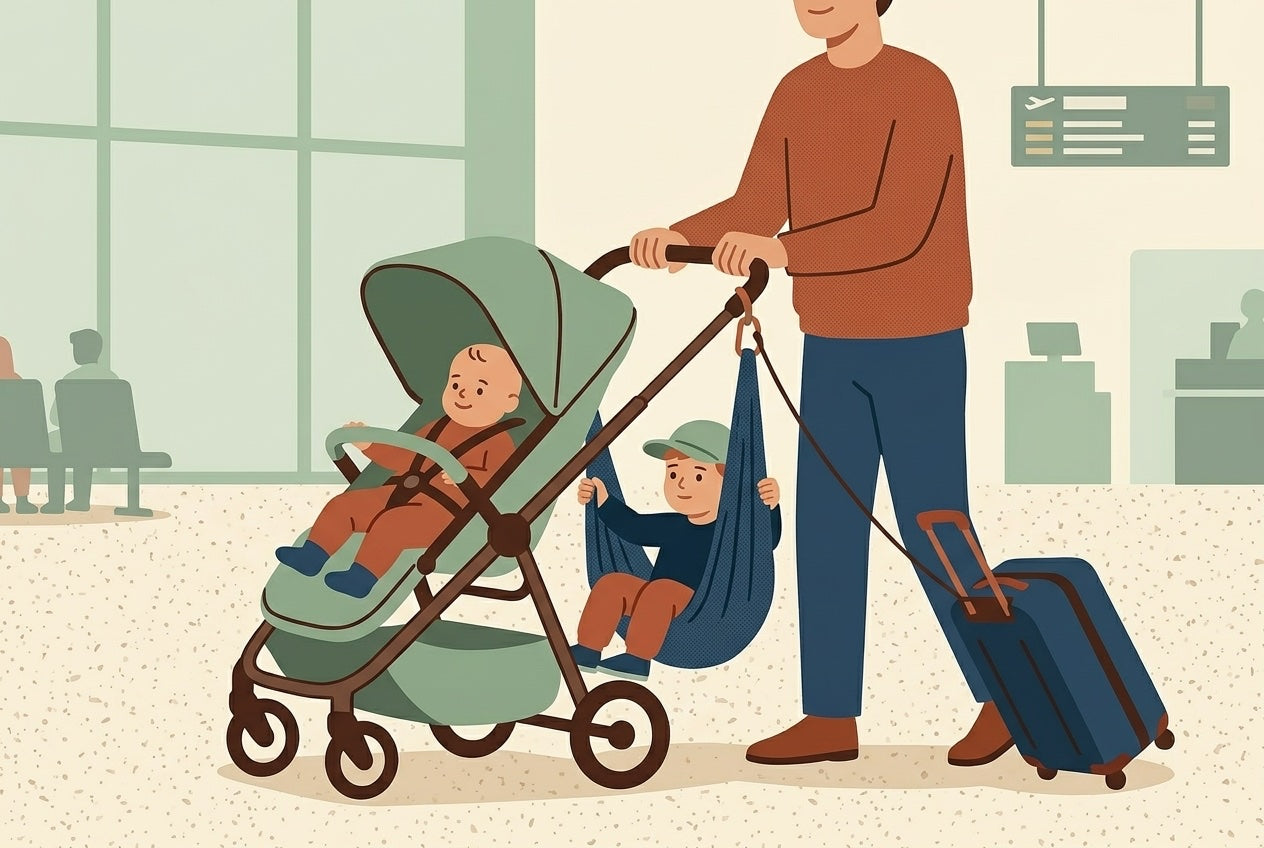
Travelling with a baby and a toddler sounds like an organisational nightmare — until you realise that most families do it every day with a single stroller and one smart addition. You don't need a bulky double stroller at the airport. You don't need a second seat check-in bag. You need a plan, a compact setup, and a hammock seat that turns your existing stroller into a two-kid solution.
Here is how to make it work, from packing at home to your first holiday walk.
Key Takeaways
One single stroller plus a hammock seat handles most travel days with two young kids.
Hoppie is designed for children from around 18 months to 5 years old, up to 20 kg / 44 lbs.
A lightweight carrier as backup makes airport security and boarding much easier.
Most airlines allow you to gate-check a stroller at no extra charge — always confirm with your carrier before you fly.
Hoppie packs flat and adds almost no bulk to your travel bag — it's one of the easiest things to bring along.
The travel kit for two kids and one stroller
Before you get to the airport, it helps to think of your travel setup as a system — not just a list of things to pack. The core is simple: one stroller, a hammock seat for your older child, a lightweight carrier, and a compact bag. Everything else is optional.
Stroller and hammock seat
Your existing stroller does most of the work. The hammock seat clips onto the rear and gives your older child somewhere to sit when tired little legs have had enough. For an airport day or a long city walk, this is the setup that keeps both kids moving without you carrying anyone.
Hoppie is designed to fit most standard strollers with a stable rear frame. It supports children up to 20 kg / 44 lbs, which covers most toddlers well into their fifth year. When the hammock seat is in use, baby rides in the main seat up front and your older child rides behind. The stroller stays the same width as always — it doesn't widen the way a side-by-side double does, which matters enormously in airport corridors and lifts.
Before you travel, make sure you've already done a trial run at home. Installation takes under 30 seconds and needs no tools, but doing it two or three times at home makes the straps feel familiar. You don't want to figure out the straps for the first time at departures.
If you're unsure whether your stroller will work with a hammock seat, tell us the exact brand and model and we'll confirm whether Hoppie fits before you book anything.
Lightweight carrier as backup
Even with the best setup, there are moments in travel when a stroller simply can't go: a crowded security lane, a narrow bus, a flight of stairs at a hotel without a lift. A lightweight soft-structured carrier folds down to almost nothing in your bag and covers every one of those gaps.
For an airport day, the carrier also gives you a hands-free option at security — more on that below. Think of it as your backup plan rather than your main tool. If you use it once the whole trip, it will have earned its space in the bag.
Compact diaper bag
Travel days demand a ruthlessly edited bag. Essentials only: nappies and wipes for the number of hours you'll be travelling plus a buffer, a change of clothes per child, snacks, a bottle or cup, and a small first-aid kit. Everything else can wait in the checked luggage.
A crossbody bag or a backpack works better than a traditional stroller-hook bag on a travel day, because the stroller setup will change — you'll gate-check it, fold it, and reload it more than once. You want a bag that works on your body, not on the stroller.
The hammock seat itself packs flat. It takes up roughly the same space as a folded rain cover, so it slides easily into a stroller organiser or the top of a carry-on.

Airport day, step by step
Airports are the hardest part of family travel. They're big, loud, and full of queues. But they're also designed for strollers — smooth floors, lifts, wide corridors. The setup that works at home works here too, with a few small adjustments.
Check-in
Keep both kids in the stroller during check-in. Your older child on the hammock seat, baby in the front — both contained, both happy with a snack. You have two hands free to manage bags, passports, and boarding passes.
If you're dropping luggage, the stroller handles the queue easily. Most airports have dedicated family check-in lanes — use them without any guilt.
Ask at check-in whether the airline's gate-check policy requires a bag for the stroller. Some airlines provide one; others ask you to bring your own. A simple drawstring stroller bag costs very little and protects the fabric and frame during loading. It's worth packing one in your carry-on.
Security
Security is the moment most parents dread, and for good reason. Here's the sequence that works.
Before you reach the conveyor belt, move your baby into the carrier on your chest. Your older child walks beside you or stands at your side. Fold the stroller — with the hammock seat removed and stored in your bag — and place it on the belt. Both kids are on your body or within arm's reach, and your hands are free to manage shoes, liquids, and trays.
Once through, find a quiet spot to reassemble: baby back in the main seat, stroller unfolded, hammock seat reattached. It takes two to three minutes once you've done it before. If you have a second adult with you, one person walks through with the kids while the other handles bags and stroller on the belt.
Most security lanes have a family queue. It moves slower but the staff are more patient. Use it.
Boarding
Gate-checking a stroller means leaving it at the jet bridge just before you board the plane. It's collected there when you land, which is far more convenient than waiting at baggage reclaim.
Before you gate-check, remove the hammock seat and pack it in your carry-on. Fold the stroller and hand it over. At most airports and with most airlines, gate-checking a stroller is free — but policies vary, so confirm this when you book or at check-in.
On the plane, your older child has their own seat. The carrier keeps the baby close during takeoff and landing if needed. Once you're airborne, both kids can settle in their own seats.
When you land and collect the stroller at the jet bridge, reassemble quickly: hammock seat back on, both kids loaded in, and you're moving again before the terminal crowds build up.

Daily holiday walks
Once you're at your destination, the single-stroller setup really earns its place. You're not navigating a double stroller through restaurant terraces, cobblestone streets, or beach boardwalks. Your stroller fits everywhere it fitted before — and your older child has a seat waiting whenever tired little legs need a break.
City walks
Old towns, markets, museums — these are the places where a double stroller becomes a liability. Narrow doorways, crowded pavements, and no turning radius. A single stroller with a hammock seat at the back moves through all of it without drama.
Your older child walks when they want to explore and hops on when they've had enough. The transition takes seconds. You don't have to stop, lift, or reconfigure anything. Just remind them to hold on and keep walking.
For longer city days, build in rest stops every hour or so. A café with outdoor seating works perfectly: baby naps in the stroller, older child eats something, you drink an actual coffee. The hammock seat folds out of the way while the stroller is stationary and both kids are off it.
Beach and parks
Beaches and parks involve a lot of ground-level play, which means the stroller often parks up for an hour at a time. That's fine. The hammock seat takes ten seconds to remove and store under the stroller or in the bag if you want to keep the rear clear.
On packed sand and firm park paths, most strollers roll easily. Soft sand is harder — for those moments, the carrier is your friend again. Baby on your chest, older child walks the short distance to a firmer surface, stroller follows.
Evening walks and promenades are where the hammock seat works best on holiday. Both kids are tired, the light is beautiful, and no one is complaining about sore feet because everyone has a seat.
Always follow Hoppie's installation instructions and check your stroller manufacturer's maximum load capacity before use. Always supervise your child while Hoppie is in use.

Making it easier every day
A few things make the whole system run more smoothly once you're actually travelling.
Practice before you go. Do one full airport simulation at home: pack the bag, put both kids in the stroller, fold it, reassemble it, run the security sequence in your kitchen. It sounds excessive and it works. You'll spot the awkward bits before they happen in public.
Snacks are your power source. A toddler who is eating is a toddler who is not running away. Keep snacks in your hip pocket or the top compartment of your bag, not buried at the bottom.
Keep the stroller until the last possible moment. At airports, in theme parks, in shopping centres — resist the temptation to fold early. The stroller is a containment device as much as it is a transport device. Use it right up to the point where it genuinely becomes more hassle than it's worth.
Accept the chaos. Things will go wrong. Someone will need a nappy change at the worst possible moment. The toddler will decide they hate the hammock seat for exactly one hour in the middle of the day and then love it again. That's travel with young kids. The setup doesn't eliminate the chaos — it just gives you one less thing to worry about.
FAQ
Can I travel with two kids using one stroller?
Yes, in most cases. A single stroller paired with a hammock seat at the rear gives your older child a place to ride when needed, while your baby or younger toddler stays in the main seat. The setup works in airports, on holiday walks, and in cities. Hoppie is designed for children from around 18 months to 5 years old, up to 20 kg / 44 lbs.
Do airlines allow stroller attachments like a hammock seat?
Most airlines don't have specific policies about accessories attached to strollers, but when you gate-check the stroller the hammock seat should be removed and packed in your carry-on. This protects both the seat and the stroller during loading. Always check your airline's stroller policy before you fly — policies vary by carrier and destination.
How do I get through airport security with two young kids?
The easiest approach: move your baby into a carrier before you reach the conveyor belt, fold the stroller with the hammock seat already removed and stored in your bag, and send it through on the belt. Your older child walks beside you. Once through, find a quiet corner to reassemble. Using the family queue gives you more space and more patient staff.
Is one stroller enough for a two-week holiday?
For most families, yes. A single stroller with a hammock seat handles daily city walks, airport transfers, beach promenades, and theme park days. The key is pairing it with a lightweight carrier for the moments when the stroller can't come — stairs, very narrow spaces, or crowded indoor venues. Between those two things, you cover nearly every scenario a two-week family holiday throws at you.
Will the hammock seat make the stroller too wide for travel?
No. The hammock seat hangs vertically behind the stroller — it doesn't add any width. Your stroller fits through the same doors, lifts, and corridors it always did. The only added dimension is a little extra length at the rear, which is rarely an issue in practice.
What if my toddler refuses to sit in the hammock seat mid-trip?
It happens. The hammock seat is most useful when your older child chooses to use it — and most toddlers ask for it once their legs are genuinely tired. On the days they don't want it, let them walk and leave the seat attached. It weighs almost nothing and takes seconds to remove if you need the rear space.
How do I know if my stroller is compatible before we travel?
Hoppie is designed to fit most standard strollers with a stable rigid rear frame and a forward-facing main seat. If you're unsure, tell us the exact brand and model of your stroller and we'll confirm whether Hoppie fits before your trip.
Hoppie packs flat and travels light
You don't need a second stroller to travel with two young children. Hoppie turns your existing stroller into a practical two-kid solution — compact enough for airports, sturdy enough for daily holiday walks, and easy enough to set up after a long travel day.
Hoppie is for parents who love their stroller but need a smart second seat. Keep the stroller you love. Add a second seat when you need it.
Disclaimer: Hoppie is an independent product and is not affiliated with, endorsed by, sponsored by, or approved by any stroller brand. Always follow Hoppie's installation instructions and check your stroller manufacturer's maximum load capacity before use. Hoppie is designed for children from around 18 months to 5 years old, up to 20 kg / 44 lbs. Always supervise your child while Hoppie is in use.


