

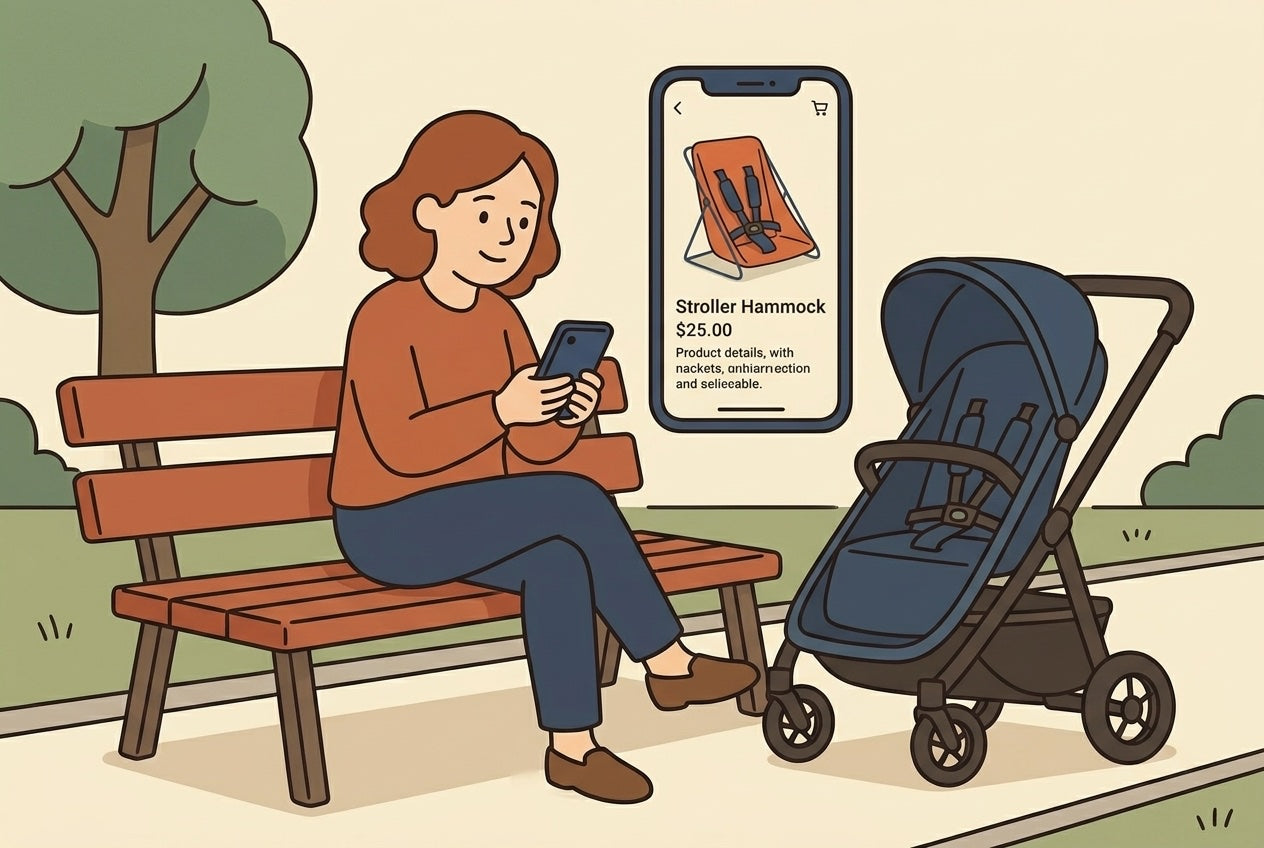
Buying a stroller hammock seat is simpler than buying a double stroller — but it's not quite as simple as clicking "add to cart." A few quick checks before you order will save you a lot of back-and-forth later. Here are the seven things every parent should look at before buying a stroller hammock seat.
Key Takeaways
Check that your stroller has a stable, rigid rear frame before ordering any hammock seat.
Confirm the seat's weight limit matches your child — Hoppie is designed for children up to 20 kg / 44 lbs.
Look for breathable, non-toxic materials — your child will be sitting in this for extended periods.
A clear returns policy and realistic shipping times matter more than you think once you've ordered.
If you're unsure about compatibility, send the brand a photo of your stroller and ask — good brands will reply.
The 7 things to check before you buy a stroller hammock seat
The checklist is short: compatibility, weight limit, materials, safety testing, brand reputation, returns policy, and shipping. That's it. Work through each one and you'll know exactly what you're getting into before the money leaves your account.
1. Compatibility and weight limit
Check 1 — Does the seat fit your stroller?
This is the most important check. A stroller hammock seat attaches to the rear of your stroller, and not every stroller rear is built the same way.
The key question is whether your stroller has a stable, rigid rear frame. You only need to look at three things:
A rigid rear frame made of metal tubing — not a fabric-back or flexible rod design.
Enough rear clearance — around 25 cm of space behind the main seat so the hammock can hang correctly.
A rear bar shape that straps can grip — flat or gently curved bars work best, sharply angled or very narrow bars are harder to work with.
The quick test: press down firmly on the rear handlebar with both hands. If the frame doesn't flex, creak, or sag, it's a good candidate. If it bends or wobbles under your weight, the stroller is probably too light for a hammock seat.
Ultra-light umbrella strollers without a reinforced rear frame are generally not recommended for any hammock seat. Full-size strollers, travel-system strollers, and reinforced compact city strollers usually pass without issues.
If you're unsure, send the brand a photo of your stroller — from the side and from behind — and ask them directly. A good brand will tell you honestly whether it's likely to work. Don't order until you have a clear answer.

Check 2 — Does it fit your child right now?
Every hammock seat has a weight limit and an age range. Read both carefully.
For Hoppie, the seat is designed for children from around 18 months to 5 years old, up to 20 kg / 44 lbs. If your child is already close to that upper limit, it makes more sense to wait until the next sibling arrives rather than buying a seat you'll use for just a few months.
The weight limit also feeds into your stroller's total load capacity. Add your younger child's weight, any bags in the basket, and your older child's weight on the hammock seat. The total needs to stay under your stroller's rated maximum. Check the manual or the sticker near the rear wheels — it's always printed somewhere.
Always check both the hammock seat's weight rating and your stroller's total load capacity. The lower number wins.
2. Quality and safety
Check 3 — What are the materials?
Your child is going to sit in this seat regularly — often for long stretches on school runs, shopping trips, or family outings. Materials matter more than they do for a product that just sits on a shelf.
Look for:
Breathable fabric for the hammock itself — mesh or woven fabrics that let air through will keep your child comfortable in warm weather and reduce that sticky, sweaty feeling after a long walk.
Non-toxic dyes and finishes — children touch and mouth everything. Check for OEKO-TEX or equivalent textile safety certification on the fabric.
Durable straps — the straps are under constant tension when in use. They should feel thick, not plasticky, and the adjustment hardware should click firmly into place.
Easy to clean — outdoor accessories get dirty fast. A seat that wipes clean or comes off for a machine wash is a practical win.
Bargain hammock seats often cut corners on fabric quality and strap durability. A product that shows early strap wear after a month isn't a saving — it's a quality concern and a waste of money.
Check 4 — Has it been safety-tested?
Not all stroller accessories go through independent safety testing. Some are simply manufactured and sold, with no third-party review of how they perform under load.
When you're looking at any stroller hammock seat, check whether the product page or packaging mentions independent safety testing. A brand that invests in testing is also more likely to have thought carefully about installation instructions, weight limits, and frame compatibility.
Most modern strollers are built according to strict international safety standards, but accessories attached to the rear of a stroller aren't automatically covered by those standards. The accessory itself needs to have been designed and tested with safety in mind.
Ask the brand directly if the product page isn't clear: "Has this been designed for everyday family use?" If they can't answer that question, that's useful information too.

Check 5 — Does the brand have a real reputation?
A hammock seat for your child isn't the place to experiment with an unknown seller. Before ordering, spend five minutes on this:
Read parent reviews — not just the star average, but the written comments. Parents talk about real-world installs, how the seat held up over time, and how the brand responded when something went wrong.
Check whether the brand has a real support channel — an email address or live chat where you can ask a question and get a real answer. Compatibility questions need a human, not a chatbot.
Look for social proof — photos from real customers using the seat in everyday life. A product that parents actually use will have genuine photos, not just polished marketing shots.
Check where the company is based — a warehouse in your region makes returns easier and shipping faster.
A brand that stands behind its product will make all of this easy to find. If you have to dig hard to find a contact address, a returns policy, or any real parent photos, that's worth noting.
3. Logistics — returns and shipping
Check 6 — What is the returns policy?
Returns are the objection most parents forget to check until the moment they need one.
Here's what to look for before ordering:
How many days do you have? Some brands offer 14 days, others 30. The longer the window, the more time you have to test the seat in real conditions — not just around the living room.
Who pays for return shipping? Most brands ask customers to cover return shipping unless the product is defective. That's standard — just know it before you order so there are no surprises.
What condition does the product need to be in? A fair returns policy allows you to try the product. Read the fine print carefully if the policy says "unused only" — a seat you've never put a child in is hard to evaluate properly.
What happens if the product is defective? Stitching setup issues, broken hardware, or a seat that doesn't sit right despite correct installation should be handled as defective returns, with no return shipping cost to you.
The brands that make returns easy are the same ones that are confident in their product. A complicated or hidden returns process is a red flag.

Check 7 — How long will shipping take?
Shipping times vary depending on where the brand's warehouse is and where you live. The brands with regional warehouses — Europe, North America, Australia — usually ship faster to customers in those regions than brands shipping everything from a single international hub.
A few practical things to check:
Is there a tracking number? Any reputable brand ships with tracking. If you can't see where your package is, that's a problem.
Is there express shipping available? If you're planning a trip or need the seat for a specific date, check whether you can pay for faster delivery.
Are shipping times shown at checkout? Estimated delivery dates should appear before you pay, not after. If the website only shows shipping times buried in a FAQ page, go back and read them carefully.
Plan for a few days of buffer. Testing the seat at home before a big trip is much better than receiving it the night before you travel.
Putting it all together
Run through the seven checks before you order:
Compatibility — stable rigid rear frame, enough rear clearance, right bar shape.
Weight limit — your child now, your stroller's total load capacity.
Materials — breathable, non-toxic, durable, easy to clean.
Safety testing — designed for everyday family use, not just manufactured and sold.
Brand reputation — real parent reviews, real support, real transparency.
Returns policy — time window, who pays return shipping, what counts as defective.
Shipping times — realistic delivery date, tracking, express options if needed.
If a product clears all seven, you're ready to order with confidence. If it's unclear on any of them, the right move is to contact the brand and ask before paying.
FAQs
What should I check before buying a stroller hammock?
Check seven things: stroller compatibility (stable rigid rear frame and enough rear clearance), your child's weight against the seat's limit, the materials the seat is made from, whether the product has been designed for everyday family use, the brand's reputation and parent reviews, the returns policy, and the shipping times to your location. Running through all seven takes about ten minutes and will tell you everything you need to know before ordering.
Are all stroller hammock seats safety-tested?
In many cases, Some stroller accessories are sold without independent safety testing. Look for a product that mentions third-party or independent safety testing on the product page, and don't hesitate to ask the brand directly if it isn't clear. A brand that has invested in testing will be able to answer that question simply and directly.
How long does shipping take for a stroller hammock seat?
Shipping times depend on where the brand's warehouse is and where you're ordering from. Brands with regional warehouses — in Europe, North America, or Australia — typically deliver faster to customers in those regions. Always check the estimated delivery date at checkout before paying, and build in a few days of buffer if you need the seat for a specific date.
Can I return a stroller hammock if it doesn't fit my stroller?
Most brands allow returns within a set window — commonly 14 to 30 days — but policies vary. Customers usually pay return shipping unless the product is defective. Read the returns policy before ordering, not after. The easiest way to avoid a return altogether is to check compatibility carefully before buying, and to send the brand a photo of your stroller if you're unsure.
How do I know if a stroller hammock seat is compatible with my stroller?
The key check is whether your stroller has a stable, rigid rear frame. Press down firmly on the rear handlebar with both hands — if the frame doesn't flex or creak, it's a good sign. You also need around 25 cm of rear clearance behind the main seat, and a total load capacity that can handle your older child's weight on top of your usual setup. If you're unsure after running those checks, send the brand a photo of your stroller and ask them directly.
What weight limit should a stroller hammock seat have?
Look for a clearly stated maximum weight, and check it against your child's current weight — not their weight a year ago. Hoppie, for example, is designed for children up to 20 kg / 44 lbs, which covers most children from around 18 months to 5 years old. Don't forget to factor your child's weight into your stroller's overall load capacity as well.
Is a stroller hammock seat a good alternative to a double stroller?
For many families, yes. A hammock seat lets you keep the stroller you already own and add a second seat for your older child when they're tired — without the cost, size, and weight of a full double stroller. It's a practical alternative for parents who don't want to replace a stroller they love, and it keeps the setup compact enough for cafés, public transport, and car boots.
What materials should I look for in a stroller hammock seat?
Look for breathable fabric — mesh or woven materials that let air through — non-toxic dyes and finishes, durable adjustment straps, and fabric that's easy to wipe clean or machine wash. Your child will sit in this seat for extended periods, so comfort and material safety matter as much as structural strength.
Ready to check Hoppie against your list?
Hoppie is a safety-tested stroller hammock seat designed for children from around 18 months to 5 years old, up to 20 kg / 44 lbs. It fits most standard strollers with a stable rigid rear frame, keeps your setup compact, and is a practical alternative to buying a double stroller.
Use this checklist when you're ready — and if Hoppie is on your shortlist, we're happy to help you check compatibility before you order. Send us a photo of your stroller and we'll help you decide.
Disclaimer: Hoppie is an independent product and is not affiliated with, endorsed by, sponsored by, or approved by any stroller brand. Always follow Hoppie's installation instructions and check your stroller manufacturer's maximum load capacity before use. Always supervise your child while using Hoppie.


