

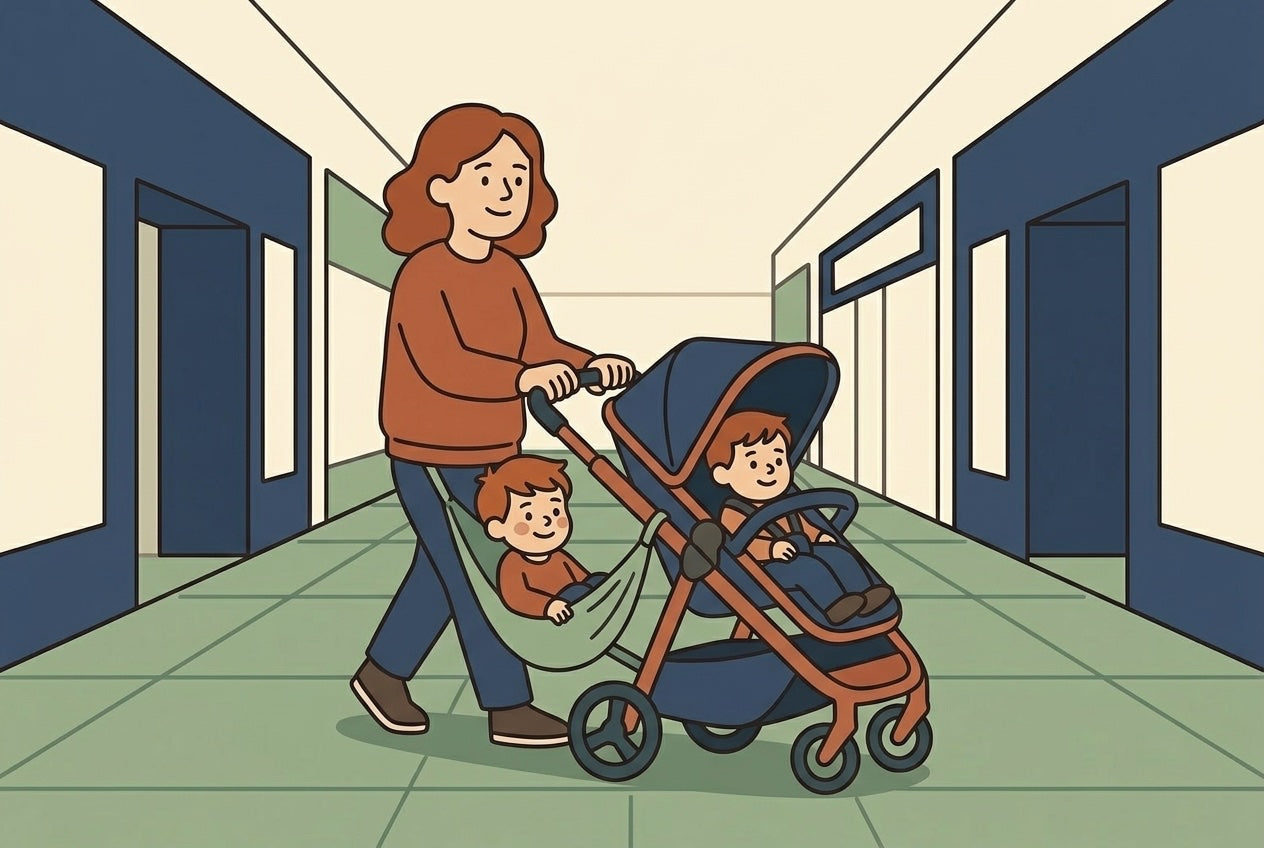
Mall days with two kids are a lot. Long corridors, bright lights, too many people, and a toddler who walked in cheerfully but is now demanding to be carried past the third shop. A hammock seat doesn't fix the crowds — but it does give your older child a place to rest without you hauling a double stroller through narrow clothing aisles.
Key Takeaways
Malls tire toddlers fast — sensory overload and long distances hit harder than a regular walk.
A hammock seat gives your older child a place to rest while staying compact enough for standard shop aisles.
Hoppie is designed for children from around 18 months to 5 years old, up to 20 kg / 44 lbs.
The hammock hangs vertically behind your stroller — your overall width stays the same as your single stroller.
Always follow Hoppie's installation instructions and check your stroller's maximum load capacity before use.
Why malls drain kids and parents
There's a reason a trip to the mall feels three times longer than the same distance walked outside. It's not just the shopping — it's everything happening at once.
Sensory overload hits fast
Malls are built to stimulate. Bright lighting, music from every direction, perfume counters, food smells, escalators, crowds, and screens at every turn. For an adult, it's background noise. For a toddler, it's an awful lot of information arriving all at once.
Young children don't filter sensory input the way adults do. When they've reached their limit, they don't just slow down — they stop, melt, or start demanding to be carried. It's not naughtiness. It's their nervous system waving a white flag.
The result for you: a child who walked in cheerfully is now a lead weight on your hip while you're trying to push the stroller with one arm and get to the car park exit before everyone falls apart.
The distances are longer than they look
A typical mall trip — two or three shops, a toilet stop, a snack, and the walk back to the car — easily covers a kilometre or more of actual walking. For little legs, that's a genuine workout. Toddlers have shorter strides and less stamina than they think they do when they excitedly insist on walking from the car.
Add in the start-stop nature of mall walking — stopping for a window display, doubling back to the escalator, queuing at the checkout — and the trip becomes even more draining. It's not continuous movement; it's repeated acceleration and deceleration, which tires children out faster than a straight walk.
When your older child is tired but your baby still needs the stroller, the usual answer is to carry the toddler. And that's exhausting for you in a way that turns the last twenty minutes of any mall trip into a survival exercise.

The hammock-seat mall routine
The practical shift a hammock seat makes is simple: instead of carrying your older child or dragging a double stroller through the shop floor, your older child hops into the hammock behind the stroller when they're done walking. You keep moving. Everyone gets through the day.
Here's how it tends to look in practice.
When to put the toddler on Hoppie
Most parents don't use the hammock seat the entire trip. The better rhythm is to let the older child walk when they're happy and energetic — usually the first half of the trip — and switch to the hammock when the signs appear.
The signs are easy to read: shuffling feet, arms reaching up, a sudden fixation on being in the "pushchair", or the start of a complaint about tired legs. At that point, rather than negotiating or carrying them, you lift them into the hammock seat, clip them in, and carry on.
For children from around 18 months upwards, the transition takes a few seconds. Hoppie is designed for children from around 18 months to 5 years old, up to 20 kg / 44 lbs. Once they're in, they tend to settle quickly — they can see where you're going, they're close to you, and they're not being carried or dragged.
Some parents reverse the approach: start with the toddler in the hammock seat for the most crowded parts of the trip, and let them walk freely in quieter sections. There's no single right way. You'll find the rhythm that suits your two children after the first trip or two.
Bathroom, food court, and car-park transitions
The tricky moments in a mall trip are the transitions — the bits between shops where you need both hands and two children under control.
Toilets. A single stroller fits into an accessible cubicle. A double stroller frequently doesn't. With Hoppie, your stroller stays the same width it has always been, so you're not negotiating an enormous frame through a narrow doorway while holding a baby and a toddler.
Food court. Queuing at a food counter with two small children and a double stroller in a crowded food court is one of the more stressful experiences parenting has to offer. With a single stroller and a hammock seat, you keep your footprint small. Your older child stays seated in the hammock while you order. The stroller fits alongside a standard table.
Car park. The walk back to the car at the end of a mall trip is where energy reserves run out for everyone. Having the older child already in the hammock seat for the car-park walk means you're not carrying them across a surface that isn't designed for tired families. You push, they rest, you get to the car in one piece.
On a compact stroller, remove Hoppie before folding — on most standard strollers you can usually fold with it still attached. Unclipping it takes a few seconds and protects both the straps and the stroller frame. Once the children are loaded into the car, the seat folds away easily for the boot.

Keeping the stroller compact in a crowded mall
One of the main worries parents have when thinking about a second seat is width. Clothing stores, in particular, have aisles that can feel tight even with a single stroller. The thought of adding a seat to the back sounds like it might make things worse.
In practice, it doesn't. A hammock seat hangs vertically behind the stroller, not out to the sides. Your overall stroller width stays exactly the same. What changes is the depth — how far back the stroller extends — and that's usually less of an issue in shop aisles, which are wide enough front-to-back but sometimes narrow side-to-side.
The contrast with a double stroller is significant. Side-by-side doubles can be wider than a standard doorway. Tandem doubles are longer, which makes turning in tight spaces harder. A single stroller with a hammock seat behind it stays navigable in most standard retail environments — the same spaces you already use every week.
That said, use your judgement. Very cramped boutiques or pop-up stalls in narrow market corridors may still require you to leave the stroller at the entrance. But most standard mall shops — clothing chains, supermarkets, chemists, toy shops — are designed to fit a regular stroller, and Hoppie doesn't change that.
Hoppie is designed to fit most standard strollers with a stable rear frame. If you're unsure whether your stroller is suitable, tell us the exact brand and model and we'll confirm whether Hoppie fits.

Little things that make mall days easier
Beyond the hammock seat itself, a few practical habits make a real difference to how a mall trip goes with two young children.
Go at the right time. Early weekday mornings or just after opening on weekends are consistently the least crowded. Fewer people means fewer triggers for an overwhelmed toddler and more physical space to move.
Build in a break before they ask for one. Don't wait for the meltdown. A ten-minute sit-down and snack at the food court before either child asks for it tends to extend the whole trip by thirty minutes.
Keep the stroller basket light. A hammock seat works best when the stroller isn't overloaded. Use the basket for essentials only — nappy bag, one shopping bag. Carry heavier items in a shoulder bag or pick them up last.
Have the hammock seat ready before you need it. Attaching Hoppie when a toddler is already in meltdown mode is harder than having it set up before you leave the car. Either install it in the car park at the start or keep it attached for the whole trip.
Always supervise your child while using Hoppie. The hammock seat is designed for sitting and resting, not for standing or leaning out. A quick reminder to your child as they hop in takes two seconds and keeps the ride comfortable for everyone.
FAQs
Can I use a hammock seat inside a mall?
Yes. A hammock seat attaches to the rear of your stroller and doesn't change its overall width, so it fits in the same spaces as your regular single stroller. Most standard mall shops, food courts, and lifts are designed to accommodate a regular stroller, and a hammock seat at the back doesn't make that harder.
Does it fit through clothing-store aisles?
In most cases, yes. The hammock hangs vertically behind the stroller rather than extending out sideways, so your stroller's width stays unchanged. The depth increases slightly, but standard retail aisles are typically wide enough to accommodate this. Very narrow boutique aisles may require leaving the stroller at the entrance, as they would with any stroller.
What's the best stroller for malls with two kids?
The best stroller for a mall is almost always the one you already own — if it has a stable rear frame. A single stroller with a hammock seat at the back keeps your footprint small, fits through standard shop doors, and is much easier to navigate in a crowd than a double stroller. Look for a stroller with a rigid rear frame and enough rear clearance behind the main seat.
How do I keep two kids happy at the mall?
The honest answer is: manage energy before it runs out. Let the older child walk while they're happy, use the hammock seat when tired-leg signs appear, and build in a food-court break before either child asks for one. Arriving early when the mall is quieter also helps — fewer crowds mean less sensory overload for little ones.
What age is Hoppie suitable for?
Hoppie is designed for children from around 18 months to 5 years old, up to 20 kg / 44 lbs. For most families, that covers the exact window when a child is old enough to walk but still runs out of steam on longer outings.
Can I use Hoppie on the same stroller I already own?
Hoppie is designed to fit most standard strollers with a stable rear frame. Compatibility depends on your stroller's frame, rear clearance, and total weight capacity. If you're not sure, tell us the exact brand and model of your stroller and we'll confirm whether Hoppie fits.
Is the stroller harder to push with a second child on the back?
You'll notice the extra weight, but most parents find it manageable on mall surfaces, which are flat and smooth. The key is making sure the total load stays within your stroller's maximum weight rating. Check your stroller's manual for the combined weight limit before use.
Hoppie turns a two-hour mall trip into something both kids can actually finish
You don't need a new stroller or a double buggy to get through a mall day with two children. You need a practical backup for when tired little legs give up halfway through. That's exactly what Hoppie is for.
Keep the stroller you love. Add a second seat when you need it.
Disclaimer: Hoppie is an independent product and is not affiliated with, endorsed by, sponsored by, or approved by any stroller brand. Always follow Hoppie's installation instructions and check your stroller manufacturer's maximum load capacity before use. Hoppie is designed for children from around 18 months to 5 years old, up to 20 kg / 44 lbs. Always supervise your child while using Hoppie.


