

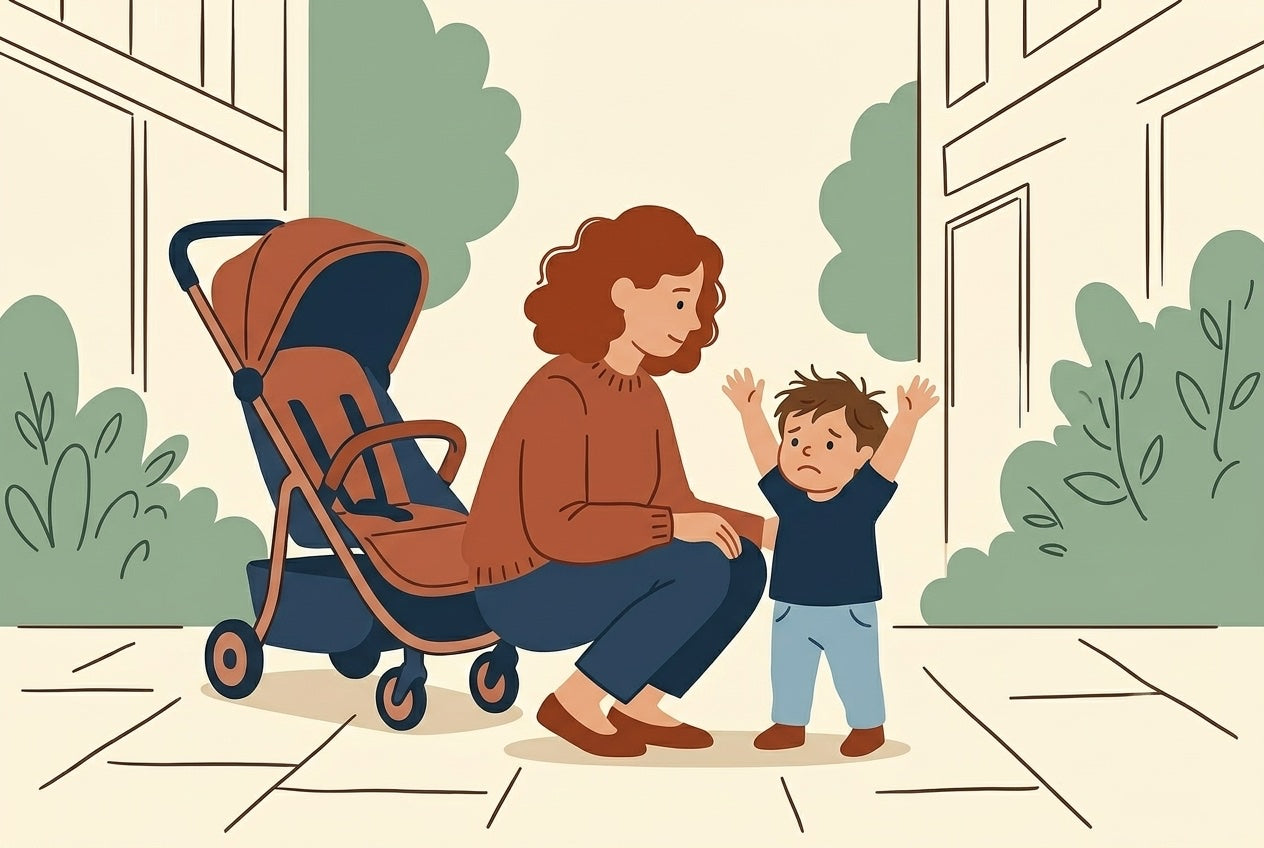
Your toddler was fine five minutes ago. Now they're stopping at every crack in the pavement, arms up, saying "carry me." You haven't even reached the park yet.
This isn't a tantrum. It's biology. Toddlers have shorter strides, smaller energy reserves, and less efficient heat regulation than adults — which means what feels like a short walk to you is genuinely exhausting for them. Understanding why helps you plan walks your whole family can actually finish.
Key Takeaways
Toddlers take many more steps than adults to cover the same distance, burning energy much faster.
Small bodies have smaller fuel tanks — blood-sugar reserves drop quickly, especially without a recent snack.
Toddlers overheat faster and have less efficient sweat response than older children and adults.
Simple planning — shorter legs of the walk, snack stops, and a backup plan — makes a real difference.
A stroller hammock seat is a practical backup for the moment tired little legs hit their limit.
The pediatric reasons toddlers tire so fast
It's tempting to think a toddler who sits down mid-walk is being dramatic. In reality, their body is simply doing something very different from yours — even when you're walking side by side.
Stride length and step count
A toddler's stride is roughly a third of an adult's. That sounds like a fact you'd forget, but it has a real consequence: to keep up with a parent walking at a normal pace, a toddler has to take two or three steps for every one of yours. They're not slow — they're just working at a completely different rate.
The knock-on effect is that a one-kilometre walk involves a very different number of steps for a three-year-old than for you. Their legs are moving almost constantly. Their muscles are firing more often. And their cardiovascular system is running at a higher percentage of its capacity just to maintain pace.
This is also why toddlers find it easier to walk when they're allowed to set their own pace — stopping to look at a dog, doubling back to collect a leaf, wandering sideways. The moment they have to keep up with an adult's walking speed, the effort level goes up significantly. That effort adds up fast.
Energy reserves
Toddlers have smaller bodies, which means smaller fuel tanks. The reserves of glycogen — the stored form of energy muscles use during exercise — are proportionally much smaller than in adults. A child who had breakfast two hours ago and no snack since is running genuinely low by the time you're halfway to the shops.
This isn't a willpower problem. When blood sugar drops in a small child, the effect is physical and fast. Legs feel heavy. Motivation collapses. The world suddenly feels very unfair. Parents often describe this as a mood crash — but the root cause is usually physical, not behavioural.
The AAP and NHS both note that young children need regular small meals and snacks throughout the day to support their activity level. A toddler walking any meaningful distance without a snack on hand is essentially asking a phone to run on four percent battery.
Heat regulation
Small children overheat faster than adults, for a simple reason: their body surface area is large relative to their body mass. They produce heat from exercise but can't dissipate it as efficiently. Their sweat response is also less developed — sweating is one of the body's main tools for cooling down, and toddlers use it less effectively than older children.
On a warm day, or even a mild one with a lot of sun, this becomes a significant factor. A walk that feels comfortable to a parent can leave a toddler feeling uncomfortably warm within fifteen minutes. The body responds by slowing down — which toddlers experience as tiredness, not heat.
Keeping a child well-hydrated before and during a walk helps, as does timing longer outings for cooler parts of the day — early morning or late afternoon — when temperatures are lower and direct sun is less intense.

How to plan walks toddlers can actually finish
None of this means you need to stay home or keep every outing to ten minutes. It means planning with your toddler's actual capacity in mind, not the capacity you might have expected based on how they looked at the start.
Time and distance rules of thumb
Paediatricians and child development experts generally suggest that toddlers can sustain comfortable walking for around one minute per year of age — so a two-year-old might comfortably walk for around twenty minutes before needing a proper rest. A four-year-old might manage forty minutes on a good day with stops.
These numbers vary a lot depending on the child, the terrain, the weather, and how recently they ate. They're a starting point, not a guarantee. The more useful habit is simply paying attention to the signals your child gives — slowing down, going quiet, dragging their feet — before they reach the point of collapse.
Distance is less useful than time as a measure, because children's speeds vary so widely. A kilometre on flat ground with plenty of stops is very different from a kilometre uphill in direct sun. Thinking in minutes rather than kilometres usually gives a more honest picture.
For longer outings — shopping trips, school runs, family days out — the practical answer is to build in the assumption that your toddler will not walk the whole way. That's not pessimism; it's just accurate planning.
Snack and rest stops
A snack before leaving and another one roughly halfway through any outing longer than thirty minutes makes a noticeable difference. It doesn't need to be elaborate — a small pouch of fruit, a couple of crackers, or a piece of cheese is enough to top up blood sugar and extend the walking window meaningfully.
Rest stops work the same way. Sitting down on a bench for three minutes is not a detour — it's a reset. A toddler who takes a rest at the halfway point often walks the second half without complaint, when they might otherwise have hit their limit before arriving.
It helps to make rest stops feel like part of the plan rather than an emergency. "We're going to sit by the fountain for a bit" lands differently than "do you need to stop again?" One feels like an adventure; the other feels like a problem to manage.

The backup plan
Even with good planning, walks don't always go to plan. A tired toddler at the shops, still two streets from the car, with a baby in the pram and both hands full — that's the moment every parent knows.
Having a backup plan isn't about expecting setup issue. It's about reducing the stress of that moment when it comes. For many parents, a stroller hammock seat is exactly that backup. When tired little legs give out, your older child can hop on behind the pram and you keep moving — without carrying them, without losing the pushchair, without the walk becoming a crisis.
Hoppie is designed for children from around 18 months to 5 years old, up to 20 kg / 44 lbs. It attaches to the back of your existing stroller so your older child has somewhere to sit when they've hit their limit. You don't need a double stroller. You don't need to carry anyone. You just keep going.
Always follow Hoppie's installation instructions and check your stroller manufacturer's maximum load capacity before use. Hoppie should only be used with strollers that have a stable rear frame and enough rear clearance. Always supervise your child while using Hoppie.

Putting it together: a realistic walk plan
The simplest version of a toddler-friendly walk plan has three parts: a snack before you leave, a plan to rest roughly halfway, and a backup if the wheels come off.
For everyday school runs and short errands, the backup plan might just be knowing that the stroller is there. For longer outings — holiday days out, family walks, trips to busy places — having a stroller hammock seat available means you can say yes to more, knowing your toddler has somewhere safe to land when they've had enough.
Toddler walking fatigue is real, predictable, and manageable. Understanding it takes the frustration out of those mid-walk standoffs and turns them into something you can actually plan around. That's a better walk for everyone.
FAQ
Why do toddlers get tired so fast walking?
Toddlers take many more steps than adults to cover the same distance, which means they're working much harder to keep up. Their muscles are smaller, their energy reserves are limited, and their bodies aren't as efficient at regulating heat during exercise. All of this adds up to genuine physical fatigue, much faster than most adults expect.
How many steps do toddlers take per day?
Because toddlers have much shorter strides than adults, they take significantly more steps to cover the same ground. On an active day, toddlers often accumulate a high daily step count — not because they're especially sporty, but simply because each stride moves them less distance. Research on child activity patterns consistently shows toddlers walking in frequent short bursts rather than sustained effort.
What's the ideal walk length for a toddler?
A rough guide used by many child development practitioners is around one minute of sustained walking per year of age — so a three-year-old might walk comfortably for around twenty to thirty minutes before needing a break. On a warm day, after a big physical morning, or on uneven terrain, that window is likely to be shorter. Watching your child's cues matters more than the clock.
Do toddlers need snack breaks while walking?
Yes, especially on walks longer than thirty minutes. Toddlers have small glycogen reserves and burn through them faster than older children. A small snack at the midpoint of any meaningful outing — fruit, crackers, a pouch — can make a visible difference to their energy and mood for the second half of the walk.
What are the signs a toddler is hitting their walking limit?
Common signs include slowing down noticeably, going quiet, dragging their feet, stopping to sit on the ground, or asking to be carried. These signs usually appear before the full "carry me" meltdown. Acting on the early signals — a rest, a snack, a seat on the stroller — is much easier than recovering from full exhaustion mid-walk.
Is it normal for a four-year-old to want to be carried?
Yes, completely. Four-year-olds are more capable walkers than two-year-olds, but they still have limited stamina compared to older children and adults. Longer or more demanding walks — hot days, busy places, outings that have already been long — will reliably wear them out. Having a backup option on hand, whether a carrier or a stroller seat, takes the pressure off both of you.
How does a stroller hammock seat help with toddler walking fatigue?
A stroller hammock seat gives your older child somewhere to sit at the back of the stroller when they've reached their limit. Rather than stopping the outing, carrying the child, or managing a standoff, you keep moving — with your toddler resting comfortably. It's a practical backup for everyday walks, busy days out, and anywhere tired little legs are likely to give out before you reach the destination.
Hoppie: the calm backup plan for tired little legs
You can't always predict the moment your toddler runs out of steam. But you can be ready for it.
Hoppie is a compact hammock seat that attaches to the back of your existing stroller, giving your older child a place to sit when tired little legs have had enough. Designed for children from around 18 months to 5 years old, up to 20 kg / 44 lbs — it's the backup plan that keeps your walk moving.
Keep the stroller you love. Add a second seat when you need it.
Disclaimer: Hoppie is an independent product and is not affiliated with, endorsed by, sponsored by, or approved by any stroller brand. Always follow Hoppie's installation instructions and check your stroller manufacturer's maximum load capacity before use.