

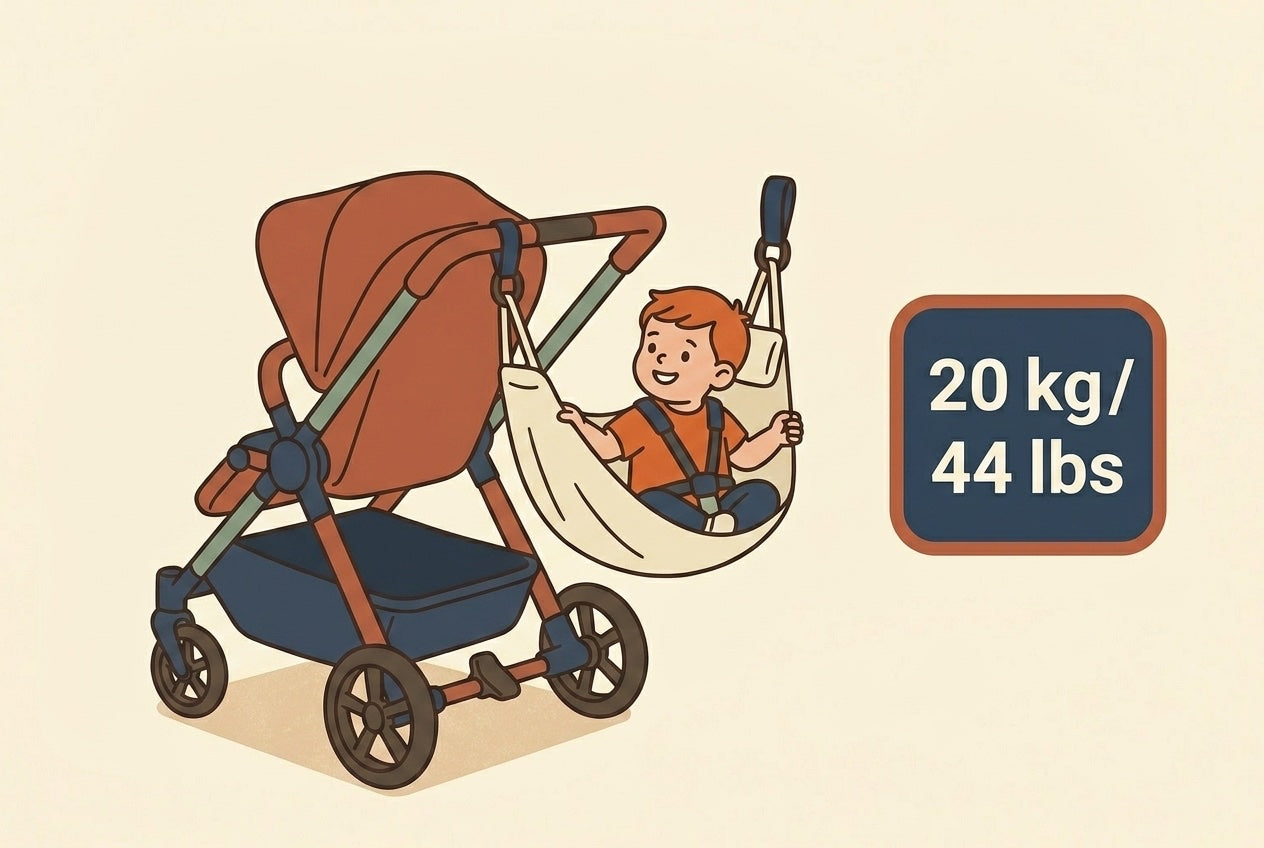
When your older child climbs into the hammock seat after a long walk, the last thing you want to wonder is whether they're too heavy for it. The 20 kg / 44 lbs limit on Hoppie isn't an arbitrary number — it's set that way because both the stability of the seat and the long-term integrity of the fabric and straps depend on staying within it. For most children, that limit covers them right through to around age five.
Key Takeaways
Hoppie is designed for children up to 20 kg / 44 lbs — roughly from around 18 months to 5 years old.
The weight limit exists for two reasons: keeping the seat stable and protecting the fabric and straps over time.
Most children reach 20 kg somewhere around their fifth birthday, though growth varies.
Once your child reaches 20 kg / 44 lbs, Hoppie should no longer be used — even for short trips.
Always check both Hoppie's weight limit and your stroller's total load capacity before use.
Why 20 kg / 44 lbs is the limit
The weight limit for a hammock seat isn't just a legal formality — it reflects two distinct things that happen when a child gets too heavy for the seat. One is about how the seat behaves in use. The other is about how long it lasts.
Stability: what happens at the rear of a stroller under load
A hammock seat attaches to the rear frame of your stroller. When your child sits in it, their weight goes down onto that frame — the seat hangs vertically, so it doesn't pull the stroller backward the way a bag on the handlebar does. Your stroller's rear frame is built to carry a certain amount of load — but only up to a point.
The stroller's main seat holds your younger child near the front, and the hammock seat holds your older child at the back. When both loads are within range — Hoppie's own limit and your stroller's total load rating — the stroller stays balanced and pushes easily in a straight line. That's also why Hoppie must always be used with a child sitting in the main seat.
Up to 20 kg, Hoppie's straps, carabiners and fabric are designed for that load in everyday walking. Beyond it, the load on the straps and on your stroller's rear frame goes past what the seat was designed for — especially on uneven ground, kerbs, or when your child shifts their weight suddenly.
This is also why Hoppie is not recommended for ultra-light strollers without a stable rear frame. The limit only works as intended when the stroller's frame itself is solid enough to handle the load without flexing.
Fabric and strap wear at higher loads
The second reason for the limit is about the material itself. Hammock seats are made from woven fabric with reinforced stitching at the load-bearing points. Every time your child sits in the seat, those stitching points absorb tension. Every step you push the stroller adds a small amount of dynamic load on top of the static weight.
Within the rated limit, the fabric and stitching are designed to handle that tension day after day, in everyday use. Beyond the limit, two things start to happen: the stitching fatigues faster, and the fabric stretches slightly more than it's designed to. You may not notice either of these things happening on a single trip. Over weeks of use, though, they compound.
A seat that looks fine to the eye can still have fatigue at the stitching that only becomes visible under load. That's why the limit applies even to "just a short walk" — the weight limit is about cumulative stress, not only single-trip load.
The short version: 20 kg / 44 lbs is where both the stability margin and the material strength were designed to end. Using the seat within that limit means both stay intact for as long as your child needs it.

What 20 kg actually looks like in real children
Weight limits on paper are easy to understand. What's harder to picture is whether your specific child is near the limit — especially when growth spurts seem to happen overnight.
Average weight by age, from toddler to school age
According to the World Health Organization's child growth standards, the average weight for children at key ages looks roughly like this:
18 months: around 10–11 kg for most children
2 years: around 12 kg
3 years: around 14 kg
4 years: around 16 kg
5 years: around 18–20 kg
These are averages. Every child grows differently, and some will reach 20 kg earlier, some later. Taller or naturally heavier children may hit the limit before their fifth birthday. Smaller-framed children may stay under the limit right up to their fifth birthday.
The age range printed on the packaging — around 18 months to 5 years old — is a guide based on these typical growth curves. But the weight, not the age, is always the deciding factor.
When children typically reach 20 kg
For most families, the weight limit doesn't become a concern until well into the fourth or fifth year. At 18 months, the average child is around half the weight limit. At three years, they're still well within range.
That said, a few situations can move the timeline earlier:
Children on the larger end of the growth chart may reach 18–19 kg by age four. If your child has always been in the higher weight percentiles, it's worth checking the scale a few months earlier than you might expect.
Children who have a big growth spurt between ages three and four sometimes jump several kilograms in a short period. A child who was comfortably within range in the autumn may be close to the limit by spring.
Children who were born larger (above the 85th or 90th weight percentile) often stay ahead of the average curve throughout the toddler years.
The simplest habit: weigh your child at each routine health check and compare to the 20 kg limit. Most family health services weigh children at the one-year, two-year, and three-to-four-year check. That's usually enough to catch a limit approach in time.
If you don't have a recent weight, a bathroom scale works well for children this age. Have your child stand on it alone, then compare to 20 kg. If you're within 1–2 kg of the limit, plan to retire the seat within the next few months.

Checking the total load — not just your child's weight
The 20 kg limit applies to the child sitting in Hoppie. But there's a second number you also need to check: your stroller's total maximum load capacity.
Your stroller is carrying more than just your older child in the hammock seat. It's also carrying your younger child in the main seat, anything stored in the basket, the weight of any accessories attached to the frame, and the stroller itself. All of that combined needs to stay within the stroller's rated total load.
Here's a simple way to think about it:
Find your stroller's maximum total load in the manual or on the label near the rear wheels.
Subtract your younger child's weight and the weight of anything in the basket.
The remaining number is the capacity available for your older child in Hoppie.
If that remaining number is less than your older child's weight, the stroller is over its rated limit — regardless of Hoppie's own rating.
Both limits matter independently. Hoppie's limit protects the seat itself. Your stroller's limit protects the stroller frame and keeps the whole setup stable. Always follow Hoppie's installation instructions and check your stroller manufacturer's maximum load capacity before use.

What to do when your child is approaching the limit
The weight limit isn't a cliff edge where everything is fine one day and not the right setup the next. But it is a firm line. Here's a practical way to handle the transition:
At 17–18 kg: continue using Hoppie normally, but start weighing your child every couple of months to track progress toward the limit.
At 19 kg: treat this as the final phase. Use Hoppie for the outings where you need it most, and start planning your next solution for when your child outgrows the seat.
At 20 kg: stop using the hammock seat. The limit is the limit, even if your child looks comfortable and the seat appears fine.
By the time most children reach 20 kg, they're also becoming more confident walkers. School-age children handle longer distances much better than toddlers, and the need for a rest seat during walks tends to drop naturally around the same time the weight limit is reached. For many families, it works out rather neatly.
Always supervise your child while using Hoppie, and check the seat's straps and fabric periodically for any signs of wear or stretching.
FAQ
What is the maximum weight for the Hoppie hammock seat?
Hoppie supports children up to 20 kg / 44 lbs. This applies to the child sitting in the hammock seat. You also need to check that the total load — including your younger child in the main seat and anything in the basket — stays within your stroller's own maximum load rating.
At what age does a child usually reach 20 kg?
Most children reach 20 kg somewhere around their fifth birthday, based on average growth curves from the World Health Organization. Children who are naturally larger or taller may reach this weight earlier — closer to age four. Children on the smaller end of the growth chart may still be well under the limit at five. Weight is always a more reliable guide than age.
What happens if I exceed the weight limit?
Using Hoppie beyond the 20 kg / 44 lbs limit puts extra stress on the fabric stitching and straps, and increases the load on your stroller's rear frame. Both effects get worse over time with repeated use. The seat is not designed to handle loads beyond the limit safely — even for short trips. If your child is over 20 kg, it's time to retire the hammock seat.
Can I weigh my child on a bathroom scale?
Yes — a standard bathroom scale works well for children in this age range. Stand on the scale yourself first and note your weight. Then pick up your child and stand on the scale again. The difference between the two readings is your child's weight. For children who can stand still, you can also just have them step on the scale alone. Either method is accurate enough for checking against the 20 kg limit.
Does the weight limit change if my child is sitting very still?
No. The limit applies to your child's body weight, not to how much they move. Dynamic load — from movement, shifting, or the stroller going over a kerb — is already factored into the design. The limit is 20 kg, regardless of how calm or active your child is during the ride.
Is the age range on the packaging a hard rule?
The "around 18 months to 5 years" range is a guide based on typical growth and developmental readiness — children under 18 months generally don't have the core strength to sit comfortably in a hammock seat for longer outings. The weight limit of 20 kg / 44 lbs is the firm rule. If your child is within the age range but has already reached 20 kg, the weight limit takes priority.
Should I check my stroller's weight rating separately?
Yes, always. Hoppie's 20 kg limit protects the seat. Your stroller's total load rating protects the stroller frame and the whole setup. Check the manual or the label near the rear wheels for your stroller's maximum total load, then add up all the weight you're carrying — both children, basket contents, and accessories. Both limits need to be respected at the same time.
Designed for tired little legs — right up to 20 kg / 44 lbs
Hoppie is designed for children from around 18 months to 5 years old, up to 20 kg / 44 lbs. For most families, that covers the whole toddler chapter — from the first "carry me" moments to the long school-run days when little legs just don't want to keep going.
Keep the stroller you love. Add a second seat when you need it.
Disclaimer: Hoppie is an independent product and is not affiliated with, endorsed by, sponsored by, or approved by any stroller brand. Always follow Hoppie's installation instructions and check your stroller manufacturer's maximum load capacity before use. Hoppie should only be used with strollers that have a stable rear frame and enough rear clearance. Always supervise your child while using Hoppie.