

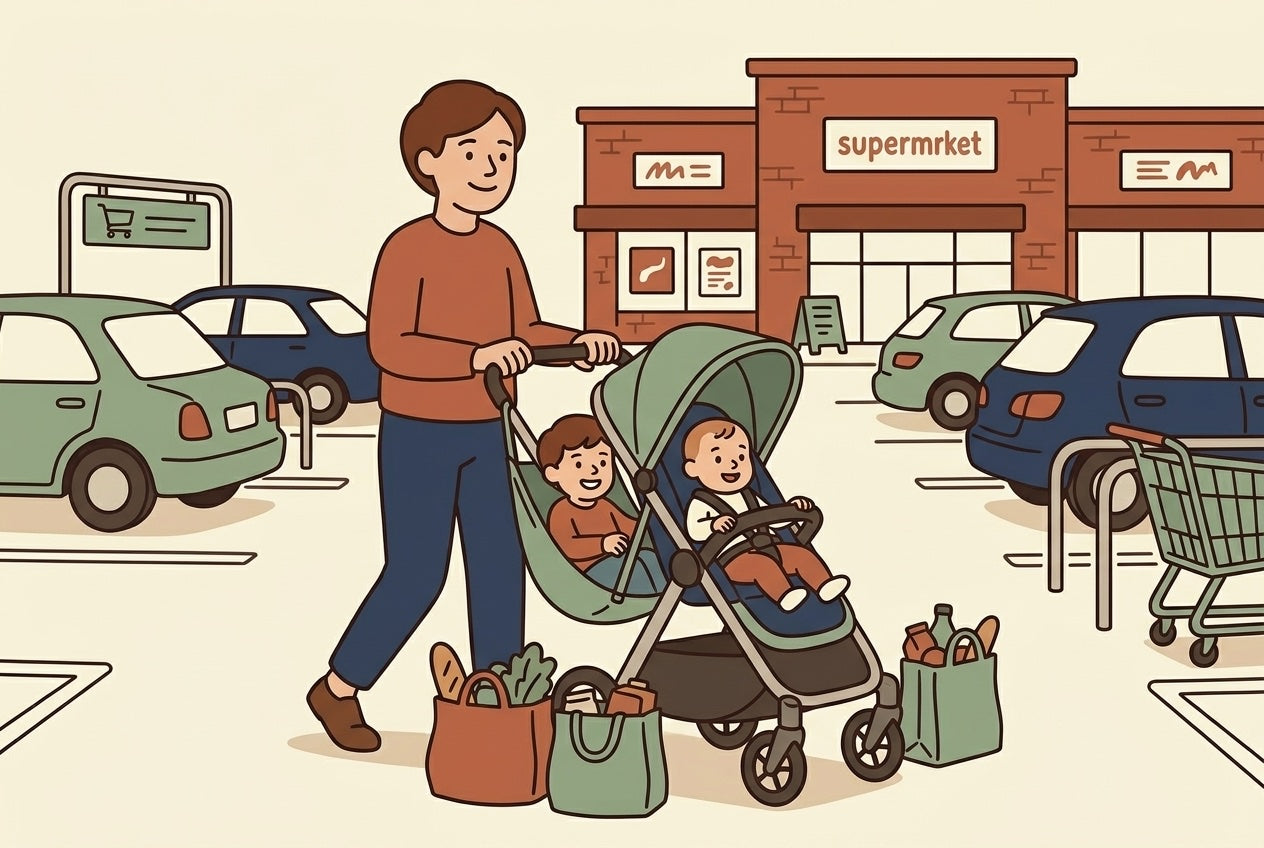
A double stroller can cost anywhere from $400 to well over $800. A hammock seat for your existing stroller costs a fraction of that. If you have two young children and you don't want to spend hundreds on a bulky rig you'll use for a year or two, the math is worth looking at closely.
This article breaks down the real costs, the hidden ones most parents don't see coming, and how to make a simple, affordable setup work in everyday life.
Key Takeaways
A stroller hammock seat typically costs $60–90, compared to $400–800+ for a double stroller.
Double strollers come with hidden costs: storage space, heavier lifting, and a short usable window before your older child outgrows it.
A hammock seat works with the stroller you already own — no new purchase, no learning curve.
Hoppie is designed for children from around 18 months to 5 years old, up to 20 kg / 44 lbs.
If you're unsure whether your stroller is compatible, send us a photo and we'll help you check.
The price math, broken down
Let's start with the number that matters most: what you actually spend.
What a double stroller actually costs
Entry-level double strollers — the ones that are light enough to be practical and sturdy enough to feel safe — start around $300 to $400. Mid-range models with better frames, larger canopies, and reclining seats sit in the $500 to $700 range. Premium doubles push past $800 and can easily reach $1,000 or more.
Then there are the things that don't show up on the product page:
Adapters and accessories to make the stroller work for your setup
A second set of rain covers, sun shields, or footmuffs
A larger car to fit the thing (some families genuinely upgrade)
Replacement parts if the cheaper model breaks under the extra load
By the time your second child is walking reliably, you've spent real money on something that lives in the boot of your car.
What a hammock seat costs
A stroller hammock seat — the kind that clips to the rear frame of your existing stroller and gives your older child a place to sit when tired legs kick in — typically costs between $60 and $90.
That's it. No adapters. No accessories. No new stroller. If you already own a stroller with a rigid rear frame, you're done.
The setup works because your older child only needs a seat occasionally — at the end of a long walk, at an airport, during a school run that ran long. They're not strapped in for hours. They hop on when they're tired and hop off when they're ready to walk again. A full second seat is rarely what the situation actually calls for.
The resale picture
Double strollers do hold some resale value, especially premium models in good condition. But "good condition" is harder than it sounds. Two children, daily use, a car boot, rain, muddy wheels — doubles take a beating. Many families find the resale price is lower than expected, or they simply can't find a buyer quickly enough.
A hammock seat is easy to resell at a reasonable price because it's small, lightweight, and in demand from parents in exactly the situation you were in. Some families pass it on to a sibling or friend when the older child outgrows it.
Either way, the starting outlay is so much lower that even zero resale recovery still leaves you ahead financially.

The hidden costs of a double stroller
The sticker price is only part of what a double stroller costs you. The rest shows up in your daily life.
Storage and car space
A double stroller is big. Not slightly-bigger-than-a-single big — genuinely large in a way that changes how your household operates. Many parents discover this only after it arrives.
The hallway becomes an obstacle course. The car boot can't fit the weekly shop alongside the stroller. City lifts are tight. Café doorways that work with a single stroller become a negotiation with a double. None of these things are insurmountable, but they add friction to every outing, every single day.
A hammock seat weighs under a kilogram and rolls up small enough to fit in a tote bag. It adds nothing to your hallway, nothing to your boot, and nothing to the width of your stroller in a lift.
Weight and effort
Double strollers are heavier than singles — often significantly so. Lifting a loaded double stroller into a car boot is a workout. Folding it is a two-handed job. Unfolding it in a car park with a baby on your hip and a toddler running off is the kind of moment that makes parents question every decision they've ever made.
Families who switch from a double to a single-plus-hammock-seat often say the same thing: they didn't realise how much energy the double was costing them until they stopped using it. Pushing a single stroller is just easier. Everything about the logistics is lighter.
Outgrowing it fast
Here's the part that surprises most parents: the window where a double stroller is genuinely useful is shorter than it looks on a spreadsheet.
You need it when your older child tires easily and your younger child still needs a stroller. That's roughly the period between your second child being a few months old and your first child being reliably on their feet — usually somewhere between age three and five. After that, the older child walks, and the double becomes cargo.
A hammock seat has the same useful window — but because it costs so much less, the maths look completely different. You're not trying to recoup hundreds of dollars from two years of use. You paid $60–90 and got what you needed.
Hoppie is designed for children from around 18 months to 5 years old, up to 20 kg / 44 lbs. That window lines up almost exactly with when parents say they need a second-seat solution most.

How to make the cheap setup work day-to-day
Saving money only matters if the setup actually works for your family. Here's what parents consistently say about making the single-plus-hammock-seat combination work in real life.
Daily use tips
The hammock seat isn't meant to replace the stroller's main seat for the whole journey. Think of it as a rest stop on wheels — your older child walks most of the time and hops on when they're flagging. That's the design intent, and it works well when you approach it that way.
A few things that help:
Get the installation right the first time. The first setup takes a few minutes. Read the instructions, make sure the straps are routed correctly, and check that the seat sits taut against the rear frame with very little slack. Once you've done it once, it's quick.
Always follow Hoppie's installation instructions and check your stroller manufacturer's maximum load capacity before use. Your stroller has a total weight limit — baby in the main seat, basket contents, and your older child on the hammock seat all count toward it.
Remove the seat before folding the stroller. It takes a few seconds and protects both the straps and the stroller's rear frame. Leaving it on during the fold is the most common source of wear.
Supervise your child while they're in the seat. It's designed for stability and comfort, but it's not a substitute for an attentive parent.
Most parents say the first week is an adjustment — figuring out the rhythm of when to encourage walking and when to let the older child hop on. After that, it becomes automatic.
When a double stroller might still make sense
A hammock seat isn't the right answer for every family. Be honest about your situation:
If your older child is very young and still needs a proper seat for most of every outing, a double stroller may serve you better in the short term.
If your daily routine involves very long walks where both children need to be seated for extended periods, a side-by-side or tandem double gives you more capacity.
If your older child is already close to five or heavier than 20 kg / 44 lbs, they're at the upper limit of what a hammock seat is designed for.
But for the majority of parents with a toddler who walks most of the time and a baby or young toddler in the main seat, the hammock-seat setup handles the job for a fraction of the price.
Hoppie is designed to fit most standard strollers with a rigid rear frame. If you're unsure whether your stroller is compatible, send us a photo and we'll help you check.

FAQ
What's the cheapest double-stroller alternative?
A stroller hammock seat is one of the most affordable options available. It attaches to your existing stroller's rear frame and gives your older child a place to sit when tired, without requiring a new stroller purchase. For families who already own a stroller they like, it's often the most practical and cost-effective choice.
How much does a stroller hammock seat cost?
Most stroller hammock seats, including Hoppie, cost between $60 and $90. That's the full cost — there are no accessories or adapters required beyond the seat itself, as long as your stroller has a compatible rear frame.
Can I buy a used double stroller instead?
Secondhand double strollers can bring the cost down, but it's worth factoring in condition, hygiene, and whether all safety components are intact. Used doubles can be a good option, but many parents find that even secondhand models are bulky, heavy, and short-lived for their needs. A new hammock seat at $60–90 often compares favourably once you account for those factors.
Is it worth saving on a stroller setup?
Yes — if the cheaper option genuinely meets your needs. The key question is whether your older child needs a full-time second seat or just an occasional rest. For most parents with a toddler who walks most of the time, a hammock seat covers the gap well. If both children need a seated solution for the whole journey every day, a double stroller may still be the right investment.
Does the hammock seat work with my stroller?
Hoppie is designed to fit most standard strollers with a stable rigid rear frame. It's not recommended for ultra-light umbrella strollers without a reinforced rear frame. If you're unsure, send us a photo of your stroller from the side and rear and we'll help you check before you order.
How long will a hammock seat last?
Hoppie is designed for children from around 18 months to 5 years old, up to 20 kg / 44 lbs. For most families, that covers the exact period when a second-seat solution is most needed. Once your older child is walking reliably and independently for the duration of your outings, the seat can be stored away or passed on.
Is a hammock seat safe for everyday use?
Yes, when used correctly. Hoppie is designed for stability and comfort on strollers with a stable rear frame. Always follow the installation instructions, check your stroller's total load capacity, and supervise your child while they're in the seat. Use only as instructed.
The affordable way to carry two kids — without a double
You don't need to spend hundreds on a double stroller to manage two young children on walks. Hoppie is the practical alternative for parents who love their stroller and just need a smart second seat for when tired little legs give out.
Keep the stroller you love. Add a second seat when you need it.
Disclaimer: Hoppie is an independent product and is not affiliated with, endorsed by, sponsored by, or approved by any stroller brand. Always follow Hoppie's installation instructions and check your stroller manufacturer's maximum load capacity before use. Hoppie is designed for children from around 18 months to 5 years old, up to 20 kg / 44 lbs. Always supervise your child while using Hoppie.


