

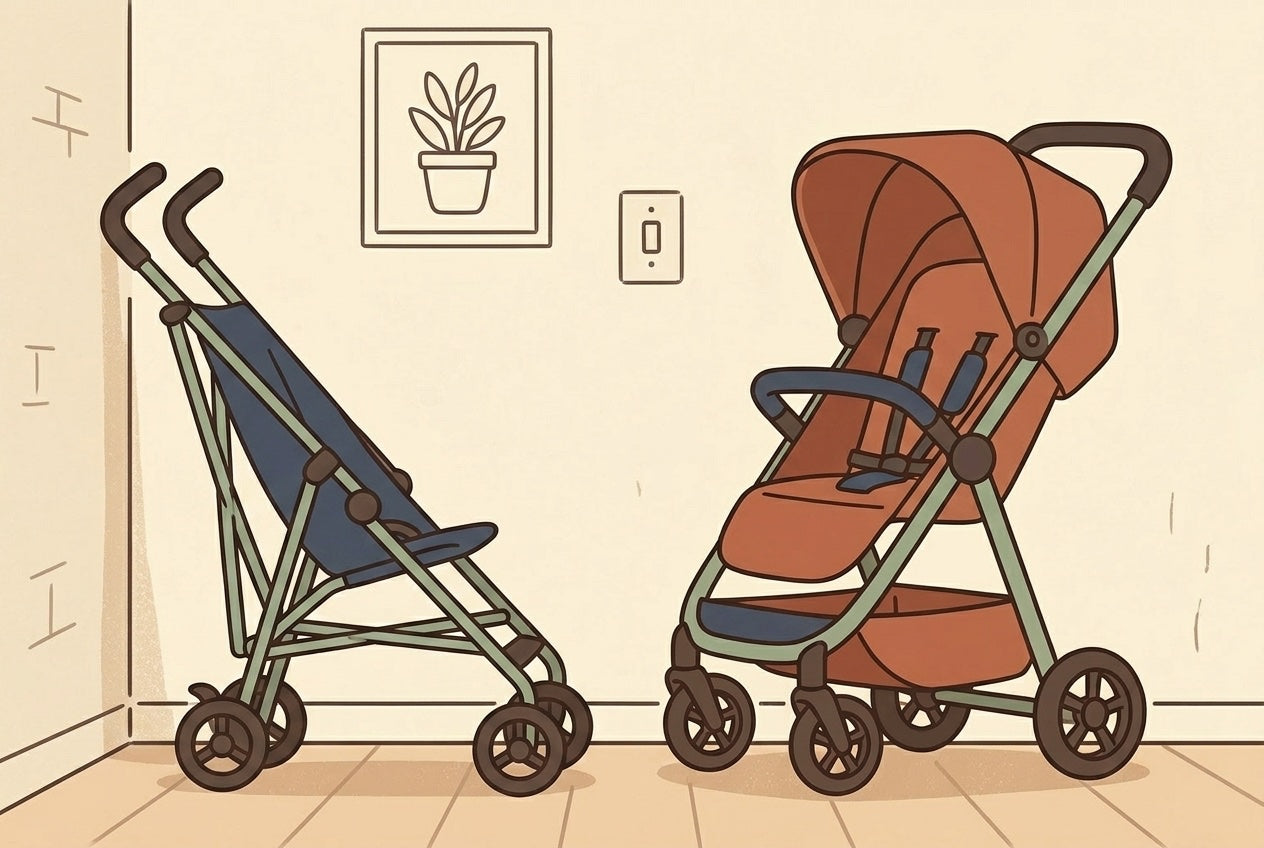
Most umbrella strollers are not recommended for hammock-style add-on seats. That's the short answer — and it's worth saying plainly before you spend any time measuring or shopping. The frames on ultra-light umbrella strollers are simply not designed to hold the weight and lever forces of an older child sitting at the rear.
But there are exceptions. A small number of lightweight strollers — sometimes sold as umbrella-style or compact strollers — have reinforced rear frames that can pass the basic compatibility test. This guide explains why most umbrella strollers fall short, how to spot the ones that might work, and what your best alternatives are if yours doesn't make the cut.
Key Takeaways
Most ultra-light umbrella strollers are not recommended for hammock-style add-on seats — their frames flex too much under rear load.
A small number of reinforced lightweight strollers may pass the compatibility check — but you need to test the frame first.
The 60-second push-and-flex test tells you more than the spec sheet in most cases.
If your umbrella stroller needs a closer look, babywearing or a second compact stroller are the most practical alternatives.
If you're unsure, send us a photo of your stroller and we'll help you check.
Why most umbrella strollers need a closer compatibility look
Umbrella strollers are designed around one goal: fold fast and pack light. That design principle — which makes them so useful at airports and on public transport — is exactly what makes them a poor match for rear add-on seats.
A hammock-style seat places your older child's full weight — up to 20 kg / 44 lbs — at a single point behind the stroller. The rear frame has to absorb that weight without bending, and it also has to cope with the lever forces created by a child shifting, leaning, and moving as you walk. That is a very different load pattern from a baby sitting in the main seat, where the weight is distributed across the whole frame.
Most umbrella strollers are not built for that kind of rear load. Here's why.
Frame thickness and rigidity
The rear frame on a typical ultra-light umbrella stroller uses thin aluminum tubing — often just wide enough to keep the stroller from collapsing under a young child in the main seat. At that thickness, the frame is stable enough for its intended job. But it visibly flexes when you press down on the rear handlebar with both hands and any real body weight.
That flex is the problem. When a frame bends under a test press, it's telling you the metal isn't thick enough or strong enough to hold steady under rear load. A child sitting in a hammock seat is not a static load — they shift, kick their legs, and lean sideways. A flexing frame under those conditions feels unstable to the child and, in the worst cases, can compromise the whole setup.
On a standard full-size stroller, the rear tubes are noticeably thicker and the frame stays rigid under the same test. That's the structural difference that matters.
Wheel size and stability geometry
Umbrella strollers also tend to have smaller rear wheels and a shorter wheelbase than full-size strollers. That's fine for a lightweight child in the main seat — the centre of gravity stays comfortably forward. Add a second child at the rear, and the balance shifts backward. On a stroller with a short wheelbase and small wheels, that shift is harder for the frame to absorb, and the stability point to check is higher than on a stroller with a longer, wider rear axle.
This is why the frame rigidity test is only one part of the picture. Even if a lightweight stroller's rear bar feels solid enough, the overall geometry — wheelbase, wheel diameter, rear clearance — still needs to make sense for a rear-mounted seat.
Always check your stroller's manual and maximum load before use. The total weight capacity has to cover your baby in the main seat, anything in the basket, and your older child on the add-on seat.

The rare exceptions: reinforced lightweight strollers
Not every compact or lightweight stroller is an ultra-light umbrella frame. Some strollers are marketed as lightweight or city-compact but are built on a substantially thicker, more rigid rear frame. These are the strollers that sometimes pass the compatibility test — and they're worth knowing about.
What "reinforced" actually means
A reinforced lightweight stroller has thicker rear tubing — you can usually see the difference by eye when you compare it to a classic umbrella frame. The rear bar sits flat, feels solid when tapped, and shows no visible flex when you press down firmly with both hands.
Here's how to run the test on your stroller:
Open the stroller fully and lock it in its standard used position. Apply the brake. Both rear wheels on flat ground.
Stand behind it. Place both hands flat on the rear handlebar, shoulder-width apart.
Press down with roughly half your body weight. Hold for two seconds.
Watch the rear tubes. They should not visibly bend, creak, or compress. The handlebar should move down no more than about 1 cm.
Let go. The frame should spring back cleanly to its original position. No residual sag, no creaking.
If your stroller passes all five steps, it's structurally in the right zone for a rear add-on seat. If the frame flexes noticeably or creaks, it's a no — regardless of how light or sturdy it looks otherwise.
How to read the manufacturer spec sheet
If your stroller passes the flex test, the next step is the spec sheet or manual. Look for two things:
Total load rating. This is the maximum weight the stroller is designed to carry across all load points. You need enough headroom for your baby in the main seat, the basket, and your older child on the rear seat.
Accessory guidance. Some manufacturers list compatible accessories or specify whether rear accessories are permitted. If the manual says "no rear accessories", follow it — even if the frame passes the flex test.
A stroller with a total load rating comfortably above your combined weight needs, a rigid rear frame, and no explicit ban on rear accessories is your best candidate. If any of those three conditions is missing, treat it as a need a closer look and look at alternatives.
Hoppie is designed to fit most standard strollers with a stable rear frame. It is not recommended for ultra-light umbrella strollers without a reinforced rear structure. If you're unsure whether your stroller qualifies, send us a photo and we'll help you check.

Better alternatives for umbrella-stroller owners
If your umbrella stroller needs a closer frame look — or if you already know it's an ultra-light frame — that's not the end of the road. There are a couple of practical options that work well for parents in exactly your situation.
Babywearing for the older child
A soft-structured carrier is the most flexible solution when your stroller can't safely take a second seat. Your older child rides on your back or front, your baby stays in the stroller, and you keep moving without a second piece of gear to manage.
The practical limits are honest ones: carrying a tired three-year-old on your back for two hours is hard. But for school runs, short shopping trips, and travel days where you're moving between gates and not just walking a long distance, a carrier solves the tired-toddler problem without touching the stroller at all.
Most soft-structured carriers support children up to around 20 kg / 44 lbs — roughly the same range as Hoppie. If you already own one, it's worth reaching for it before shopping for additional gear.
A compact second stroller for the older child
If your daily routine involves longer walks or outings where carrying isn't practical, a second compact stroller for the older child can work well — especially in two-adult families where each parent pushes one stroller. Entry-level compact strollers are far less expensive than a full double stroller, and they're easy to fold and store.
The tradeoff is that you're now managing two separate pieces of equipment. That's fine with two adults and more challenging solo. If you're mostly on your own, babywearing is usually easier to manage in practice.
The third option — if you're at the beginning of your stroller journey or considering an upgrade — is simply to choose a stroller with a rigid rear frame from the start. Full-size strollers and reinforced city strollers with a stable rear frame open up the option of a hammock-style second seat later, without buying a bulky double stroller now.

When a double stroller makes more sense
A rear add-on seat is not the right solution for every family. If both your children need a full seat regularly — for example, a baby and a toddler who walks very little — a proper double stroller may be the better long-term investment. A hammock seat is a practical alternative for parents whose older child mostly walks and only needs a seat on tired days or longer outings. If that's not your situation, a double stroller may fit your routine better.
The honest answer is that the right tool depends on how you actually use your stroller day to day. Hoppie is for parents who love their current stroller, whose older child walks most of the time, and who need a smart backup seat — not a permanent one.
FAQ
Can I attach a hammock seat to a folding umbrella stroller?
In most cases, no. Folding umbrella strollers use thin, lightweight frames that flex under rear load. That flex makes them unsuitable for a hammock-style seat that places an older child's full weight at the rear. A small number of reinforced lightweight strollers — sometimes sold in the compact or city-stroller category — may pass the flex test. Run the 60-second push-and-flex test described above to check yours specifically.
What weight can an umbrella stroller usually support?
Most umbrella strollers list a total load capacity of around 15–22 kg. That capacity is designed for one child in the main seat with the load distributed across the whole frame. A rear hammock seat concentrates an older child's weight at a single point at the back — a very different load pattern. Even if the total weights add up on paper, the frame may not be built to handle rear-concentrated load safely. Always check both the total capacity and the stroller's manufacturer guidance on rear accessories.
Why are lightweight strollers not ideal with add-on seats?
Because they're designed to be light, not to carry extra rear load. The thinner tubing and shorter wheelbase that make them easy to carry on and off public transport are exactly the features that create problems when you add a second child at the back. The frame flexes, the balance shifts rearward, and the setup feels less stable than on a full-size stroller. A rear add-on seat puts real demands on the frame — demands that most lightweight strollers simply aren't built for.
What if my umbrella stroller has aluminum tubing?
Aluminum tubing alone doesn't guarantee a rigid frame. Almost all lightweight strollers use aluminum — the material is less important than the tube diameter and wall thickness. A thin aluminum tube flexes just as much as a thin steel one. What matters is whether the frame passes the push-and-flex test when fully open and locked. If it doesn't flex visibly under firm hand pressure, it's worth investigating further. If it does flex, the material doesn't change the outcome.
Is Hoppie compatible with my compact city stroller?
Hoppie is designed to fit most standard strollers with a stable, rigid rear frame. Some compact city strollers pass the compatibility test; others don't. The best way to know is to run the push-and-flex test and check your stroller's total load capacity. If you're still unsure after that, send us a photo of your stroller from the side and the rear — we'll help you check before you order.
Does Hoppie work with a stroller that has a fixed basket at the rear?
A fixed basket that fully blocks the rear zone is a compatibility problem regardless of frame rigidity. Most strollers have baskets that can be repositioned or removed — check yours before measuring the rear clearance. Hoppie needs around 25 cm of clear rear space behind the main seat. If the basket can't be moved and blocks that space, Hoppie isn't the right fit for that stroller.
What is Hoppie designed for?
Hoppie is designed for children from around 18 months to 5 years old, up to 20 kg / 44 lbs. It's a practical alternative to a double stroller for parents whose older child mostly walks but needs a seat on tired days, longer outings, or busy travel days. It attaches to the rear of strollers with a stable, rigid rear frame — not to ultra-light umbrella strollers without one.
Check your frame first — then decide
If you own an umbrella stroller, the honest starting point is the flex test — not a product page. Most ultra-light umbrella strollers won't pass it, and that's a useful answer to have before you spend time or money on a second-seat solution that won't work safely.
If your stroller passes the test, Hoppie is likely to be a good fit. If it doesn't, babywearing or a second compact stroller are the most practical alternatives for your daily routine.
Hoppie is for parents who love their stroller but need a smart second seat. Keep the stroller you love. Add a second seat when you need it.
Not sure whether your stroller qualifies? Send us a photo of the rear frame and we'll help you check before you order.
Hoppie is an independent product and is not affiliated with, endorsed by, sponsored by, or approved by any stroller brand. Always follow Hoppie's installation instructions and check your stroller manufacturer's maximum load capacity before use. Hoppie is designed for children from around 18 months to 5 years old, up to 20 kg / 44 lbs. Always supervise your child while using Hoppie.


