

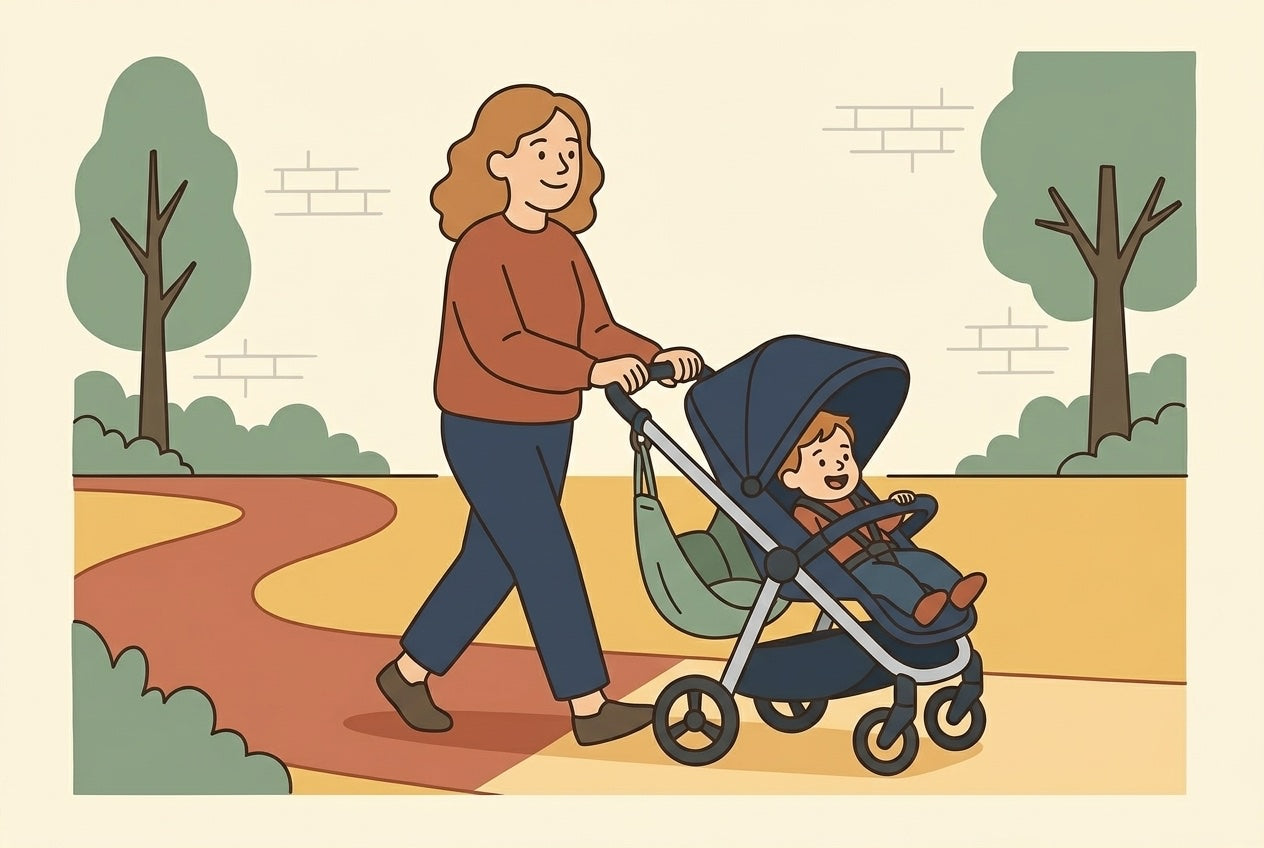
Your toddler is tired. You still have half the walk home to go. And you're wondering: is it actually safe to let them ride in that hammock seat hanging off the back of the stroller?
It's a fair question — and a smart one. Here's the short answer: stroller hammock seats are designed for everyday family use and designed for children from around 18 months to 5 years old, up to 20 kg / 44 lbs. Used correctly, with always-supervised use and a compatible stroller, they're a practical and stable option for tired little legs.
This guide walks through how hammock seats are tested, the four rules that matter most for safe use, and the real-world concerns parents actually ask about.
Key Takeaways
Hoppie is designed for everyday family use and designed for children from around 18 months to 5 years old, up to 20 kg / 44 lbs.
Safe use depends on four non-negotiable rules: weight limit, supervision, correct installation, and stroller frame check.
Hammock seats are designed for stability and comfort — not for ultra-light umbrella strollers without a rigid rear frame.
Most real-world concerns — stability, pinch points, hot weather — have straightforward solutions covered in this guide.
Always supervise your child while using Hoppie. Always follow Hoppie's installation instructions and check your stroller manufacturer's maximum load capacity before use.
How hammock seats are safety-tested
When parents ask "is it safe?", they usually mean: has anyone checked this properly, or did someone just sew a bit of fabric and put it on the internet?
The answer matters. Hoppie is designed for everyday family use — meaning it goes through a structured testing process before it's sold, not just an internal quality check. Here's what that actually involves.
Testing against stroller accessory safety standards
Stroller accessories that carry children are evaluated against international safety standards for wheeled child conveyances. These standards exist to make sure that add-on seats hold up under real-world conditions: static loads, dynamic forces, repeated use, and material wear over time.
Testing typically covers:
Whether the attachment points hold under the rated child weight, plus additional safety margin.
Whether the seat maintains its shape and position during movement.
Whether straps, buckles, and connectors release safely in an emergency but stay secure during normal use.
Whether the product degrades safely over repeated attachment and removal cycles.
Most modern strollers are built according to strict safety standards — and when you add an accessory, that accessory should be tested to a comparable standard. A hammock seat that hasn't been designed for everyday family use puts that safety margin entirely on the parent's judgment. An designed for everyday family use one gives you a verified baseline.
Material and stitching standards
The fabric, stitching, and hardware on a hammock seat are as important as the attachment mechanism. A well-tested hammock seat will use:
Load-rated webbing for straps — the same category of material used in child harness systems.
Reinforced seams at every load-bearing junction, tested to handle the full rated weight across thousands of use cycles.
Hardware — buckles, connectors, rings — that is rated beyond the product's stated weight limit, to build in a safety buffer.
Fabrics that are checked for harmful substances and tested for durability under UV exposure, rain, and regular washing.
None of this is visible when you look at the finished product. That's why independent testing matters — it verifies the internals, not just the appearance.
Hoppie is designed for children up to 20 kg / 44 lbs. The materials and construction are tested to that rating, with the kind of safety margin that proper accessory testing requires.

The 4 rules for safe use
A well-tested product is only as safe as the way it's used. There are four rules that matter most. Skip any one of them and you lose most of the safety margin that the testing built in.
Rule 1: Stay within 20 kg / 44 lbs
Hoppie is designed for children from around 18 months to 5 years old, up to 20 kg / 44 lbs. This is not a soft guideline — it's the rated limit the product was tested to.
The weight limit matters more than the age. If your child is close to 20 kg, it's time to stop using the hammock seat, even if they're still within the age range. Most children reach this weight somewhere around their fifth or sixth birthday, but every child grows differently.
The lower limit matters too. Children younger than around 18 months typically don't have the core strength to sit steadily in a hammock-style seat without leaning or slumping. Around 18 months, most children have enough postural control to sit comfortably — but if your child isn't there yet, give it a little more time.
Rule 2: Always supervise
Always supervise your child while using Hoppie. This means staying within arm's reach and keeping an eye on your child's position throughout the walk.
In practice, this is easy — you're pushing the stroller, so you're naturally right there. But supervision also means glancing back periodically, especially if your child tends to lean or shift position. A toddler who's fallen asleep mid-walk can slump in ways that change the load on the seat.
If your child falls asleep, move them to the main stroller seat before continuing. A sleeping child can't hold their own position, and a hammock seat isn't designed for sleeping use.
Rule 3: Use only as instructed
Read the installation instructions before the first use — not after. The strap routing, the attachment order, and the tightening sequence all matter. A correctly installed hammock seat sits taut against the rear frame with very little slack. A loosely installed one shifts under your child's weight, which feels unstable and reduces the safety margin.
The first installation usually takes a few minutes while you work through the instructions. Once you've done it a few times, it becomes much faster. Don't skip steps to save time — the correct installation is what keeps everything in the right position.
Also: always remove Hoppie before folding the stroller. Folding with the seat still attached stresses both the straps and the stroller frame, and it's the most common source of wear reported by parents.
Rule 4: Check the stroller frame before every walk
Before each outing, spend ten seconds on a quick visual check:
Are the straps still routed the same way as when you installed them?
Is there any new slack — straps that feel looser than last time?
Is the rear frame of the stroller still rigid? Press down briefly to confirm.
Is anything — a bag, a coat, a basket — pushing against the seat from below?
This check takes less time than buckling your child's coat. It's the kind of habit that keeps the setup safe over hundreds of uses, not just the first few.
Hoppie should only be used with strollers that have a stable rear frame and enough rear clearance. Always follow Hoppie's installation instructions and check your stroller manufacturer's maximum load capacity before use.

Real-world point to checks parents ask about
Beyond the formal safety testing and the four rules, there are a handful of concerns that parents raise again and again. They're worth addressing honestly.
Stability and stability
Adding weight to the rear of a stroller does shift the centre of gravity backward. This is true for any rear-mounted accessory — including children who stand on the rear axle bar, which many parents do without thinking about it.
The key factor is the stroller's own stability and the total weight involved. A rigid-frame stroller with a wide wheelbase handles the additional rear weight well. An ultra-light stroller with a narrow base is more affected.
Two practical points help:
Keep the main seat occupied. A baby in the front seat counterbalances the rear load effectively. A rear-only load on an empty stroller is a different balance situation.
Don't hang heavy bags on the rear handlebar. The hammock seat already adds rear weight — a heavy bag above it compounds the stability point to check.
Hoppie is designed for stability and comfort. It's built to distribute your child's weight evenly across the rear attachment points, which reduces the stability moment compared with a child who stands on one side of the rear axle.
Pinch points
Straps and fabric near a toddler's legs and hands raise a reasonable concern about pinch points. The short answer: properly installed and correctly tightened straps don't leave loose fabric that can bunch or pinch. Loose straps do.
When you install Hoppie, pull each strap snug before your child sits in the seat. Once they're seated, check that no excess strap is trailing where little hands can grab it. Tucking excess strap length into the folded edge of the seat takes two seconds and removes the issue entirely.
The seat itself is a soft hammock — there are no hard edges against your child's legs. The contact points are designed to be comfortable for the sitting position, not just structurally functional.
Hot-weather considerations
Hammock-style fabric breathes better than a standard padded seat in warm weather — there's no solid back panel trapping heat behind your child. That's genuinely useful in summer.
A few common-sense points still apply:
Check the fabric temperature if the stroller has been left in direct sun. Dark fabric in direct sunlight gets warm, just like any outdoor equipment.
On very hot days, a toddler sitting in any seat — including the main stroller seat — gets warm. Keep walks shorter, keep water available, and use a sun canopy if your stroller has one.
The hammock seat washes easily if sunscreen, snacks, or general toddler-related chaos gets onto the fabric.

Is Hoppie right for your family?
Hoppie works best for parents who already have a stroller they love and need a practical second seat for a child from around 18 months to 5 years old, up to 20 kg / 44 lbs. It's a double stroller alternative that keeps everything compact — the same café doors, the same boot space, the same stroller you already know how to fold.
It's not the right solution for every family. If your stroller doesn't have a stable rigid rear frame, Hoppie isn't the answer for that stroller. If your child is under 18 months or over 20 kg, a different solution fits better.
If you're unsure whether your stroller is compatible, send us a photo and we'll help you check. It's the fastest way to get a clear answer before you order.
FAQs
Is a stroller hammock seat safe?
Yes — when used correctly. Hoppie is designed for everyday family use and designed for stability and comfort for children up to 20 kg / 44 lbs. Safe use depends on four things: staying within the weight limit, always supervising your child, following the installation instructions, and checking your stroller's rear frame before every walk.
At what age can a child use a hammock seat?
Hoppie is designed for children from around 18 months to 5 years old. Around 18 months, most children have enough core strength and postural control to sit steadily in a hammock-style seat. If your child isn't sitting independently with confidence, it's worth waiting a little longer.
What's the maximum weight for a hammock seat?
Hoppie supports children up to 20 kg / 44 lbs. This is the rated weight limit the product was tested to — not a rough guide. If your child is approaching 20 kg, it's time to move on from the hammock seat. Also remember to check your stroller's own total load capacity and make sure the combined weight of your children and any items in the basket stays within that limit.
Can a child fall out of a hammock seat?
Hoppie is designed for stability and comfort. A correctly installed, properly tightened hammock seat keeps your child securely seated during normal walking use. That said, no seat of any type replaces supervision. Always keep an eye on your child's position, especially on uneven ground or if your child tends to wriggle.
Do I need to use a harness?
Follow Hoppie's installation instructions for the correct setup, including any harness or retention system included with the product. Never improvise with straps or harnesses not designed for Hoppie — use only the components supplied and follow the instructions exactly.
Will a hammock seat tip my stroller?
Adding rear weight does shift a stroller's balance, but a rigid-frame stroller with a child in the main seat handles this well. Keep the main seat occupied, avoid hanging heavy bags on the rear handlebar, and choose a stroller with a stable wide-base frame. Hoppie is designed to distribute weight evenly across the rear attachment points, which helps stability compared with other types of rear load.
Can I use a hammock seat in hot weather?
Yes. The open hammock fabric actually breathes better than a padded solid seat in warm weather. Check the fabric temperature if the stroller has been sitting in direct sun, keep walks shorter on very hot days, and make sure your child has water available — the same common sense you'd apply to any outdoor time with a toddler.
How do I know if my stroller is compatible with Hoppie?
Hoppie is designed to fit most standard strollers with a stable rigid rear frame and enough rear clearance. It's not recommended for ultra-light umbrella strollers without a reinforced frame. If you're unsure, send us a photo of your stroller from the side and rear and we'll help you check before you order.
Hoppie is designed with safety at its core
When your toddler says "carry me" halfway through a school run, you need something that actually works — and that you can trust. Hoppie is designed for everyday family use for children from around 18 months to 5 years old, up to 20 kg / 44 lbs. It's designed for stability and comfort, built for everyday use, and compact enough to keep your stroller the same size it's always been.
Keep the stroller you love. Add a second seat when you need it.
Hoppie is an independent product and is not affiliated with, endorsed by, sponsored by, or approved by any stroller brand. Brand names, when mentioned, are used only to indicate potential compatibility with certain stroller models. Always follow Hoppie's installation instructions and check your stroller manufacturer's maximum load capacity before use. Always supervise your child while using Hoppie.


