

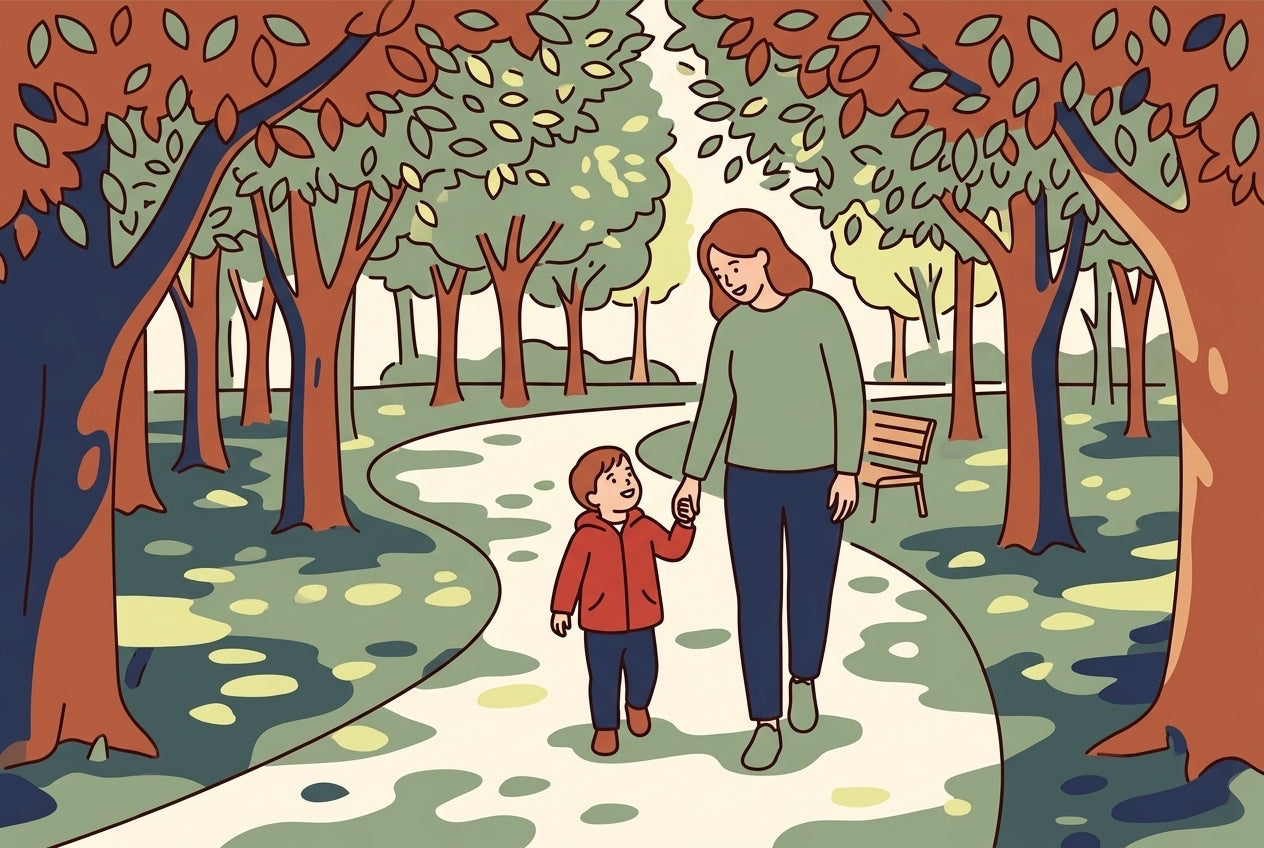
Most 3-year-olds can comfortably walk around 1–2 km / 0.6–1.2 miles in a day — but almost never all at once. Short bursts of walking, broken up by rest, play, or a ride, are what actually works at this age. If you've ever watched your toddler sprint ahead in the park and then collapse onto the pavement five minutes later refusing to take another step, you already know this.
Key Takeaways
A typical 3-year-old can walk around 1–2 km / 0.6–1.2 miles per day, broken into short segments.
Pediatric guidance recommends at least 3 hours of physical activity daily for toddlers — but walking is only part of that.
Toddler stamina varies widely based on terrain, weather, and how much energy they've already spent that day.
A mid-walk sit-down — stroller, carrier, or a bench — helps most families keep going without a meltdown.
If your walks regularly outlast your toddler's legs, Hoppie gives them a place to rest without you needing a second stroller.
What pediatric guidance actually says
If you're looking for a firm rule, the honest answer is that guidance from bodies like the AAP and NHS focuses on total daily movement — not walking distance specifically. But there's enough practical advice out there to give parents a useful picture.
AAP and NHS daily activity guidance
Both the American Academy of Pediatrics and the NHS recommend that toddlers — children aged 1 to 5 — get at least 3 hours of physical activity every day. That includes all kinds of movement: running, climbing, dancing, kicking a ball, and yes, walking.
Three hours sounds like a lot. But for a 3-year-old, physical activity doesn't look like a structured workout. It looks like running to the slide, waddling back, spinning in a circle, and then flopping onto the grass. Short, varied, unpredictable bursts — all spread across the day.
Within that 3-hour target, walking to and from the park, school, or shops counts. So does chasing the dog, climbing the stairs, and dancing in the kitchen. Parents often underestimate how much movement their children already get just through everyday life.
The key thing both sets of guidance agree on: sedentary time should be limited, but the activity doesn't need to be long or structured. Short windows of movement throughout the day are just as good — often better — than one long outing.
Walking distance vs total activity
Walking is great for 3-year-olds. It builds leg strength, coordination, and stamina. But it's worth knowing that walking is harder for toddlers than it looks — their stride is short, they expend more energy per step than adults do, and they're still developing the muscle endurance for sustained effort.
As a rough guide, around 1–2 km / 0.6–1.2 miles is a reasonable total walking distance for many 3-year-olds in a day. Some will manage more, especially on flat ground with something exciting at the end. Others will max out well below that, especially if the terrain is hilly, the weather is warm, or they've already had an energetic morning at nursery.
The segment rule matters more than the total distance. Most toddlers do better with walks of 10–20 minutes followed by rest or play, rather than one long unbroken stretch. Think of a morning walk to the shops, some time in the playground, and a walk home — that's often the most any 3-year-old will do comfortably in a day without significant protest.

Real-world variation: why your toddler's stamina isn't the same every day
Every parent has had the experience of their toddler walking twice as far one day and giving up after two minutes the next. That's not stubbornness — it's just how 3-year-old physiology works.
Why kids' stamina varies
A few things that make a big difference to how far your 3-year-old will walk on any given day:
Terrain and gradient. Flat pavement is easiest. Hills, cobblestones, and uneven paths tire little legs out much faster than you'd expect.
Temperature. Warm weather drains energy quickly. A toddler who walks happily in October may hit the wall in July after half the distance.
How their day started. A toddler who's had a busy morning at nursery, skipped a nap, or woke up early will have much less in the tank than one who's rested.
What's at the destination. Most 3-year-olds will walk considerably further when there's a playground, a dog, or an ice cream at the end. Motivation is a genuine performance enhancer at this age.
Footwear. Ill-fitting shoes, stiff new trainers, or wellies worn on a long walk can shorten the distance dramatically. Comfortable shoes make a real difference.
Whether they're getting ill. Sometimes "I'm tired" is the first sign that something is coming. If a normally energetic toddler suddenly can't walk to the end of the road, keep an eye on them.
The short answer: don't plan a day out based on your best-day experience. Plan for your average day, and have a backup plan for when your toddler's legs give out earlier than expected.
When to expect a refusal
The "carry me" moment is almost universal for parents of 3-year-olds. It's not manipulation — it's a genuine signal that their body has reached its limit. At this age, toddlers don't have the self-regulation to pace themselves. They go hard until they can't, and then they stop.
Signs your toddler is hitting the wall:
Slowing down noticeably without stopping to look at anything
Dragging their feet or scuffing their shoes
Going quiet (especially if they were chatty before)
Sitting down on the pavement with no warning
Asking to be carried or to go home
When you see two or three of these together, a rest is more effective than encouragement. A toddler who's had a five-minute break and a snack can often walk another stretch. One who's pushed past their limit tends to melt down — which is harder for everyone.

When to use a stroller — and why it's not giving up
There's sometimes a quiet pressure among parents to keep toddlers walking as much as possible. Fresh air, exercise, independence — all genuinely good things. But using a stroller for part of a walk isn't a setup issue. It's a practical tool that keeps the whole family moving when tired little legs have had enough.
A good strategy for longer outings with a 3-year-old: let them walk the stretches where there's something to see or explore, and use the stroller for the in-between bits — the stretch of road between the park and the café, the long pavement section on the way home. That way they get the movement, the independence, and the sensory experience of walking, without burning out before you reach your destination.
If you have a baby or younger toddler already in the stroller, this is where things can get tricky. The older child needs a ride, but there's no seat for them. Carrying a 3-year-old on top of pushing a stroller is one of the most exhausting things about having two young children. Having somewhere for the older child to sit — even just for the last ten minutes of a walk — can make the difference between a manageable outing and a very stressful one.
Hoppie is designed for exactly this situation. It attaches to the back of your existing stroller and gives your older child a place to sit when their legs give out — without you needing to replace your stroller or buy a separate one. It's designed for children from around 18 months to 5 years old, up to 20 kg / 44 lbs. For many parents, it's the thing that turns a daily walk with two kids from a negotiation into a routine.

Practical tips for walking with a 3-year-old
A few things that genuinely help on family walks:
Set a walk time, not a distance. "We're walking for 15 minutes" is easier for a toddler to understand than "we're going 800 metres." It also gives you flexibility to slow down or stop.
Bring snacks. A small snack at the halfway point can reset energy levels noticeably. Raisins, a banana, or a rice cake all work — nothing too sugary right before you need them to walk more.
Give them a job. Carrying the park bag, pressing the crossing button, or counting red cars keeps attention up and makes walking feel purposeful rather than endless.
Let them lead sometimes. Toddlers who feel in control of the walk — even just the direction at the next corner — tend to keep going longer.
Build in rest stops. A bench, a wall, or a patch of grass where they can sit for a few minutes is not wasted time. It often buys you another 10–15 minutes of walking afterwards.
Have a backup plan. Whether it's a carrier, a stroller, or a route that loops back early, knowing you have an out makes the walk less stressful for you — and toddlers pick up on parental stress.
FAQs
How far can a 3-year-old walk in a day?
Most 3-year-olds can manage around 1–2 km / 0.6–1.2 miles of walking in a day, split into several short stretches. Some children walk further with rest breaks in between; others reach their limit sooner depending on terrain, weather, and how much energy they've already used. Planning for 1 km of walking and having a backup plan for more is a sensible approach for most families.
Is it OK to walk a toddler 5 km?
A 5 km walk in one go is likely too far for most 3-year-olds without significant rests or a stroller for part of the journey. Their leg muscles and cardiovascular endurance are still developing, and pushing them past their comfortable limit often leads to exhaustion, upset, and sometimes aching legs the next day. If your route is 5 km, plan to use a stroller, carrier, or scooter for at least part of it.
How long should toddler walks be?
Short walks of 10–20 minutes tend to work well for 3-year-olds. Multiple short walks throughout the day — rather than one long one — are usually easier for toddlers to manage and easier for parents to fit around naps, meals, and nursery. A walk of more than 30 minutes without a break or distraction can be a stretch for many children this age.
When should I start using a stroller again for my 3-year-old?
Any time their body needs it. A 3-year-old sitting in a stroller after walking for 20 minutes isn't behind — they've walked as far as is comfortable and now need a rest. The goal is to keep the family moving and the outing enjoyable, not to prove your child can walk the whole way. Using a stroller for the last stretch home is a practical choice, not a step backwards.
Should I be concerned if my 3-year-old refuses to walk at all?
A toddler who sometimes refuses to walk is very normal. A toddler who consistently refuses or seems to have much less stamina than expected may be worth mentioning to your GP or paediatrician at the next check-up, just to rule out anything going on. Most of the time it's temperament, tiredness, or a phase — but it's always worth a quick conversation with your health visitor or doctor if you're genuinely concerned.
Does walking help build a toddler's stamina over time?
Yes. Regular walking gradually builds leg strength, coordination, and endurance. Most parents notice that by age 4 or 4.5, children can walk noticeably further than they could at 3 — partly because of physical development and partly because they've had more practice. Keeping walks regular, varied, and fun is the best way to support that development without making it feel like a workout.
What if I have two children and one is still in the stroller?
This is one of the most common daily challenges for families with two young children. The younger child often still needs the stroller for longer outings, while the older child can walk but tires before you reach your destination. A stroller add-on seat — like Hoppie — gives your older child a place to rest when their legs give out, without you needing a second stroller. It's designed for children from around 18 months to 5 years old, up to 20 kg / 44 lbs, and attaches to the back of most standard strollers with a stable rear frame. Always follow Hoppie's installation instructions and check your stroller manufacturer's maximum load capacity before use.
If your walks regularly outlast your toddler's legs
A tired toddler mid-walk isn't a problem you can always walk around. But it's one you can plan for. Snacks, rest stops, shorter segments, and a backup ride all help — and so does having a second seat ready for when those little legs have genuinely had enough.
Hoppie is a compact hammock seat that attaches to the back of your existing stroller. When your 3-year-old hits the wall, they get a place to sit. You keep moving. No second stroller, no carrying a child while pushing a pram, no meltdown on the pavement.
It's designed for children from around 18 months to 5 years old, up to 20 kg / 44 lbs, and is a practical fit for most standard strollers with a stable rear frame.
Keep the stroller you love. Add a second seat when you need it.
Disclaimer: Hoppie is an independent product and is not affiliated with, endorsed by, sponsored by, or approved by any stroller brand. Always follow Hoppie's installation instructions and check your stroller manufacturer's maximum load capacity before use. Always supervise your child while using Hoppie.


