

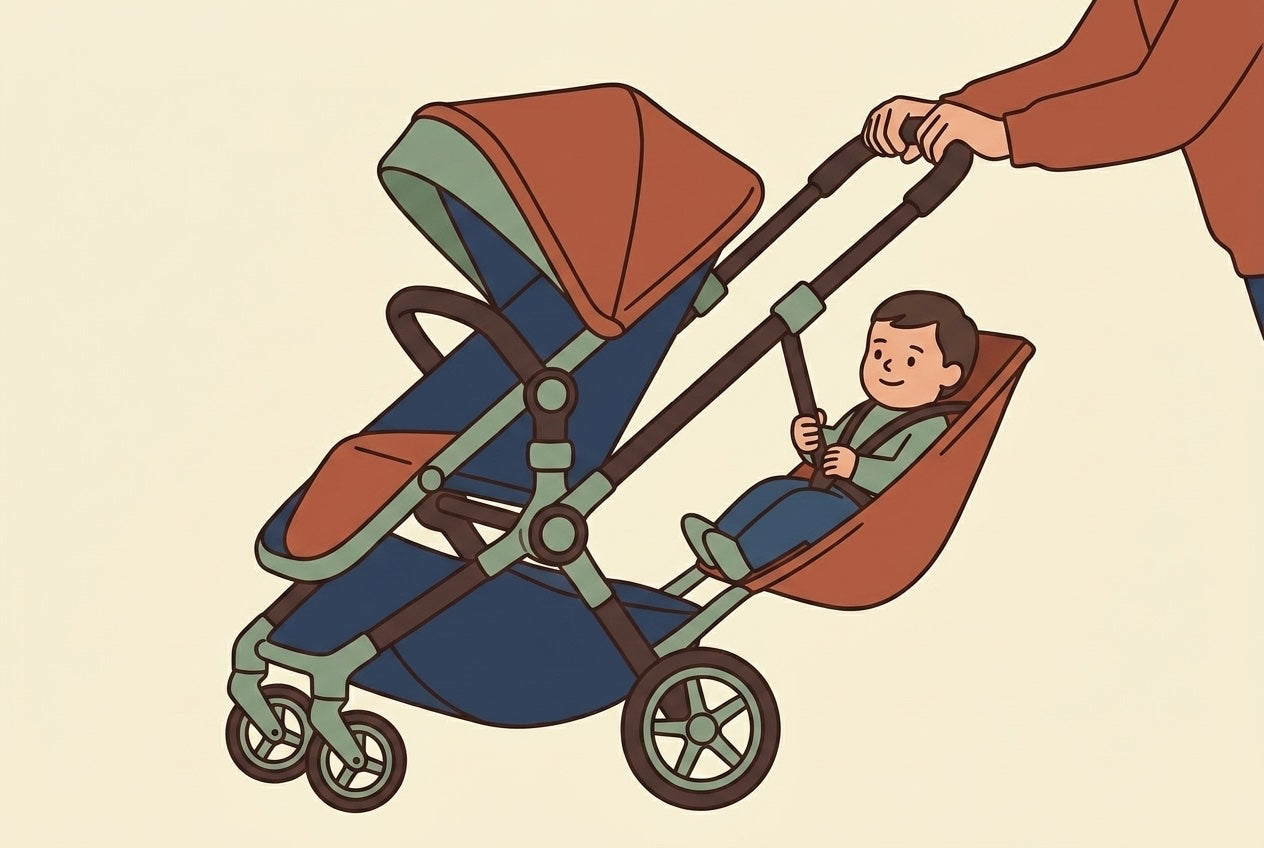
If you own a premium full-size stroller — a Bugaboo, an Uppababy, a Cybex Balios, a Joolz Hub, a Nuna Mixx, a Stokke Trailz — you already have one of the strongest rear frames on the market. That's genuinely good news when it comes to fitting a second seat. But premium brands also have strong opinions about third-party accessories. Before you order anything, it helps to understand both sides of the picture.
This article looks at what makes Bugaboo-style strollers a solid starting point for a hammock seat, what brand accessory politics actually mean for you in practice, and how the setup holds up on real family days.
Hoppie is an independent accessory and is not affiliated with, endorsed by, sponsored by, or approved by any stroller brand. Brand names, when mentioned, are used only to help parents understand potential compatibility.
Key Takeaways
Premium full-size strollers like Bugaboo, Uppababy, Cybex, Joolz, Nuna, and Stokke generally have rigid rear frames that are a strong starting point for a hammock seat.
Compatibility depends on rear frame rigidity, rear clearance, and your stroller's total weight capacity — not just the brand name.
Third-party accessories may affect your stroller product guidance — check your manual before adding anything to your stroller.
Hoppie is designed for children from around 18 months to 5 years old, up to 20 kg / 44 lbs.
If you're unsure whether your specific model will work, send us a photo and we'll help you check.
Why premium full-size strollers are usually a strong starting point
Parents shopping for a hammock seat often wonder whether their stroller is "good enough" to carry a second child at the rear. For premium full-size strollers, the honest answer is: the frame usually is. Here's why.
Sturdy frames built for real use
The strollers that sit at the top of the market — Bugaboo Cameleon, Bugaboo Fox, Uppababy Vista, Cybex Balios S, Joolz Hub, Nuna Mixx, Stokke Trailz — all share a common engineering philosophy. They're built around thick aluminum tubing that forms a continuous rigid skeleton from front to rear. These frames are made to handle years of daily use, heavy baskets, travel knocks, and cobblestone streets.
When you press down firmly on the rear handlebar of a Bugaboo Fox or an Uppababy Vista, you feel almost nothing move. That structural rigidity is exactly what a hammock seat needs. The seat hangs from the rear bar and carries your older child's weight at that single anchor point — so a frame that doesn't flex under pressure is the right foundation.
Compare that to an ultra-light umbrella stroller. Press down on its rear bar and you'll often feel the whole frame shudder slightly. That's not a flaw — it's a design choice made for portability. But it makes those frames unsuitable for a rear hammock seat, no matter the brand.
Premium full-size strollers are built in the opposite direction: heavy enough to be stable, engineered for accessory loads, designed to carry the realities of family life.
Generous rear space
Premium strollers tend to have generous proportions. The rear zone — the space between the rear axle and the back of the main seat — is typically deeper than on compact city strollers. This matters because a hammock seat needs around 25 cm of clear rear space to sit properly and let your child ride comfortably without their feet dragging.
On models like the Bugaboo Fox or the Uppababy Vista, that rear clearance is usually available even with a standard basket in place. Some models have repositionable baskets that create even more space when moved. The Nuna Mixx and Joolz Hub are similarly well-proportioned at the rear.
One thing to check: if your stroller has a large fixed accessory at the rear — an extended organizer tray, a fixed cup holder bracket, or a particularly deep under-seat basket — measure the actual available space before assuming clearance is fine. A tape measure from the center of the rear axle straight upward tells you what you actually have.
Always follow Hoppie's installation instructions and check your stroller manufacturer's maximum load capacity before use.

Brand accessory politics: what you actually need to know
Premium stroller brands have built well-developed accessory ecosystems. Bugaboo sells footmuffs, rain covers, and board attachments. Uppababy has its own piggyback board. Stokke has a sibling board. These products are designed, tested, and sold as part of each brand's official lineup — and they carry the brand's safety endorsement.
Third-party accessories sit outside that ecosystem. That's worth understanding honestly.
First-party vs third-party accessories
First-party accessories — the ones sold by Bugaboo, Uppababy, or Cybex themselves — are tested specifically for each stroller model. The brand knows the exact frame dimensions, the rear bar diameter, the weight capacity margins, and the geometry. When you buy a Bugaboo sibling board, you're buying something designed by the people who designed the stroller.
Third-party accessories like Hoppie are designed to work with most standard strollers with a rigid rear frame — not with one specific brand. That's a different design philosophy. The advantage is flexibility: one product that works across many strollers. The trade-off is that compatibility depends on the physical check you do yourself, rather than a brand-to-brand guarantee.
Hoppie is designed to fit most standard strollers with a stable rear frame and enough rear clearance. Whether your specific stroller model is a good fit depends on those three things — rear frame rigidity, rear space, and total weight capacity — not on the stroller's brand name or price tag.
If you're unsure whether your stroller is compatible, send us a photo of your stroller from the side and rear and we'll help you check.
Helpful setup notes
This is the part most parents don't think about until after they've bought an accessory.
Premium strollers come with multi-year product guidance — typically two to five years depending on the brand and the country of purchase. Those product guidance usually cover manufacturing defects in the frame, wheels, fabrics, and joints. What they often don't cover is damage caused by using non-approved accessories.
The practical reality: most parents who use a third-party hammock seat never encounter a setup issue, because they use the accessory correctly and the stroller is fine. But if something goes wrong — a frame crack, a worn rear bar — and you're using a third-party rear accessory, the brand may decline to cover it under product guidance.
The honest advice here is simple: read your stroller's manual before adding any accessory. Many manuals have a section on approved accessories and weight limits. Some explicitly say no rear add-ons; others are silent on the subject. If yours is silent, that's not the same as approval — but it's also not a prohibition.
Hoppie should only be used with strollers that have a stable rear frame and enough rear clearance. Always supervise your child while using Hoppie.

Setups that work well day-to-day
If your premium stroller passes the rear-frame check and you've read the product guidance section of your manual, here's what the actual day-to-day experience tends to look like.
City walks and school runs
This is where premium strollers with a rear hammock seat genuinely shine. A Bugaboo Fox or Uppababy Vista with a Hoppie attached keeps its original width — it doesn't become a double stroller. You still fit through café doors, school gate queues, supermarket aisles, and bus doors that would stop a side-by-side double stroller cold.
Your older child — designed for children from around 18 months to 5 years old, up to 20 kg / 44 lbs — rides at the rear when their legs get tired. When they feel like walking again, they hop off. The seat folds flat or detaches in seconds. You don't have to manage a second vehicle — you manage one stroller with an optional second seat.
Parents using this setup on school runs consistently report the same thing: the hard part is not the stroller, it's the moment when a tired four-year-old decides the last 200 meters are simply impossible. Having a rear seat ready for exactly that moment makes the whole walk more relaxed for everyone.
The premium stroller's smooth ride also helps. Full-size strollers with suspension handle kerbs and cobblestones better than compact travel strollers, which means the ride for both children is more comfortable across a full urban morning.
Travel days
Airports, train stations, holiday destinations — travel days with two young children are genuinely tiring. Having one stroller that carries both children is a significant practical advantage over managing two separate strollers or a double that barely fits the airport elevator.
Bugaboo-style strollers fold reasonably compactly for premium full-size models, and Hoppie should be removed before folding — that's standard practice for any rear accessory. Removal takes a few seconds and protects both the stroller and the straps.
The setup that works best on travel days is one your older child already knows. If they've been riding the rear seat on daily walks, hopping on and off during an airport transit feels natural. The unfamiliar environment is already stressful enough — a familiar seat at the back of the stroller is one less thing to manage.
Hoppie is a practical alternative to a double stroller for parents who want to keep their premium stroller and manage two children without replacing everything they already own.

FAQ
Can I add a hammock seat to a Bugaboo stroller?
In most cases, yes — Bugaboo full-size strollers like the Fox and the Cameleon have rigid aluminum rear frames and generous rear clearance, which are the two structural requirements for a hammock seat. Compatibility also depends on your stroller's total weight capacity and the amount of rear space available with your current setup. Run the frame and clearance check before ordering, and always check your stroller's manual for any guidance on rear accessories.
What should I know before using a third-party accessory?
It depends on your product guidance terms and your country's consumer-protection laws. Most premium stroller product guidance cover manufacturing defects — not damage caused by accessories. In practice, using a rear hammock seat on a stroller with a strong rigid frame and within its stated weight capacity rarely causes unwanted wear. That said, read your manual's accessory section before adding anything. If your product guidance is important to you and the manual is silent on third-party rear accessories, contact the brand directly to ask.
Is the Bugaboo rear frame strong enough for a second child?
Bugaboo full-size strollers — the Fox, the Cameleon, the Donkey in single mode — are built around thick aluminum frames that are among the most rigid in the stroller market. Press down firmly on the rear handlebar: if the frame doesn't flex visibly and doesn't creak, the structural starting point is strong. The deciding factor beyond frame rigidity is your stroller's total weight capacity and how much of that capacity is already used by your younger child and basket contents.
What's the weight limit for a hammock seat like Hoppie?
Hoppie is designed for children up to 20 kg / 44 lbs. Before use, always check your stroller's total maximum load capacity and subtract the weight of your younger child, any accessories, and basket contents. The remainder needs to cover your older child's weight. If the math is tight, check the manual or contact the stroller brand to confirm the rear-accessory weight margin.
Will a hammock seat damage my Bugaboo or Uppababy stroller?
When installed and used correctly on a stroller with a stable rear frame and within its weight limits, a hammock seat is unlikely to cause unwanted wear. The most common cosmetic wear reported by parents is from leaving the seat attached during folding — the straps can mark the rear bar over time. Remove Hoppie before folding every time and that issue doesn't arise. Always follow Hoppie's installation instructions and check your stroller manufacturer's maximum load capacity before use.
Can I use Hoppie with a Bugaboo Donkey in tandem configuration?
The Bugaboo Donkey in tandem mode already has a second seat at the rear, which typically blocks the rear zone that a hammock seat would occupy. In single-seat mode, the Donkey has a rigid rear frame and usually has sufficient rear clearance. If you're using the Donkey as a single stroller, run the standard clearance and weight checks. If you're unsure, send us a photo of your specific setup and we'll help you assess it.
Is Hoppie officially compatible with Bugaboo, Uppababy, or Cybex strollers?
Hoppie is an independent product and is not affiliated with, endorsed by, sponsored by, or approved by any stroller brand. Brand names are used only to help parents understand potential compatibility. Whether Hoppie is a good fit for your specific stroller model depends on the physical checks — rear frame rigidity, rear clearance, and total weight capacity — not on a brand-to-brand approval.
What if I'm not sure whether my specific stroller model will work?
Send us a photo of your stroller from the side and from the rear — ideally with the basket in its usual position. We'll look at the rear frame, the clearance, and the bar shape and give you an honest answer. It's the fastest way to know for sure without having to guess.
Hoppie is for parents who love their stroller
You don't need to replace a stroller you've invested in. Hoppie adds a practical second seat for tired toddlers on everyday walks, school runs, and travel days — without turning your premium stroller into something you don't recognise.
Keep the stroller you love. Add a second seat when you need it.
Hoppie is designed for children from around 18 months to 5 years old, up to 20 kg / 44 lbs, and is designed to fit most standard strollers with a stable rear frame. If you're unsure whether your stroller is a good match, send us a photo and we'll help you check.
Disclaimer: Hoppie is an independent product and is not affiliated with, endorsed by, sponsored by, or approved by any stroller brand mentioned in this article. Brand names are used only to indicate potential compatibility with certain stroller models. Always follow Hoppie's installation instructions and check your stroller manufacturer's maximum load capacity before use.


