

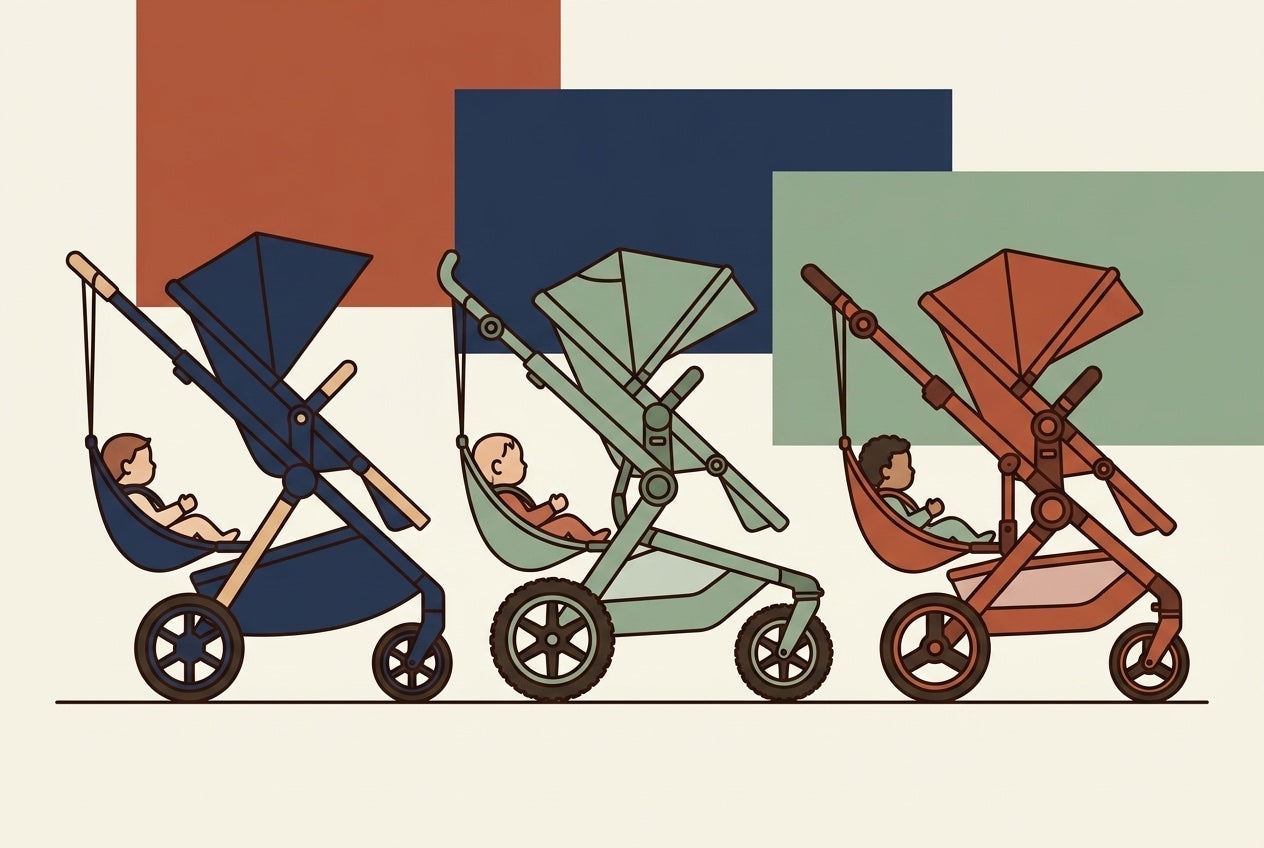
You spent a lot on your stroller. Whether it's a Joolz, a Stokke, or a Nuna, replacing it when your family grows isn't the plan. The good news: premium strollers are often the best candidates for a compact add-on hammock seat, precisely because their rear frames are built to last. This guide walks through the three main frame profiles you'll find on Joolz, Stokke, and Nuna strollers — and what to check before adding a second seat for your older child.
Hoppie is an independent accessory and is not affiliated with, endorsed by, sponsored by, or approved by any stroller brand. Brand names, when mentioned, are used only to help parents understand potential compatibility.
Key Takeaways
Premium strollers like Joolz, Stokke, and Nuna typically have sturdy rear frames that are good candidates for a hammock seat.
Each brand has a distinct frame profile — tall Scandinavian, sporty hybrid, or modular — so a quick rear-clearance check still matters.
Hoppie is designed for children from around 18 months to 5 years old, up to 20 kg / 44 lbs.
Using a hammock seat correctly — and removing it before folding — helps protect your stroller's resale value.
If you're unsure whether your specific model is a good fit, send us a photo and we'll help you check.
The 3 frame profiles you'll find on premium strollers
Not all premium strollers are built the same way. Once you understand the three main rear-frame profiles, you'll know exactly what to look for — and which quick checks still apply.
Scandinavian-style frames — Joolz and Stokke
Joolz and Stokke strollers share a design philosophy rooted in Scandinavian minimalism: tall silhouettes, visible aluminum tubing, and a solid rear frame that tends to run cleanly from the rear axle to the handlebar. If you stand behind a Joolz Hub or a Stokke Xplory and press down on the rear handlebar with both hands, the frame typically shows little to no flex. That's exactly what you want when fitting a hammock seat.
Both brands also tend to place their underseat baskets in a way that leaves a usable rear zone. Stokke strollers sit notably high off the ground, which means the rear clearance above the basket is generous on most models. Joolz strollers have a similarly solid build, though the basket position varies slightly between the Hub and the Day models — worth checking on your specific version.
A few things to verify on Scandinavian-style frames:
Press down firmly on the rear handlebar — the frame should not flex visibly or creak.
Measure rear clearance from the rear axle upward. Aim for around 25 cm of clear space.
Check that the rear bar shape is flat or gently curved — straps grip reliably on these shapes.
Sport and hybrid frames — Nuna
Nuna strollers — the Mixx and Triv lines in particular — sit in a slightly different category. They're built for urban parents who want the feel of a full-size stroller in a slightly more compact footprint. The rear frame on most Nuna models is sturdy aluminum, and the handlebar is a continuous bar that forms part of the main frame structure. This is the kind of build that tends to handle accessory loads well.
Nuna strollers often have a rear bar that sits at a comfortable height for strap attachment. The basket on most models is suspended below the seat rather than extending far back, which generally leaves the rear zone clear. That said, some Nuna models have rear-axle accessories or specific basket placements that can reduce available rear space on certain configurations — so running the 25 cm clearance check on your specific setup is still worth a minute of your time.
For Nuna-style frames, the key checks are:
Confirm the rear handlebar is part of the main frame — not a clip-on accessory bar.
Check rear clearance with the seat in its upright position and the basket loaded as you'd normally carry it.
Look at the rear bar diameter — it should be consistent and grippable along its full width.
General fit rules for premium strollers
Whatever the brand, three things decide compatibility:
A rigid rear frame. Metal tubing that doesn't flex under firm hand pressure.
Around 25 cm of rear clearance. Measured from the rear axle straight up, with nothing in the way.
Enough total weight capacity. Your stroller's rated load minus baby, basket contents, and accessories leaves the room for your older child on Hoppie.
Premium strollers pass the first test more often than not. But always run checks two and three before ordering — they depend on your specific configuration, not just the brand.
Always follow Hoppie's installation instructions and check your stroller manufacturer's maximum load capacity before use.

Hammock seat setup for Joolz, Stokke, and Nuna strollers
The setup process for Hoppie is the same on all strollers — but knowing the quirks of each frame saves you a few minutes on the first install.
Setting up on a Joolz-style stroller
Joolz strollers have a clean, wide rear handlebar that sits at a comfortable height for adults. The strap attachment on most Joolz models is straightforward — the bar is horizontal, flat, and at a good diameter for the hammock seat's straps to grip without slipping.
The main thing to check on a Joolz is the basket. On some models the basket extends slightly further back than on other premium strollers, so confirm your 25 cm clearance with the basket in its normal position. If the basket can be slid forward slightly, that often opens up all the space you need.
First installation on a Joolz-style frame typically takes a few minutes — read the instructions fully before you start, and make sure the straps are taut before your child climbs on. Once you've done it once, the next installs are quick.
Setting up on a Stokke-style stroller
Stokke strollers sit high off the ground, and that height works in your favour here. The elevated riding position means the rear zone above the axle is typically more spacious than on lower-slung strollers. Parents using Stokke strollers often find that rear clearance is one of the easier checks to pass.
The Stokke handlebar is distinctive — it wraps slightly inward on some models. This doesn't affect Hoppie's strap attachment, but it's worth checking that the straps sit flush and don't slip toward the center of the bar during use. A quick tug test after the first install confirms they're seated correctly.
Stokke strollers are also among the easier ones to keep clean, which matters if you care about the finish — more on that in the care section below.
Setting up on a Nuna-style stroller
Nuna strollers have a handlebar that often features a rubberized or soft-grip covering. This is comfortable to push, and it also gives the hammock seat's straps something to grip against. Most parents find the strap attachment on Nuna-style bars feels secure and settled.
On some Nuna models the handlebar is height-adjustable. If yours is, set it to your normal pushing height before running the compatibility check — the strap routing and rear clearance can change slightly between handlebar positions.
As with all strollers: always supervise your child while using Hoppie, and remove the seat before folding the stroller.
If you're unsure whether your specific Joolz, Stokke, or Nuna configuration is a good fit, send us a photo of your stroller from the side and from the rear and we'll help you check.

Protecting your stroller's condition and resale value
One of the best arguments for keeping a premium stroller is resale value. Joolz, Stokke, and Nuna strollers hold their value well in the secondhand market — especially when they're kept in good condition. The good news: using a hammock seat correctly won't harm your stroller. The point to checks only appear when parents skip a couple of simple habits.
Keeping your stroller in resale condition
The single most important rule: remove Hoppie before folding. Leaving the hammock seat attached when you fold the stroller is the most common cause of cosmetic wear — small scuffs and strap marks on the rear frame. It takes five seconds to unclip, and it keeps the frame looking clean.
A few other habits that make a difference:
Wipe the rear bar after use if your child has been eating snacks or in dusty conditions. Premium strollers often have anodized or coated aluminum — a damp cloth is usually all it takes.
Check the straps periodically for any fraying or loosening. Taut straps distribute the load evenly and don't rock against the frame.
Store Hoppie separately when not in use. Leaving it clipped on in the boot of a car can cause small marks if the seat shifts during driving.
Check your stroller's own manual for any specific care instructions on the rear frame coating.
Parents who follow these habits consistently report that their stroller looks essentially the same after using Hoppie as it did before. The frame finish on Joolz, Stokke, and Nuna strollers is durable — you're not dealing with a delicate surface. A little care goes a long way.
Thinking about the long game
Premium strollers are often bought once and used for years — sometimes across multiple children. Adding a hammock seat for a second or third child's toddler years doesn't shorten that life. It extends the stroller's usefulness without any permanent modification. No screws, no drills, no attachments that leave marks when removed correctly.
When your older child no longer needs the hammock seat, you simply unclip Hoppie and your stroller is exactly as it was. The frame is unchanged. The fabric is unchanged. The folding mechanism is unchanged.
That's the whole point: Hoppie keeps your premium stroller premium. You don't replace it — you get more out of it.

Hoppie: a smart second seat for parents who love their stroller
You chose a Joolz, a Stokke, or a Nuna because you wanted quality. Hoppie lets you keep that stroller — and use it for two children — without trading it in for a bulky double.
Hoppie is designed for children from around 18 months to 5 years old, up to 20 kg / 44 lbs. It attaches to the back of your existing stroller — no tools, no permanent changes, no fuss. When your older child's tired little legs give out, they have a seat. When they want to walk again, they hop off.
Keep the stroller you love. Add a second seat when you need it.
Frequently asked questions
Can I add a hammock seat to a Joolz stroller?
In many cases, yes. Most Joolz strollers have a rigid aluminum rear frame and a clear rear zone that is compatible with a hammock seat. Run the 60-second frame check — press firmly on the rear handlebar, confirm around 25 cm of rear clearance, and check total weight capacity. If those three pass, Hoppie is likely to be a good fit for your Joolz. If you want to be sure, send us a photo of your specific model and we'll help you check.
What about Stokke or Nuna strollers?
Stokke and Nuna strollers also tend to have strong rear frames that work well with a hammock seat. Stokke's elevated design often means generous rear clearance. Nuna's handlebar is typically sturdy and grippable. As always, compatibility depends on your specific model's configuration — rear clearance and total weight capacity are the two checks that can vary between models in the same brand family. When in doubt, send us a photo and we'll take a look.
Will adding a hammock seat affect my stroller's resale value?
Not if you use it correctly. The key habit is removing Hoppie before folding the stroller — this prevents the small cosmetic marks that can appear when the seat is left on during folding. With that one step, the stroller's frame and fabric stay in the same condition as before. Hoppie makes no permanent modifications to your stroller.
Are premium strollers safer with add-on seats than budget strollers?
Premium strollers often have more rigid frames, more stable geometry, and higher total weight capacities — all of which matter when adding a second seat. That said, "premium" alone doesn't guarantee compatibility. The same frame-rigidity and rear-clearance checks apply regardless of brand or price. A stroller that passes those checks is a suitable candidate; one that doesn't is not, regardless of how much it cost.
Does Hoppie work on strollers with a height-adjustable handlebar?
Yes, in most cases. If your handlebar is height-adjustable, set it to your normal pushing height before installing Hoppie and running the compatibility check. The strap routing and rear clearance should be assessed at the height you'll actually use when walking.
What is the weight limit for Hoppie?
Hoppie is designed for children up to 20 kg / 44 lbs. Before use, always check both Hoppie's instructions and your stroller manufacturer's maximum total load capacity to make sure the combined weight of all children and contents stays within the stroller's rating.
How do I know if my specific stroller model is compatible?
Run the three-point check: rigid rear frame (no flex under firm hand pressure), around 25 cm of rear clearance, and enough remaining weight capacity for your older child. If you pass all three, Hoppie is likely to be a good fit. If you're not sure, send us a photo of your stroller from the side and from the rear — we'll help you check before you order.
Disclaimer: Hoppie is an independent product and is not affiliated with, endorsed by, sponsored by, or approved by any stroller brand mentioned in this article. Brand names are used only to indicate potential compatibility with certain stroller models. Always follow Hoppie's installation instructions and check your stroller manufacturer's maximum load capacity before use.


